The green building that wouldn’t fall: How it survived Nepal’s raging flood
Engineering explains its survival as viral ‘pastor’s house’ claim is debunked
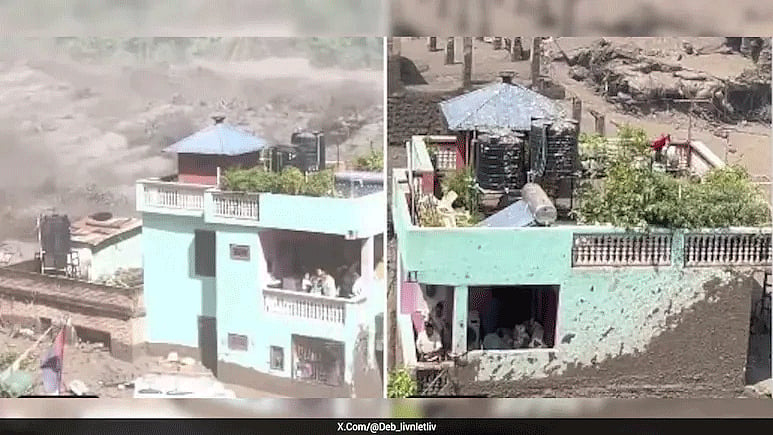
Dubai: Around them, almost everything was moving.
A furious brown torrent carrying mud, uprooted trees, rocks and wreckage tore through the valley, smashing into buildings and sweeping debris downstream.
Yet in the middle of the chaos stood a small mint-green house.
On its upper balcony, at least three members of a family could be seen watching the flood rage around them, apparently with nowhere to go.
The water surrounded their home. Debris slammed past it. Buildings nearby were damaged or swept away.
But the green building did not fall.
And neither did the family perish.
Footage from Nuwakot in Nepal’s Bagmati Province, filmed during Wednesday’s catastrophic floods, has become one of the most extraordinary images to emerge from the disaster. Reuters Connect said the house withstood the torrent long enough for at least three family members to survive until rescuers reached them.
The remarkable escape quickly generated another question online: Why did this house survive?
More than luck
An engineering explanation circulating after the footage went viral suggests the answer lies partly in the way the building was constructed — and partly in precisely where it stood.
Unlike traditional stone-masonry houses commonly found in Himalayan valleys, the green building was constructed with a reinforced-concrete frame, according to an analysis by Architecture Presenta-tion cited by NDTV.
That distinction matters enormously when a building is struck from the side.
Ordinary masonry structures may be capable of carrying substantial weight vertically, but the side-ways — or lateral — forces produced by fast-moving water, mud and debris can cause walls to fail.
The green house appears to have had a structural skeleton designed to behave differently.
“Continuous steel rebar tied the columns, beams, and foundation together into a single, rigid skele-ton,” the Architecture Presentation analysis said.
Instead of individual walls taking the full impact, the reinforced frame could absorb some of the lateral force and transfer it through the structure towards the foundation.
In simple terms, the house was better able to act as one unit rather than a collection of walls that could be pushed apart.
Location may have saved it too
But concrete and steel alone may not explain its survival.
The building also appears to have benefited from its position.
Debris flows do not distribute their destructive power evenly. Their deepest channels can carry the largest rocks and heaviest material — effectively turning a flood into a moving mass capable of battering structures in its path.
The green house stood slightly away from the main channel and on marginally higher ground, according to the engineering analysis.
Its relatively compact shape also allowed the torrent to divide and flow around either side.
As mud and debris accumulated around the building, the deposits may even have formed a natural ramp that helped divert subsequent surges away from it.
It was, in other words, an extraordinary combination: A comparatively strong structure standing in a comparatively favourable spot while an overwhelmingly destructive force passed around it.
‘Pastor’s house’ claim goes viral
The survival story has inevitably acquired another layer on social media.
Posts began claiming that the building belonged to a Christian pastor and portraying its survival as an act of divine protection.
There is, however, no verified evidence that the house belonged to a pastor.
A fact-check by Boatos.org found no official report or established news account identifying either the owner or the occupants as a pastor. It also found that claims that this was the only house left standing were exaggerated — other structures can be seen surviving in the wider area.
What is verified is remarkable enough.
The footage is genuine. The green building survived. And, most importantly, so did the people sheltering inside it.
Their escape provides a rare image of hope from a disaster that has devastated communities across Nepal and Tibet and left thousands of families waiting for news of missing relatives.
For a few terrifying minutes in Nuwakot, however, one family could do little more than watch from a balcony as a river of mud and destruction closed around them.
Their mint-green house held.
And they lived.

Sign up for the Daily Briefing
Get the latest news and updates straight to your inbox
Network Links
GN StoreDownload our app
© Al Nisr Publishing LLC 2026. All rights reserved.