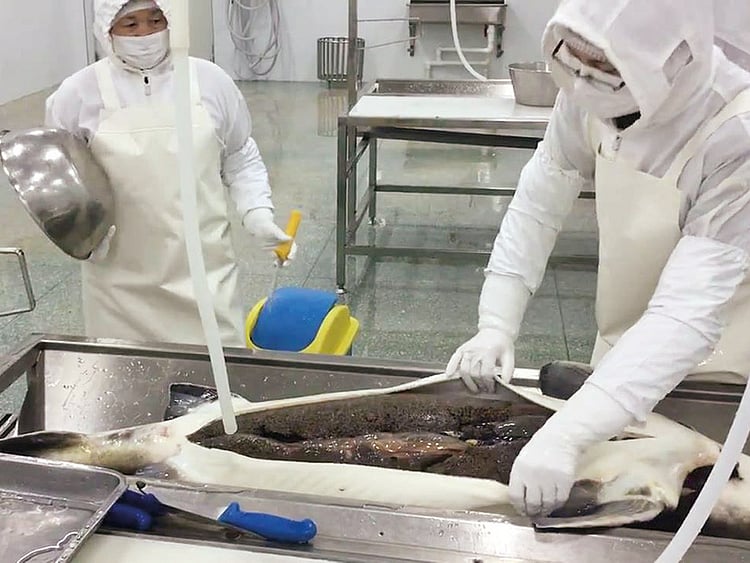
Quzhou: One hundred years after Russian aristocrats fleeing the Bolshevik revolution brought caviar to the haute-cuisine restaurants of Paris, the “black gold” has found a new home in China — a country more known for food scares involving exploding melons and fake eggs.
The famed salt-cured fish roe, which is traditionally extracted from wild sturgeon in the Caspian Sea, has for centuries been a symbol of status and opulence — not to mention a source of power and wealth — for European monarchs, ruthless smugglers, and more recently, leaders of the Soviet Union.
Now China has also been seduced, and local producers are battling to overcome a reputation for shoddy food production standards to become one of the biggest players on the global market. It has been a short, but arduous journey for China’s new sturgeon farmers, and many continue to be discreet in labelling the country of origin on products.
“Most of the labels are in Russian,” said Su Shunqing, a fish trader at Beijing’s cavernous seafood market. “It’s because people always think Chinese caviar is fake or inferior.”
Chefs’ favourite
But while consumers — both domestic and international — are yet to appreciate Chinese caviar, it has become a key ingredient for the world’s greatest chefs.
Kaluga Queen, China’s top caviar producer, supplies 21 of the 26 restaurants in Paris to have been awarded the maximum three Michelin stars.
But the scheme helped Kaluga Queen produce its first tin of roe in 2006 — a landmark event which was followed by five years of pain as the company sought to transform positive reviews into sales, said Xia Yongtao, the company’s vice president.
‘Made in China’
“The general distrust in ‘Made in China’ food stood in the way of our development,” Xia said, in an interview at the company’s processing plant in Quzhou, about 120 miles south of Hangzhou. But its opportunity came when strict quotas on fishing in the Caspian Sea were enforced following concerns that stocks were fast becoming depleted.
Kaluga Queen made its breakthrough in 2011, when Lufthansa chose its caviar to be served in the airline’s first class cabins.
“You can see through the water for seven metres,” Xia said. “And you can drink the water directly from the lake, no problem.”
But while Chinese producers are confident, the caviar industry is facing headwinds due to the rise of eco-conscious consumers in the West, who object to depleting fish stocks and the killing of female sturgeon for the contents of their ovaries.
Kaluga Queen is now targeting domestic five-star hotels and high-end restaurants in the hope that China’s new rich will be the next in the long line of wealthy elites to fall for caviar’s enduring charm.
Sign up for the Daily Briefing
Get the latest news and updates straight to your inbox
Network Links
GN StoreDownload our app
© Al Nisr Publishing LLC 2026. All rights reserved.