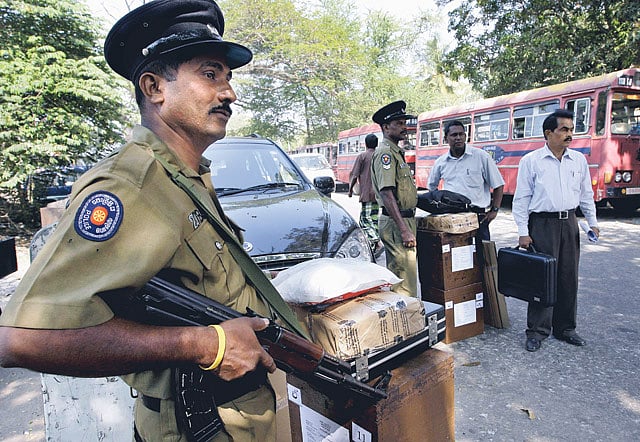
Colombo: Sri Lanka goes to polls Tuesday. The main contenders are two men despite 22 candidates submitting nominations. Some of them are fake candidates who have entered the fray just to use the air time given on state-run TV and radio for candidates on behalf of one or the other two main contenders incumbent President Mahinda Rajapakse and former army commander General Sarath Fonseka.
Politicians, artists and other groups are divided between the two candidates. Rajapakse's ruling coalition consists of 15 parties.
Fonseka, who is contesting under an almost unknown party, just to fulfil a constitutional requirement, initially had the support of the main leftist party, the Janatha Vimukthi Peramuna (JVP), and an amalgam of parties consisting of the main opposition party, the United National Party, the main Muslim party, Sri Lanka Muslim Congress (SLMC), and two other smaller outfits. On the last lap of the campaign, the main Tamil party, which is in fact a coalition, the Tamil National Alliance (TNA), too joined his bandwagon.
Both sides have built alliances of parties with diametrically opposing policies.
However, leaders of both sides have been questioning the validity and genuineness of the other alliance.
The majority Sinhalese are divided between Rajapakse and Fonseka.
However, minorities (11 per cent Tamils, 8 per cent Muslims and 5.5 per cent Tamils of Indian origin) gained importance at the latter part of the campaign.
Major factors
Tamils seem to be guided by two major factors, one being favourable to Rajapakse while the other to Fonseka. After 30 years of ethnic war, they have an opportunity to live without the fear of their children being conscripted by Tamil Tiger rebels or their houses being flattened by air force raids. On the other hand they have been hurt by the humiliating defeat of the Tamil Tigers at the hands of the Sinhalese army.
The natural inclination of the Sri Lankan Muslims, except those in the Eastern Province, for a long time has been towards the opposition UNP, while the SLMC has the largest vote base among the Eastern Muslims. Both parties are now on one platform. However, apart from the comparatively smaller traditional Muslim support base of the ruling party, some Muslim leaders from all over the country have swapped their allegiance with portfolios and perks. They too might have considerable influence over the community.
Sign up for the Daily Briefing
Get the latest news and updates straight to your inbox
Network Links
GN StoreDownload our app
© Al Nisr Publishing LLC 2026. All rights reserved.