Philippines: Sara Duterte impeachment — 3 charges dropped, ₱818-million wealth allegation remains
VP vows ‘I will never resign’ as Senate trial narrows to alleged unexplained wealth
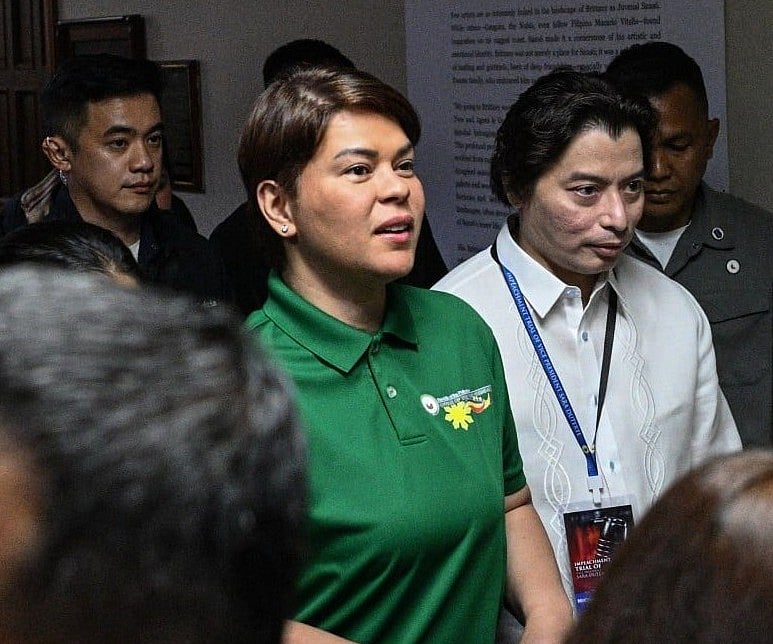
Manila: The Senate impeachment court has approved the withdrawal of three of the four impeachment articles against Vice President Sara Duterte.
The move leaves allegations of unexplained wealth, incomplete asset declarations and prohibited business interests as the sole basis for the continuing trial.
Duterte, meanwhile, ruled out stepping down, saying on Tuesday: “I will not resign, will never resign from the Office of the Vice President.”
The House prosecution panel said it would focus on Article II, arguing that evidence already presented was sufficient to justify Duterte’s conviction and removal from office.
The Senate impeachment court, presided over by Senate President Pro Tempore Francis “Chiz” Escudero, accepted the withdrawal on October 13, the trial’s 39th day.
Get it: Fast, verified news for FREE ... download the Gulf News app — simply click here
The decision substantially narrows the case, but it does not amount to an acquittal.
The remaining allegations must still be assessed by the impeachment court, while Duterte has denied wrongdoing and challenged the prosecution’s claims.
Why prosecutors dropped 3 articles
Lead prosecutor and Batangas Rep. Gerville Luistro said the prosecution would no longer pursue:
Article I: Alleged misuse and misappropriation of confidential funds.
Article III: Alleged bribery and corruption involving the Department of Education.
Article IV: Alleged grave threats against President Ferdinand Marcos Jr., First Lady Liza Araneta-Marcos and former House Speaker Martin Romualdez.
The panel will proceed with Article II, which concerns alleged unexplained wealth, potentially incomplete or inaccurate Statements of Assets, Liabilities and Net Worth (SALNs), and failure to divest from prohibited business interests.
Luistro said concentrating on one article would reduce the number of issues and witnesses the court would need to consider.
She said about 32 witnesses would no longer be called.
The withdrawal has important procedural consequences.
According to the court’s ruling, Articles I and IV were "withdrawn with prejudice".
This means they cannot be revived in another impeachment proceeding against Duterte during her current term.
Article III was "withdrawn without prejudice" because prosecutors had not yet presented evidence on the bribery allegation.
The ₱817.87-million allegation
The remaining article centres on the prosecution’s financial examination of Duterte and her husband, lawyer Manases “Mans” Carpio.
Forensic accounting expert Alexander Cabrera estimated that the couple had approximately ₱817.87 million in allegedly unexplained wealth and undeclared assets or income between 2022 and 2025.
The prosecution said its analysis drew on bank transactions, tax documents, property records, insurance information, corporate records and other financial material.
It compared these records with Duterte’s asset declarations and information about the couple’s income and business interests.
The House prosecution has also cited a possible higher estimate of around ₱1.5 billion under a broader assessment. That figure was presented as a potential upper estimate, not a final finding of illegally acquired wealth.
At this point, these are prosecution allegations, not a judicial finding that the money was illegally acquired.
The defence has disputed the evidence.
The impeachment court must determine whether the records establish the alleged violations and whether the evidence meets the standard for conviction.
Defence calls the move 'unfair'
Duterte’s lead defence counsel, Sheila Sison, objected to the withdrawal, arguing that the prosecution had already presented damaging allegations concerning confidential funds and grave threats before deciding not to pursue those articles.
The defence said Duterte should have a meaningful opportunity to rebut allegations that had been aired during the public proceedings.
It also said its decision to present evidence would not change simply because prosecutors had narrowed their case.
The controversy is not merely about the number of charges.
It concerns how the court should balance the prosecution’s ability to focus its case against the respondent’s right to answer accusations already presented in public.
The court also addressed restrictions on public discussion of the withdrawn articles, allowing the parties to discuss those matters outside the trial — following the subjudice rule — because they would no longer be adjudicated as impeachment charges.
The dispute over how Duterte may respond publicly to the allegations has added another procedural dimension to the case.
The sub judice rule in Duterte's impeachment trial refers to Rule 18 of the Senate Impeachment Rules, which legally bars the presiding officer, senator-judges, prosecutors, the respondent (Vice President Sara Duterte), defence counsel, and witnesses from publicly discussing or commenting on the merits of an ongoing case. Its core purpose: prevent "trial by publicity," and guard against the weaponisation of the media to sway public opinion over actual evidence, and protect the dignity and integrity of the Senate impeachment court.
Duterte says she will not resign
Duterte’s declaration that she would never resign signals that she intends to remain in office while the proceedings continue.
The impeachment case is also politically significant because Duterte has announced plans to seek the presidency in 2028. A conviction could remove her from office and disqualify her from holding public office, potentially affecting those plans.
Her political relationship with Marcos has deteriorated sharply since they ran together in the 2022 election.
The dispute intensified after her father, former president Rodrigo Duterte, was arrested and transferred to the custody of the International Criminal Court over alleged crimes against humanity linked to his administration’s anti-drug campaign.
He remains in ICC custody in the Netherlands, with his trial scheduled to begin on November 30, according to the Associated Press.
What happens next?
The trial will now focus on Article II.
The prosecution must formally offer its documentary evidence, after which the defence can challenge its admissibility and present its own evidence.
The defence is scheduled to begin presenting its case on November 9.
The court will eventually decide whether the remaining article has been proved and whether the constitutional grounds for impeachment conviction are established.
The outcome could have consequences beyond Duterte’s tenure as vice president. It could affect the 2028 presidential race, the relationship between the Marcos and Duterte political camps, and public confidence in the accountability mechanisms applied to the country’s highest officials.
For now, the central question is whether the prosecution can substantiate its financial allegations — and whether Duterte’s defence can successfully challenge the evidence before the Senate impeachment court.
Sign up for the Daily Briefing
Get the latest news and updates straight to your inbox
Network Links
GN StoreDownload our app
© Al Nisr Publishing LLC 2026. All rights reserved.