Philippines: Glitches found in optical counting machines could delay May 9 polls, officials and opposition leaders say
Compatibility issues found while testing source codes
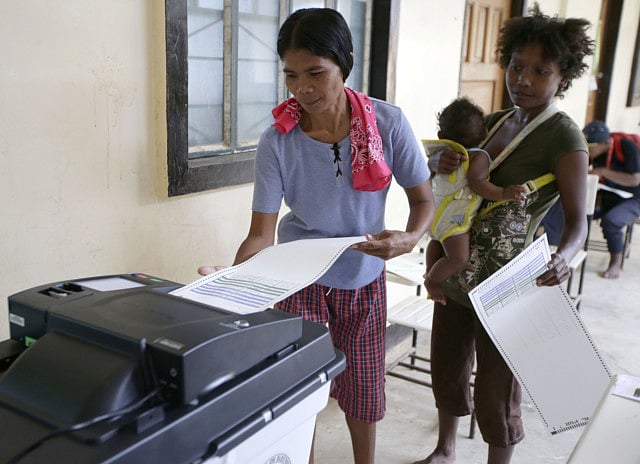
Manila: A government-run poll body has called for a two-week correction of glitches found in the optical counting machines that tally votes “in order to keep the integrity” of the May 9 polls, but opposition leaders claimed this could delay and “manipulate” the election of a leader who will replace President Beningo Aquino in midyear.
“The Commission on Elections (Comelec) will need two weeks to check on the capacity of Smartmatic Total Information Management System’s optical counting machines to tally votes,” said Comelec Commissioner Christian Robert Lim, adding the correction of the recently found glitch will create “more trust” in the poll body’s automated election system.
Denver-based SLI Global Solutions, a software testing company, “found a compatibility issue when it conducted functional testing on the source codes” of the election management system (EMS) and the consolidated and canvassing system (CCS) of the vote counting machines (VCM) that Smartmatic provided to Comelec, said Traci Mapps. SLI’s director for operations.
“The affected source codes must be fixed,” said Mapps, adding the source code is the human readable instructions that dictate what the automated election system will implement.
In the same test done by SLI, “it did not find any malicious code in the source codes,” Mapps said, hinting the problem would not result in cheating, The SLI has been certifying Comelec’s automated election system since the 2010 and 2013 polls.
The problem prevented Comelec from depositing the source codes at the Philippine Central Bank, said Comelec commissioner Lim. “The worst case scenario is we are not able to configure the machines and deploy them on time. If that happens, the elections in some areas will not happen on May 9,” he added.
Justifying the poll body, Communications Secretary Herminio Coloma Jr said, “Comelec has been transparent in informing the public on what it is doing to deal with the problems that have been identified.”
Not appeased, Mon Ilagan, spokesman of the opposition United Nationalist Alliance (UNA) said, “We hope Comelec will not use these issues to invoke its power to suspend the polls (nationwide) or allow our return to manual elections.”
National Citizens’ Movement for Free Elections (Namfrel), an election watchdog, also expressed alarm and possible “election manipulation”.
Comelec has adopted the technology of optical counting machines to speed up the slow manual counting of ballots that was blamed for cheating in the past.
The Omnibus Election Code allows Comelec to delay the elections “in case of violence, terrorism, force majeure, and other analogous causes”.
On May 9, 54.3 million registered Filipino voters will choose their president, vice president, 300 lawmakers in Congress, and 18,000 local government leaders.
Sign up for the Daily Briefing
Get the latest news and updates straight to your inbox
Network Links
GN StoreDownload our app
© Al Nisr Publishing LLC 2026. All rights reserved.