Philippine Supreme Court rejects challenges to Sara Duterte impeachment vote rule
Court’s action means the Senate's Sept. 23 ruling remains in effect
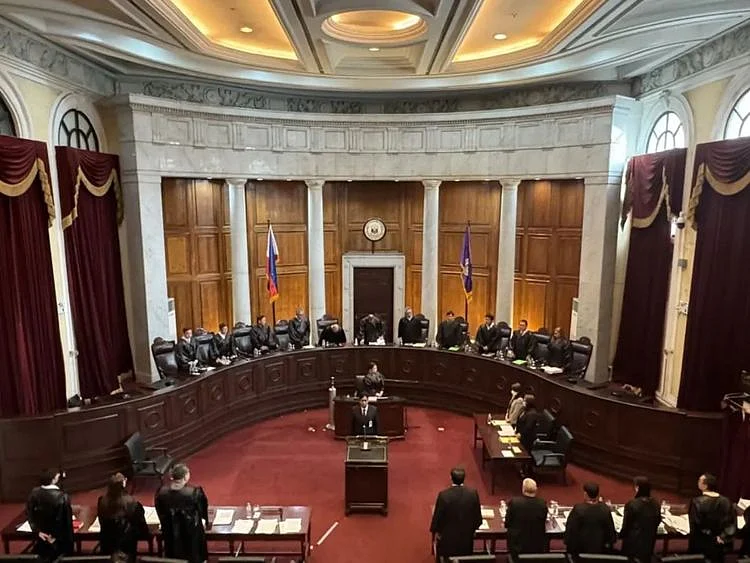
Manila: The Philippine Supreme Court has dismissed three petitions challenging the Senate’s interpretation of the voting threshold for convicting Vice President Sara Duterte in her impeachment trial, clearing the way for the proceedings to continue under the rule adopted by the Senate impeachment court.
The Supreme Court en banc dismissed petitions filed separately by former Executive Secretary Victor Rodriguez, lawyer Ernesto Francisco Jr. and Berteni Cataluña Causing on procedural grounds, including lack of standing and prematurity.
What it means
The court’s action means the Senate impeachment court’s Sept. 23 ruling remains in effect.
Importantly, the Supreme Court did not rule on the substantive constitutionality of the Senate’s interpretation in dismissing the petitions.
The ruling is the latest development in Duterte’s impeachment trial, which has become a major constitutional and political dispute over how the Philippines should calculate the two-thirds vote required to convict an impeached official.
Get it: Fast, verified news for FREE ... download the Gulf News app — simply click here
From 16 votes to a variable threshold
The controversy centres on Article XI, Section 3 of the 1987 Constitution, which states that an impeached official cannot be convicted without the concurrence of two-thirds of all the members of the Senate.
With 24 senators, former Senate impeachment court presiding officer Francis “Chiz” Escudero had previously interpreted the requirement as 16 votes.
But on Sept. 23, the impeachment court reversed that interpretation in a 13-1 vote, with six senator-judges not participating.
It ruled that the two-thirds calculation should be based on senators who are “legally and factually capable of participating” in the proceedings when the verdict is rendered.
The formula excludes senators who are detained or suspended, are being sought by authorities and cannot be located, are physically or medically incapacitated, are beyond the Senate’s coercive reach or are otherwise legally unable to participate.
Senators backing the new interpretation have stressed that it does not remove the constitutional two-thirds requirement.
Rather, they argue that it determines which members should be included in the denominator when some senator-judges cannot participate.
Why the number can now change
The practical effect is significant.
The Senate currently has 20 senator-judges participating in the proceedings, according to reports, because four members are unavailable for different reasons.
That means the two-thirds requirement would currently translate into 14 votes, rather than the 16 votes that would be required if all 24 senators were counted.
The number could change again if the circumstances of individual senator-judges change before the eventual verdict.
This was precisely what petitioners challenged.
Rodriguez argued that the Senate impeachment court had effectively changed a constitutional requirement through its own ruling.
His petition asked the Supreme Court to invalidate the Sept. 23 decision and sought immediate judicial intervention.
SC leaves the underlying issue unresolved
The Supreme Court's dismissal does not amount to a declaration that the Senate's interpretation is constitutionally correct.
Instead, the petitions were rejected because of procedural defects, principally questions about whether the petitioners had legal standing to bring the challenges and whether judicial intervention was premature.
That distinction is important because the constitutional question remains potentially contentious: Does “two-thirds of all the Members of the Senate” mean two-thirds of the full 24-member Senate, or two-thirds of those legally and factually capable of participating at the time of judgment?
The Senate impeachment court has adopted the latter interpretation.
Senate welcomes ruling
Senate President Sherwin Gatchalian welcomed the Supreme Court's action, saying the decision respects the constitutional independence of the Senate when it sits as an impeachment court.
The impeachment court's spokesman, Reginald Tongol, likewise said the dismissal removes a potential obstacle to the proceedings and leaves the Sept. 23 ruling undisturbed.
House prosecutors also welcomed the decision.
Lanao del Sur Rep. Zia Alonto Adiong said the ruling allows the trial to proceed without further litigation over the voting formula, while prosecutor Terry Ridon said it would reduce distractions from the presentation of evidence.
Network Links
GN StoreDownload our app
© Al Nisr Publishing LLC 2026. All rights reserved.