China executes 3 Filipino drug mules
Despite appeals for clemency, China executes three Filipino drug smuggling convicts
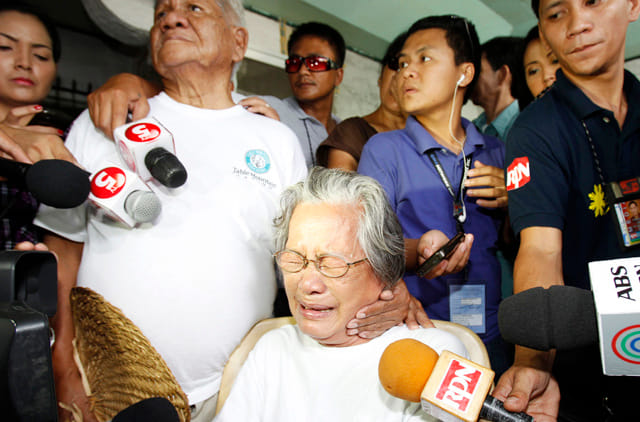
Manila: The Philippine government said China on Wednesday executed three Filipinos convicted of drug smuggling despite last-minute appeals for clemency and political concessions by the Southeast Asian country's leaders.
Sally Ordinario-Villanueva, 32, and Ramon Credo, 42, met their families for the last time early on Wednesday before they were put to death by lethal injection in Xiamen city in southeastern China, said Philippine Consul Noel Novicio.
Elizabeth Batain, 38, was allowed to meet with her relatives hours ahead of her execution in southeastern Shenzhen city, Novicio said.
The three were not aware they would be executed on Wednesday, although their sentences were promulgated early in the day, Novicio said. It was the first time that Philippine citizens were executed in China.
China normally does not announce executions. Amnesty International says China is the world's biggest executioner, with thousands of convicts killed every year. The Philippines has abolished the death penalty.
"They already gave us (her) things. It's too much, they gave us only one hour (with her). They have no mercy," Ordinario-Villanueva's sister, Maylene Ordinario, said in a text message from Xiamen to her family in the Philippines.
She said that her sister was blessed by a priest and "she said she wants to be forgiven for all her sins, but she insisted that she was a victim."
"She asked us to take care of her children, to take care of each other and to help one another. I have not accepted what will happen. We are forcing ourselves to accept it, but I can't," she told Manila radio station DZBB.
Neighbours, relatives and activists held overnight vigils at the homes of the condemned, offering prayers to the distraught family members. The dominant Roman Catholic Church, which opposes the death penalty, held special Mass in Manila.
The three were arrested separately in 2008 carrying packages containing at least 4 kilograms of heroin. They were convicted and sentenced in 2009.
In its appeal for clemency - which included three letters by Philippine President Benigno Aquino III to his Chinese counterpart and a February visit to Beijing by the vice president, which prompted China to postpone the executions by a month - the government said it was able to prove that a drug syndicate took advantage of the Filipinos.
It said that Philippine authorities had succeeded in identifying and arresting some members of the syndicate.
Jayson Ordinario, Ordinario-Villanueva's younger brother, said last week that his sister was hired as a cellphone dealer in Xiamen and was tricked into carrying a bag that had a secret compartment loaded with heroin, allegedly by her job recruiter.
China defended the executions.
"Drug trafficking is universally recognised as a severe crime," Foreign Ministry spokeswoman Jiang Yu told reporters at a regular news conference Tuesday in Beijing. "In China, our judicial authorities handled the case independently and we grant equal treatment to foreign drug traffickers. The involved individuals rights and treatment are ensured and safeguarded according to the law. China has fulfilled its international obligations in the process."
She added, "We'd like to stress this is an isolated individual case. We would not like to see any impact on bilateral relations."
Smuggling more than 50 grams of heroin or other drugs is punishable by death in China.
In another move seeking to spare the Filipinos, Aquino decided not to send a representative to the Nobel Peace Prize ceremony in December in Oslo, Norway, honouring a jailed Chinese dissident.
Manila also deported to Beijing last month 14 Taiwanese facing fraud charges in China despite protests from Taipei.
China and the Philippines also are facing off in the disputed Spratly Islands in the South China Sea, one of the world's busiest sea lanes, where a Philippine oil exploration ship last month reported being harassed by two Chinese patrol boats. They left after the Philippine military deployed two aircraft.
The Chinese ambassador in Manila said earlier that the executions had nothing to do with the territorial spat.
Sign up for the Daily Briefing
Get the latest news and updates straight to your inbox
Network Links
GN StoreDownload our app
© Al Nisr Publishing LLC 2026. All rights reserved.