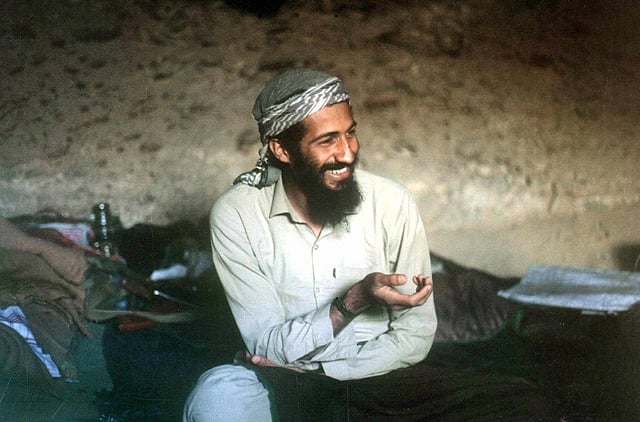
The American operation that raided Osama Bin Laden’s compound, killed him and took his body away has several implications for the global counterterrorism campaign, Afghanistan and Pakistan. While a significant boost for Obama and his western allies, and a setback for Bin Laden’s followers, it is unlikely to deter continuing attacks from his ideological adherents regionally and beyond. It could facilitate America’s quasi-withdrawal from Afghanistan given negotiation with all sides, including the Taliban.
There will inevitably be criticism from Afghanistan, India and the western media as to how Osama was able to install himself undetected in a medium-size city, thus demonstrating Pakistan’s failure to counter terrorism. It was perhaps not surprising that Bin Laden chose to hide not in the borderlands of Afghanistan and Pakistan where he was being sought, but in a city following Edgar Allan Poe’s famous maxim that a public hiding space was often best. US intelligence relied on G.K. Chesterton’s story, The Dog That Didn’t Bark, suspecting a large compound lacking communication facilities.
Such criticism is largely unfounded. Pakistan’s intelligence cooperation with the US and the deeply unpopular facilities and access provided constituted the foundation for the intelligence gathering behind this and many previous operations to capture high-level Al Qaida targets. Pakistan could well have pre-empted what took place but agreed to let the Americans take the credit as they insisted. Regardless, Pakistan’s energy and resources are overstretched and under sustained stress.
Intelligence restructuring
On one flank of Pakistan, India rides high on its economic buoyancy and American alliance and loses no opportunity to pressure Pakistan to the extent of projecting a threatening military capacity even under the nuclear threshold that has kept the peace till now. Despite the resumption of talks, in real terms relations have never been worse. On the other flank, Afghanistan’s occupation has alienated Pakistan’s Pashtuns who outnumber those in Afghanistan, and fuelled terrorism in Pakistan causing multiple attacks against civilians and military throughout the country. Thirty thousand civilians have been killed; 150,000 Pakistani troops are engaged in counter-terrorism operations on the Afghan border, more than all the western troops in Afghanistan. Over 5,000 Pakistani troops and security forces have laid down their lives and more have been grievously wounded. The $85 billion (Dh312 billion) cost to the economy does not provide fiscal space to recoup.
Nonetheless, in Pakistan it is a time for reflection. There is a need to reassess and draw strategic and operational lessons from this current event capturing global imagination. It should lead to internal intelligence restructuring. Pakistan has a number of intelligence agencies and police investigation units but these must work better together. Terrorists, criminals and kidnappers alike, increasingly operating across Pakistan, must be targeted. Road checks cannot be effective when colour photocopied IDs are accepted; these must be outlawed. Each checkpoint must be equipped with hand-held scanners connected by WiFi to the central national database for verification.
The fact that American helicopters could fly deep into Pakistan from Afghanistan without apparent detection, despite admitted US military stealth and jamming technology, should worry air defence officials and military planners protecting nuclear assets.
The extremist mantra is that America and it allies are occupying Muslim countries and Islam is under threat. In the West and within Pakistan there is a Greek chorus lamenting the lack of a credible counter-narrative. Resources have been wasted in setting up additional infrastructure to create counterterrorism strategies. In reality, overcoming weaknesses in implementation is the key.
Traditionally in Muslim countries when subjected to internal injustice or external humiliation there is a call to return to the pristine era of Islam. Today in Pakistan, the Taliban claim they stand for equity and quick justice which they compare to the state’s inefficient delivery, law and order breakdown, lack of respect for the rule of law and impunity of those with power and resources.
With governance shortfalls and stagnating economic activity such extremist appeals will continue to attract a marginalised population. The only counter-narrative is to improve governance, particularly law and order, and concentrate on education and infrastructural projects which would generate job opportunities. A mindset change is needed to adapt without damaging national security. On the Afghan border, it is time to fence it despite its length, terrain and Afghan objections. Afghanistan can’t have it both ways, decrying cross-border infiltration yet opposing normal border controls. With India, Pakistan must make it plain that it can tackle terrorism more effectively if India puts into practice its political protestations of wanting better relations and a stable and prosperous South Asia. Internally Pakistan needs to work for progressively reducing its military and economic aid reliance on the US to counter what will now be increasing US demands for more drone strikes, American intelligence presence and cross-border operations. Pakistan can come out of this stronger if it takes the right steps.
Ambassador Tariq Osman Hyder is a retired Pakistani diplomat who has handled counterterrorism issues.
Sign up for the Daily Briefing
Get the latest news and updates straight to your inbox
Network Links
GN StoreDownload our app
© Al Nisr Publishing LLC 2026. All rights reserved.