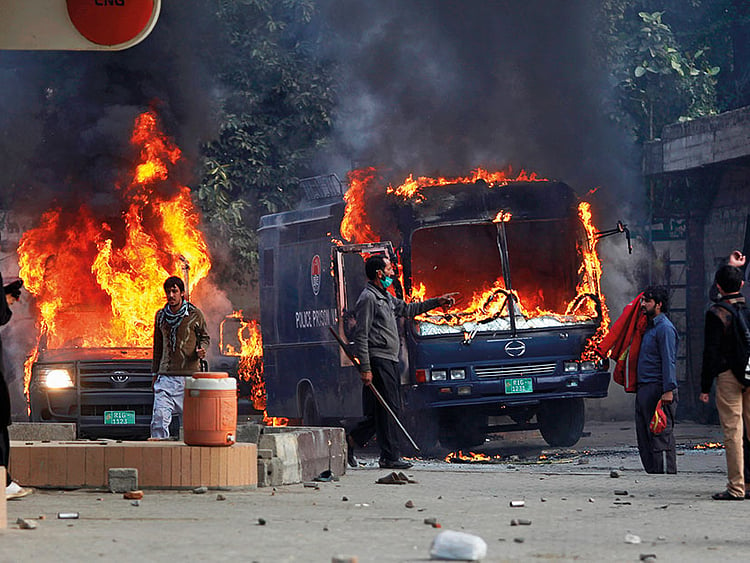
Islamabad: After three weeks of protests and several futile attempts at talks, Pakistan’s government finally decided on November 25 to forcefully disperse protesters who had been occupying the Faizabad junction, connecting Islamabad and Rawalpindi.
The operation was suspended within few hours and protesters returned to the streets.
Activists from Tehreek-e-Labaik had been protesting since November 6, demanding the dismissal and arrest of the law minister over his alleged role in the amendment of blasphemy law in the Elections Act 2017.
The government delayed taking action against the protesters, fearing backlash for following reasons:
1. The foremost reason is that the ruling Pakistan Muslim League-Nawaz (PML-N) government draws support from Islamists and, during the last elections, won the support of between 30-40 per cent of votes from constituencies where Islamists dominated, particularly in Punjab.
2. Another important reason is that one of the hardline Islamist parties, the Jamiat Ulema-e Islam-F (JUI-F), Maulana Fazal-ur-Rahman’s group, which has nine seats in the national assembly and over a dozen in provincial assemblies is an important ally of the PML-N.
3. Third and the most important reason for the delayed action against the protesters is the fear among already weak government circles that, if an action was conducted against the Islamists, the PML-N government would lose more than two dozen seats in the next election, especially from rural Punjab.
Some experts have blamed the government’s delayed reaction for the resultant chaos and instability across Pakistan on Saturday.
However, others felt the problem was more complicated.
Criticising the crackdown, the chief of politico-religious Jamaat-e-Islami, Siraj ul Haq, said the use of force has intensified the situation.
“The government should have engaged the protesters in negotiations to resolve the standoff peacefully instead of using force,” Haq said.
Political analyst Hasan Askari echoed similar views, saying that “The forceful action by government has aggravated the condition.”
He warned that: “The situation must now be handled sensibly and peacefully to avoid any further violence.”
Zafarul Haq, the PML-N leader, who headed the probe committee over the controversy, said a timely action would have averted the situation.
Shehzad Farooqi, a local analyst, believes the government grossly mishandled the situation. Had the law minister resigned earlier, the government could have avoided the chaos, he noted.
“But now the situation is out of control after attacks on former interior minister Chaudhry Nisar’s residence, the law minister’s house in Pasrur and PML-N MNA Javed Latif.”
Also because of poor planning, the government’s crackdown against religious protesters at Faizabad backfired as the protests spread to other parts of Pakistan, critics said.
“The attempt to free Faizabad led to blockade of other major cities” including Karachi, Lahore, Faisalabad and interior Punjab.
Veteran journalist, Zahid Hussain, believes the protesters have a political motive. “Tehreek-e-Labaik Ya Rasool Allah has already participated in two by-elections and they have now announced their participation in the general elections. This is linked to that: they want to whip and exploit the religious sentiment for their own political objectives.”
With this protest, “Tehreek-e-Labaik has shown that it can create a dent in the PML-N vote bank” which is one of the reasons the government took so long to react, according to Tahir Mehdi, a political researcher.
Sign up for the Daily Briefing
Get the latest news and updates straight to your inbox
Network Links
GN StoreDownload our app
© Al Nisr Publishing LLC 2026. All rights reserved.