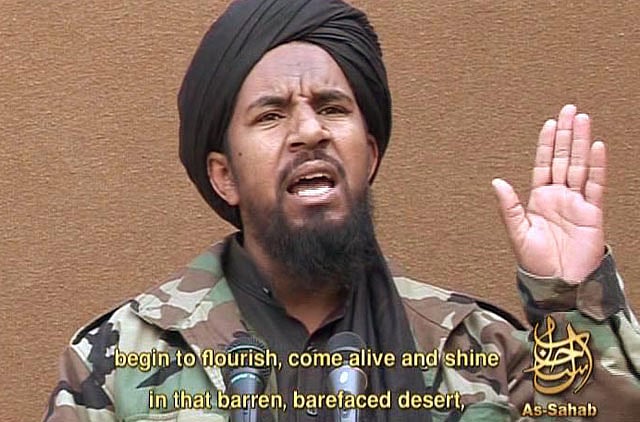
US official confirms the death in Pakistan drone strike of top al Qaida operative Abu Yahya Al Libi.
Abu Yahya Al Libi had been number two in Al Qaida and his death is a major blow to militants, US official said.
Pakistan has conveyed "serious concern" over drone strikes to American Charge D'Affaires, Foreign Ministry says.
Abu Yahya Al Libi was one of al Qaeda's top strategists and seen as the most prominent figure in the network after leader Ayman al Zawahri.
Earlier it was reported that If his death was confirmed it would be the biggest blow to Al Qaida since U.S. special forces killed Osama Bin Laden in a secret raid in Pakistan in May 2011.
The CIA's drone campaign in Pakistan, stepped up under the administration of President Barack Obama, has made the South Asian nation a perilous place for Al Qaida.
Before his death was confirmed analysts speculated that Al Libi's death would bolster the American argument that the unmanned aircraft were a highly effective weapon against militants.
The United States has also escalated drone strikes against Al Qaida figures in Yemen, where militants gained a foothold during a popular uprising against former President Ali Abdullah Saleh.
The pressure may encourage Al Qaida to seek new havens in areas where it has come under less scrutiny. A growing number of experts point to an influx of militants into Mali, for instance.
Cleric with a degree in chemistry
US sources said Al Libi, a Libyan cleric with a degree in chemistry who has survived previous attacks by drones, was a target of a strike early on Monday in northwest Pakistan's North Waziristan tribal region, home to some of the world's most notorious militant groups.
Sajjan Gohel, chief executive of the Asia-Pacific Foundation security research consultancy, said Libi was one of the few remaining key figures within Al Qaida's core.
"Libi has also been at the centre of al Qaeda's plans to reconstitute itself and try and remount a trans-national terror campaign. This is one of the reasons he was viewed as a high value target," he told Reuters by email.
Some U.S. officials describe Al Libi, whose real name is Mohammad Hassan Qaid, as number two to Zawahri, the Egyptian doctor who took over Al Qaida after Bin Laden's death.
Diplomats and some Pakistani intelligence officials say funding for Al Qaida in Pakistan dried up after Bin Laden's death, forcing some fighters to return to their home countries, mostly in the Arab world.
Inspiration
Still, some analysts say the death of an Al Qaida leader does not necessarily spell disaster for the group, arguing it is decentralised and offers inspiration to militants and not just logistical support or financing.
"Even if he's killed it doesn't matter much to the organisation as long as Dr Zawahri remains alive," said Imtiaz Gul, author "The Most Dangerous Place", a book about the lawless border area between Pakistan and Afghanistan.
Drone strikes have undoubtedly made it more difficult for al Qaeda leaders and fighters to operate along the border.
Pakistan says that while the CIA-run drone campaign has some advantages, it fuels anti-American sentiment and is counterproductive because of collateral damage.
Drones are a sticking point in talks between the United States and Pakistan aimed at repairing ties damaged by a series of issues, including the recent imprisonment of the Pakistani doctor who helped the CIA hunt down Bin Laden.
Pakistan on Tuesday summoned the U.S. charge d'affaires to the Foreign Ministry to convey its "serious concerns" over drone strikes, the ministry said in a statement.
Pakistani intelligence officials told Reuters they believe Libi, which means Libyan in Arabic, may have been among seven foreign militants killed in Monday's strike by a drone aircraft.
Telephone chatter
One of the officials said Pakistani authorities had intercepted telephone chatter about Al Libi, an al Qaeda theologian and expert on new media whose escape from a U.S.-run prison in Afghanistan in 2005 made him famous in Al Qaida circles.
"We intercepted some conversations between militants. They were talking about the death of a 'sheikh'," one of the Pakistani intelligence officials said, referring to the title given to senior religious leaders.
"They did not name this person but we have checked with our sources in the area and believe they are referring to Libi."
The intelligence official said according to informants, Libi was seriously wounded in the strike and was taken to a private hospital where he died.
It can take months to confirm whether drone strikes have killed an Islamist militant leader because the area of the attack is often sealed off by the Taliban in the lawless northwest of Pakistan.
Residents of the village where Pakistani intelligence officials said Al Libi may have been killed, Hesokhel, noted an unusually high number of militants gathered there after the drone strike and they kept people away.
'Put bodies in their cars'
"They usually bury the bodies after a drone strike in the nearest graveyard," said one of the villagers, describing the aftermath of previous strikes in the area. "This time they put all the bodies in their cars and took them away."
A senior Taliban commander in North Waziristan said Al Libi had been living in Pakistan near the Afghan border since 2005 when he escaped along with three cell mates from the Bagram military base north of Kabul, where U.S. forces run what is considered the most secure U.S. prison in Afghanistan.
'Man of action'
For the United States, Libi is one of Al Qaida's most dangerous figures. In September last year, the United States Treasury imposed financial sanctions against him. It said Al Libi, in his late 40s, released 68 public messages on al Qaeda's behalf and was second in visibility only to Zawahri.
Recently released letters written by bin Laden and captured during the U.S. raid in which he was killed last year show Al Libi to have been one of a handful of Al Qaida officials relied upon by Bin Laden to argue Al Qaida's case to a worldwide audience of militants, in particular to the young.
Believed to have received more theological training than either bin Laden or Zawahri, Libi has a reputation as a man of action, a jihadi scholar and a populist propagandist.
He was also a unifying figure in Al Qaida, said Gohel.
Terse relationship
"There has often been a terse relationship between the Libyan and Egyptian factions within Al Qaida and it is believed that Libi had bridged that gap," said Gohel.
"His death 'if confirmed' will be another significant blow to Al Qaida and another example that the controversial drone strike policy is working."
A Western expert on Al Libi, U.S. scholar Jarret Brachman, wrote on his blog: "If true (Libi's death), (this would be) a cataclysmic blow to the future of Al Qaida's General Command. For my money, there's no recovering from this one."
Al Libi, reportedly born in 1963, made repeated appearances on Al Qaida videos and wrote prolifically, becoming one of the group's most prominent media warriors.
Brachman, also a biographer, said Al Libi was seen as having made Al Qaida "cool" for a younger generation.
Sign up for the Daily Briefing
Get the latest news and updates straight to your inbox
Network Links
GN StoreDownload our app
© Al Nisr Publishing LLC 2026. All rights reserved.