Security tightened, barricades put up at Jantar Mantar, Tolstoy Marg and Janpath areas, in view of a call for protest by the CJP on October 10, in New Delhi on Friday.
Jantar Mantar: From astronomical marvel to India's protest capital — all you need to know
From farmers to anti-corruption activists, how a small Delhi road becamesymbol of dissent
Last updated:
6 MIN READ
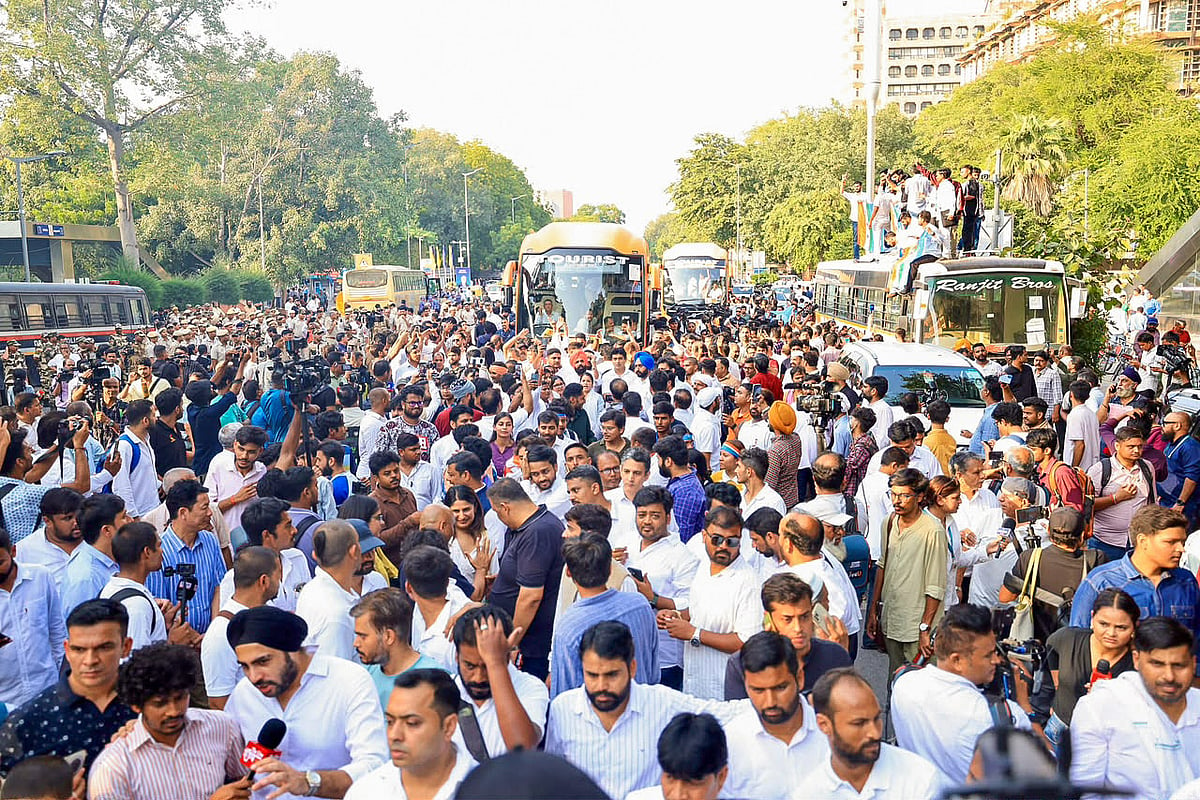
Protesters and police gather in New Delhi. Jantar Mantar has been a focal point for demonstrations in India's capital for more than three decades.
AFP
Dubai: Built to measure time and track the heavens, Jantar Mantar has become a place where Indians seek to change the course of politics.
For decades, a narrow stretch of road beside the nearly 300-year-old astronomical observatory in the heart of New Delhi has witnessed some of India’s most significant protest movements.
An NDTV special report tracing the history of Jantar Mantar explains how the site evolved from an astronomical landmark into one of India’s most recognisable centres of political protest.
Farmers have demanded debt relief, activists have campaigned against corruption, military veterans have sought better pensions and political parties have challenged government decisions.
On Saturday, October 10, the historic protest venue was once again at the centre of a political confrontation.
Police prevented demonstrators from gathering at Jantar Mantar for a protest organised by the Cockroach Janta Party (CJP), which is demanding the resignation of Chief Election Commissioner Gyanesh Kumar over alleged irregularities in the revision of electoral rolls.
At least 3,000 people, including political leaders, were detained across Delhi, according to reports.
A day earlier, the Supreme Court had called for authorities to identify alternative protest sites with better facilities, raising fresh questions about the future of one of India’s most recognisable centres of public dissent.
But why is Jantar Mantar so important, and how did an ancient observatory become synonymous with political protest?
What is Jantar Mantar, and what does its name mean?
Jantar Mantar is an astronomical observatory built in 1724 by Maharaja Sawai Jai Singh II of Amber, a ruler with a keen interest in mathematics and astronomy.
Its enormous instruments, constructed from stone and masonry, were designed to measure time, observe the positions of celestial bodies and calculate astronomical events.
The name comes from the Sanskrit words yantra, meaning instrument, and mantra, which in this context refers to calculation or formula. Together, Jantar Mantar is commonly understood to mean instruments used for astronomical calculations.
Jai Singh built five observatories across India — in Delhi, Jaipur, Ujjain, Varanasi and Mathura. The Mathura observatory no longer survives, while Jaipur’s Jantar Mantar is a UNESCO World Heritage Site.
There is, however, an important distinction.
The famous protest venue is not inside the historic observatory. It is on the road beside the monument, which has become known by the same name.
Why do protesters gather at Jantar Mantar?
Location is the biggest reason.
Jantar Mantar lies in central New Delhi, approximately 1.5km from Parliament House and close to important government institutions.
Its proximity to the country’s political leadership makes it a highly visible location for groups seeking to draw attention to their demands.
A demonstration here can attract national media coverage, political attention and public debate.
Unlike protest grounds on the outskirts of Delhi, Jantar Mantar places demonstrators close to the institutions whose decisions they want to challenge.
Over the years, it has become a recognised gathering point for farmers, students, workers, political activists and civil society organisations.
For many protesters, gathering at Jantar Mantar carries symbolic importance beyond the size of the crowd.
Congress MP Priyanka Gandhi Vadra holds a copy of the Indian Contitution during a protest at Jantar Mantar on October 7.
How did it become India’s protest capital?
For decades after Independence, some of Delhi’s biggest political demonstrations were held at the Boat Club lawns near India Gate, close to the government’s administrative headquarters.
A turning point came in 1988 when farmer leader Mahendra Singh Tikait led a massive agitation there.
An estimated 500,000 farmers gathered under the banner of the Bharatiya Kisan Union, demanding concessions including electricity bill waivers and higher sugarcane prices.
The protest continued for about a week and put considerable pressure on the government of then Prime Minister Rajiv Gandhi.
The scale of such demonstrations, along with growing security concerns, eventually led authorities to restrict protests at the Boat Club lawns.
By 1993, demonstrations had largely shifted to Jantar Mantar Road, roughly two kilometres away.
Over time, the relatively small stretch became India’s best-known designated protest venue, while larger rallies were directed towards places such as Ramlila Maidan, according to NDTV.
Which historic protests made Jantar Mantar famous?
Several movements helped establish Jantar Mantar’s reputation as a centre of public dissent.
The Anna Hazare anti-corruption movement, 2011: Veteran activist Anna Hazare began a hunger strike at Jantar Mantar demanding stronger anti-corruption legislation and the creation of an independent Lokpal institution.
The campaign attracted nationwide attention and became one of the defining political movements of the decade.
As the protests grew, major gatherings shifted to Ramlila Maidan. The movement also helped launch the political career of Arvind Kejriwal, who later founded the Aam Aadmi Party.
Tamil Nadu farmers’ protest, 2017: More than 80 farmers travelled to Delhi seeking drought relief and agricultural loan waivers.
Their 41-day demonstration attracted attention for its unusual and sometimes disturbing methods, including carrying skulls they said belonged to farmers who had died by suicide.
Wrestlers’ protest, 2023: Prominent Indian wrestlers staged demonstrations at Jantar Mantar over allegations of sexual harassment against then Wrestling Federation of India chief Brij Bhushan Sharan Singh.
The agitation attracted international attention and renewed debate over accountability in Indian sport.
Military veterans’ protests: Retired military personnel have also used the venue to press demands over pensions, including the One Rank One Pension issue.
These movements turned Jantar Mantar into a familiar address for groups seeking national attention.
Can anyone organise a protest there?
No. Demonstrations at Jantar Mantar are subject to police permission and restrictions.
Authorities regulate the size, duration and timing of gatherings, citing public safety, traffic management, security and the rights of nearby residents.
The venue is relatively small, with a permitted capacity of about 1,000 people under the restrictions cited by Delhi Police.
Police guidelines have also limited demonstrations to specified daytime hours and generally restricted continuous programmes extending beyond a day.
Organisers are required to apply for permission in advance.
In the latest confrontation, Delhi Police refused permission for the CJP’s October 10 protest, referring to an earlier agitation that allegedly continued for about a month despite permission being granted for only one day.
The restrictions have created recurring disputes between authorities seeking to maintain order and groups asserting their right to peaceful assembly.
Was protesting at Jantar Mantar ever banned?
Yes.
In October 2017, the National Green Tribunal ordered a ban on demonstrations at Jantar Mantar Road following complaints from nearby residents about noise pollution, sanitation problems and disruption.
The tribunal directed that protests be shifted to Ramlila Maidan.
However, the ban was challenged before the Supreme Court.
On July 23, 2018, the court set aside the blanket prohibition, recognising the importance of peaceful demonstrations while allowing authorities to impose reasonable regulations.
The judgment reinforced the principle that the right to protest must be balanced against public order and the rights of other citizens.
Jantar Mantar subsequently continued to function as a protest venue, subject to police controls.
Why is the Supreme Court considering alternative protest sites?
The latest debate centres on whether Jantar Mantar remains suitable for large demonstrations.
The venue has limited space, restricted access and insufficient facilities for large crowds.
During hearings in August and October 2026, the Supreme Court raised concerns about infrastructure and the practical difficulties faced by people participating in lawful demonstrations.
On October 9, a bench headed by Chief Justice Surya Kant observed that basic amenities should be available to those exercising their right to peaceful protest.
The court called for suitable alternative sites capable of accommodating such facilities to be identified.
The issue gained urgency ahead of Saturday’s CJP demonstration, when police restrictions and transport disruptions prevented many protesters from reaching Jantar Mantar.
However, the Supreme Court has not ordered the permanent closure of Jantar Mantar as a protest venue.
The discussion concerns whether better-equipped alternatives should be made available and how peaceful protests can be accommodated without compromising public safety.
What would India lose if protests moved away from Jantar Mantar?
India would not lose the right to protest simply because demonstrations were relocated.
But Jantar Mantar’s importance goes beyond its physical dimensions.
For more than three decades, it has provided a recognisable location where ordinary citizens can gather near the country’s political institutions and demand to be heard.
Its history connects movements across generations — from farmers demanding fair prices to citizens campaigning against corruption and athletes seeking accountability.
Moving demonstrations to larger venues could provide better facilities, improve crowd management and reduce disruption to surrounding areas.
But critics of relocation argue that moving protests farther from Parliament and the seat of government could diminish their political visibility.
The debate therefore raises a broader question: Is providing space for public protest enough, or does the location itself matter?
For now, Jantar Mantar remains a powerful symbol of India’s protest culture.
An observatory built to study the movement of the heavens has become a landmark where generations of Indians have sought to influence events on the ground.

A Senior Associate Editor with more than 30 years in the media, Stephen N.R. curates, edits and publishes impactful stories for Gulf News — both in print and online — focusing on Middle East politics, student issues and explainers on global topics. Stephen has spent most of his career in journalism, working behind the scenes — shaping headlines, editing copy and putting together newspaper pages with precision. For the past many years, he has brought that same dedication to the Gulf News digital team, where he curates stories, crafts explainers and helps keep both the web and print editions sharp and engaging.
Sign up for the Daily Briefing
Get the latest news and updates straight to your inbox
Network Links
GN StoreAbout Gulf NewsTerms & ConditionsReach by GNSitemapContact usPrivacy PolicyGN FocusHave your sayWork with usAdvertise with usGulf News epaperPrinting Services
Download our app
© Al Nisr Publishing LLC 2026. All rights reserved.