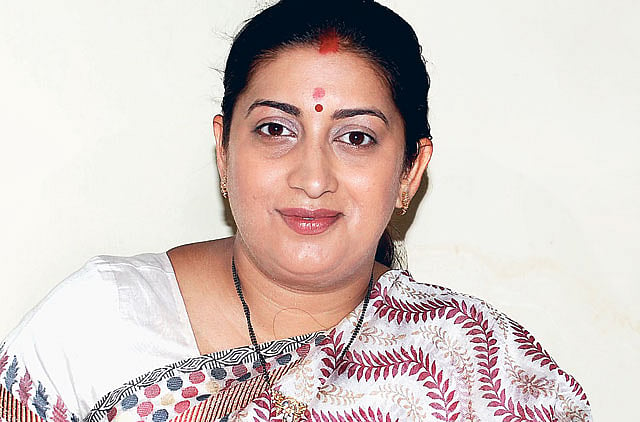
New Delhi: Life has been a roller-coaster ride for Smriti Irani who delved into various ventures before finding her true calling, first in the field of glamour and then striving for a place in politics.
Irani, one of the most recognised faces on television, created a flutter when at the peak of her fame in 2003 she jumped into the political world.
The Bharatiya Janata Party, cashing in on the celebrity's glamorous status, offered her the tough and prestigious Chandni Chowk constituency in the 2004 Lok Sabha elections.
Not familiar with the nitty-gritty of the political process and unable to comprehend the pulse of the people, Smriti lost the seat.
But certainly not the will to fight back. She stuck with the party and ever since has endeavoured to affect the lives of people by sheer hard work and dedication.
Working towards her goals in the new set-up, the President of the BJP's women's wing speaks to Gulf News in an exclusive interview.
GULF NEWS: What lesson have you learnt after your defeat in the 2004 Lok Sabha elections?
SMRITI IRANI: The lesson one gets is to gain strength to move on. We have to better ourselves.
To what would you attribute your defeat to, despite being a crowd-puller?
There is a distinction between the crowds who come to see you because they love you and the crowd that wants you to give them notes (money) to get their votes.
I was not interested in spending money to buy votes and was conscious of the fact that people like me come into politics with the belief that we want to bring about a change. But if we succumb to the whole cycle of power, then how will we initiate change. Knowing that, I consciously said no to buying votes. I am extremely vehement in my drive against corruption and use of money in politics.
You mean all those who win elections ‘buy' votes?
No. There are people who totally depend on the good work they have done. But yes, it's a reality in politics today of politicians utilising money, power, distributing liquor and capturing booths to fulfil their purpose. But one of the most significant movements I've seen now amongst the people is saying no to that kind of politics. This was evident when such tactics failed in Bihar. The polity opted for a change in governance. That kind of change is possible everywhere. It's just that it takes a lot of time and perseverance.
Any plans of entering the Parliament through Rajya Sabha or do you prefer to be given another opportunity to come through Lok Sabha?
We don't decide that. The decision is left to the Parliamentary Board.
What attracted you to politics?
I am the third generation, which is attached to the (Sangh) Pariwar. My grandfather was a swayamsewak and mother was in the Jan Sangh Party.
None of the stars, barring Shatrughan Sinha, have actually succeeded as politicians. What then do stars look for - power or the drive to do something for society?
I can't say that. I am a political activist and not a star. Nevertheless, I never let the two mingle. To me politics is a serious platform and I would rather prefer that the two do not mix and dilute the issues concerning the people. Also, I've believed that activists are evaluated on the basis of their contribution and not on how famous they are.
How are you able to balance your career as an artist and a political activist?
My priority right now is to settle in the office and get to know the office bearers. And my acting career has taken a back seat. It's a deliberate decision because if you are given some responsibility then you need to give it time.
Is there any major issue concerning the youth that frustrates you because no political party is concentrating upon it?
The BJP takes up almost every issue which is connected with the youth or people at large.
These include employment, education and basic issues such as price rises, electricity and water supplies. We believe that all these are of as much concern to the youth as anyone else.
The segregation of problems as per gender or age is a challenge in itself. The assumption that if the issue is about price rises it does not relate to the youth, is incorrect.
Employment could directly be connected to the youth, but a person in his 30s can also suddenly find himself unemployed. Retired people look for active jobs. So a lot of issues cannot be gender or youth specific.
We see atrocities towards women in the city. Any plans in this direction?
The subject of the current law and order situation will be taken up by our party leaders in Parliament. It is extremely distressing to see the rise in the crime rate in the capital itself. Our leaders have decided to raise this issue because with the on-coming Commonwealth Games, when people talk about Delhi, they should feel secure about the place.
Why do women's organisations in the city, including the Delhi Commission for Women, make a noise once in a while on some issue and then revert into sleep mode?
We ensure that irrespective of the states we are in power or not, the party takes up women's issues without bias towards any religion or caste. And we've seen that our concIentrated efforts, which start from the Centre, have helped us not only to take up issues but find solutions to the problems.
For instance, we recently took up the case of the permanent commission for women in the Army. The Delhi High Court had given the judgment and the Air Force had enforced it, but the Army refused to comply. Women officers have been fighting for the past five to seven years and it's been a long and tough battle for them.
We took up the case legally in the Supreme Court and it was shocking to find the government declaring that they were not keen on allowing combat roles to women in the Army. The government now says it will see how to amend the fundamental right as the Constitution says you cannot discriminate in terms of giving a job on the basis of gender. We are taking up this issue both in and outside the Parliament.
Do you feel that there's a need for the Women's Reservation Bill or that women should make it on their own in politics as they do in other professions?
All the women who are fighting for the Women's Reservation Bill are those who have gone through the system and realise the challenges that women at large face.
Take for instance women from rural backgrounds who have to face many challenges before they are even allowed to come to the forefront. And it's for such women that we demand reservation, so that they do not have to face problems alone and we all stand by them.
Is the Bill likely to be passed in the Lok Sabha or will it go into cold storage?
BJP had initiated 33 per cent reservation for women in the last elections when the Congress Party was only continuing to use the subject as an election tool. Whereas we informed women at that time that we were committed to the cause, we find that even till now no other party has given reservation to women within the organisation.
During the last session of Parliament, while the Congress allies could not support the Bill in the Rajya Sabha, the BJP initiated it and ensured that it was passed. Our commitment to the Bill is visible and we are looking to it being passed in the Lok Sabha. We only hope the Congress doesn't backtrack on it.
Biography
- Smriti Irani was born on March 23, 1976 in New Delhi.
- Studied in Holy Child Auxilium School, Vasant Vihar, New Delhi.
- She became famous as a television actress in the serial Kyunki Saas Bhi Kabhi Bahu Thi in 2001.
- Runs Ugraya Entertainment, which produces tele-serials.
- Joined the Bharatiya Janata Party in 2003.
- Lost the Lok Sabha elections from Delhi's Chandni Chowk constituency in 2004.
- Has been member of the National Executive five times, National Secretary twice and Vice President of the youth wing in Maharashtra.
- President of the BJP's women's wing.
Sign up for the Daily Briefing
Get the latest news and updates straight to your inbox
Network Links
GN StoreDownload our app
© Al Nisr Publishing LLC 2026. All rights reserved.