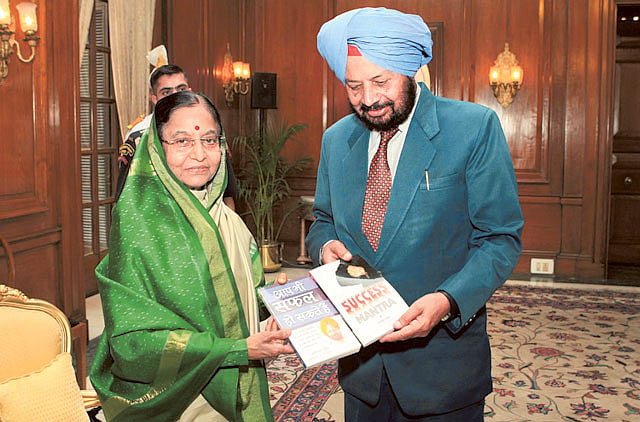
New Delhi: Amid allegations that the Central Bureau of Investigation (CBI) toned down its status report on the coal allocation scam after interference by the Federal Ministry of Law and Justice, former CBI chief Joginder Singh has once again claimed that the investigating agency has no powers.
Considered the most upright officer in the history of the CBI, he believed in sharing information rather than terming every unnecessary document as ‘top secret’. In the process, he rubbed many politicians the wrong way. Singh was suddenly transferred from the CBI in 1997, while he was away from the country.
However, the unconventional officer, who was instrumental in bringing forward Swiss documents relating to the Bofors gun scandal in India, remains hopeful. He strongly proposes autonomy to the CBI against the backdrop of the government’s interference in one probe after the other.
He speaks to Gulf News in an exclusive interview.
Gulf News: As a former CBI chief, what is your reaction to the Supreme Court calling the premier investigating agency a ‘caged parrot speaking its master’s voice’?
Joginder Singh: There is truth in what the court has said. That is because it has always been the government that decides the role of the CBI in court. The British had made laws which India has followed without realising the consequences. Probably, the then Prime Minister Jawaharlal Nehru did not realise what impact these would have and the kind of people we would be dealing with in our country.
I am reminded of British politician Winston Churchill’s words which he spoke in Parliament regarding India’s independence, “Power will go to the hands of rascals, rogues, freebooters; all Indian leaders will be of low calibre and men of straw. They will have sweet tongues and silly hearts. They will fight amongst themselves for power and India will be lost in political squabbles. A day would come when even air and water would be taxed in India.”
Today, his words have come true and I must say, Churchill must have been an astrologer!
Does it mean the CBI has absolutely no powers?
An illusion has been created about it being an independent agency. But the fact is that in legal parlance, there is no such thing as CBI. It can neither investigate nor function without the consent of the state governments. The matter pertaining to the formation of a CBI Act has been gathering dust for more than last three decades. Since CBI is not a constitutional institution like the Election Commission or the judiciary, no one can draw a road map to catch and punish the criminals. This is the reason that in cases that are with the CBI, punishing criminals is not at all a priority of any government, notwithstanding the proclamation of the high and mighty for a zero tolerance for dishonesty or corruption.
But can the Supreme Court not force the Parliament to pass a new law giving autonomy to the CBI?
We are duty bound to follow the Supreme Court strictures. But, unfortunately, the Court does not have a danda (stick) with which to beat the parliamentarians. It is for the main opposition, the Bharatiya Janata Party, to introduce a strong Bill in the Parliament giving absolute independence to the CBI, and let the ruling party oppose it. But then, it cannot be expected, because all politicians are like-minded. The tragedy is that irrespective of the party in power, no government wants an independent investigating agency, which may not be willing to follow its orders. The governments have several ways to disable the independent functioning — sometimes through checks and balances and at other times by means of delays and manipulations.
Can the CBI not draw strength from its legal department?
Though the legal department critically examines the standards of investigation, the top cadres are representatives of the Law Ministry. This defeats the entire investigation purpose, as it is the government of the day and not the CBI that decides who will represent it in the constitutional courts.
The Supreme Court has criticised the CBI on earlier occasions too, including the Jain Hawala case and 2G spectrum scam. You mean there is no hope for any change?
One can only hope for things to get better. Decisions have been long pending with the central government to make CBI stronger. The court had ordered police reforms in 2006, but no state government acted on it. Only for the simple reason that it will take away their authority to manipulate the police and other security agencies to suit their political requirements.
So is there a way out?
It is time the CBI was made ‘institutionally’ independent of pressures and pulls from within the government. And the country should be given an Independent Bureau of Investigation (IBI) by enacting a law in the Parliament. After all, it is the government and not the CBI that is responsible for the speedy justice system. And unless this is done and things change, rogues will continue to go scot-free after scams and scandals.
Did you face any political pressure during your tenure as CBI chief?
Yes, the pressures were there, but I never paid any heed. Only once a minister asked me to see him in his chamber and I went straight to the then Prime Minister Deve Gowda and apprised him of it. I made it very clear that I shall not go to anyone, but if the minister wanted, he could come to me. The minister then called me to ask if he could meet me at my residence. I said yes, provided he did not discuss any official matter. That was it.
Box
• Born on October 12, 1939 in Khajurwala village Montgomery district, Pakistan.
• Joined the Indian Police Service at the age of 20 in 1961.
• Superintendent of Police, Bidar, Karnataka.
• Special Home Secretary to the Government of Karnataka.
• Inspector General, Central Reserve Police Force, Chandigarh and New Delhi.
• Director General, Narcotics Control Bureau, New Delhi.
• Director General, Indo-Tibetan Border Police Force, New Delhi.
• Member, Executive Committee, Interpol, New Delhi.
• Director, CBI, 1996-97.
Sign up for the Daily Briefing
Get the latest news and updates straight to your inbox
Network Links
GN StoreDownload our app
© Al Nisr Publishing LLC 2026. All rights reserved.