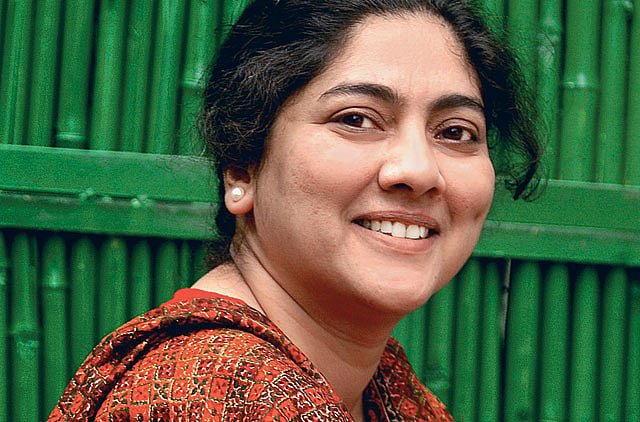
New Delhi: Daman Singh has published her second book The Sacred Grove. She has no airs about her. She giggles like a school girl. She is sans any complexities. Is trusting and transparent. Has security outside her house, which is in one of the elite areas of New Delhi. She is Prime Minister Dr Manmohan Singh’s daughter.
Daman is the kind of person, who can make even the toughest of situations pass off like ease with her wit and humour. And if that’s not enough, her simplicity and smile will do the trick.
Married to Ashok Patnaik, an Indian Police Service officer currently with the Intelligence Bureau, she says, he is very much like her father. “He too doesn’t talk about his work.” The unassuming couple loves eating out and orders a thali each, because “one gets so much variety in it.”
In probably her first in-depth interview, the soft spoken writer talks freely, warmly and exclusively to Gulf News, about her life as daughter of the most respected person in today’s politics.
GULF NEWS: It’s said that when looking for a subject for your second book, you were inspired by your teenage son Rohan, and wrote about the anxieties of a young boy. What was the writing experience like?
DAMAN SINGH: It was very educative because earlier I was only looking at things from a parent’s point of view. But when I tried to put myself in his position, I saw things in a totally different way. It was helpful to me as a parent. And as a writer it was like a new world. It really inspired me to work.
After your first book Nine by Nine, you said that the plot of your book was woven around women because you found ‘writing on men quite difficult’?
When I wrote my first novel I was very unsure of things and very nervous about saying or doing the wrong things. And so I stuck to what I was sure of and writing about women I thought would be quite easy for me. And in a way it was. But for the second book I think I was willing to take a few risks. In this book two of the characters are male. But I had the confidence to tackle them.
Was it easy writing the first or the second book?
I enjoyed the second book more because the previous one was more serious and also I was trying very hard to prove myself. But with this one there was much fun, plus less pressure.
In what way did your attitude change after that?
I was much more understanding, trusting and respectful of my son. Earlier, I would think I was always right. There isn’t a total change as such, but I have improved. Now I give his views more thought and respect.
Is your son happy about it?
I don’t think he realizes, but I notice the change in his behaviour. Earlier, we used to have lot of arguments and constant ego problems. But that’s much less now. I can’t say it’s because of this, but life is more peaceful.
Do you go through the same insecurities and concern as any other mother of a teenage child? Meaning whether he is studying or watching TV, his friends, and the websites he watches?
Of course, when I talk to my friends who have kids, we all are going through the same worries and the same fears.
How’s life without a mobile phone, which you say you don’t like to keep?
It’s great. I have a very simple life and am basically at home. I don’t really need a mobile phone, as I’m available on the landline phone to anyone who wants to reach me. Also, I’m on e-mail. I felt that a mobile was just complicating my life and meant I was 24 hours on call. I didn’t want to do that. I bought one for a few months many years ago. It’s one of those ancient models, which I have kept in my drawer just to remind myself that you tried it, but didn’t like it, so don’t try again! Back then, they were quite expensive and I spent a huge amount of my salary on it.
Like any youngster, does your son keep one? Are you intrusive whom he talks to?
Yes, he has a phone, but I don’t know what he uses it for. On most occasions it’s off and in the house. But I won’t dare touch it, as he would get angry if I did. And yes, if at all I want to know anything (about his personal life), I will wait for him to tell me. I am always there for him. But won’t be intrusive.
Do you admonish him sometimes saying don’t do this or that ... your grandfather is the Prime Minister ... what will people say?
I must confess, I have done that in the past and I’m not proud of it, especially my behaviour in public. And I feel guilty about it. It’s not fair to put so much pressure on a child. He resented it saying that (being the PM's grandchild) was not his problem. He would say, ‘I’m going to do what I want to.’ And I think it’s perfectly normal for any child.
How often does Rohan connect with his grandfather? Is the PM a doting grandfather or time constraints don’t let him spend time with the family?
My father really doesn’t get much time to spend with the family. He gets to interact and meet his grandchildren when we three sisters get together usually at a meal time. But yes, he is very doting and indulgent.
At such get-togethers, what issues generally comprise the dinner or meal time talks?
One of my nephews, who is 20-years-old, is very interested in talking about politics. But the rest of us try and stop him. So it’s always a battle. He has a secret ambition and interest in politics. But he’s still young and my father wants him to complete his studies and have good qualifications and then think of any career. He always tells him that good education is what’s going to take him ahead and that should be the focus. My mother tells him that he should rather be telling us more about his studies and life in college. And since we all come from different backgrounds and professions, there’s always a lot more to discuss.
Is it disappointing to be mostly recognized as your father’s daughter and your name not instantly getting registered with people?
Yes, it’s disappointing. And I can also make out when someone is doing something for me only because of my father. It makes me uncomfortable and I like to get out of that situation as quickly as I can. In fact, it happens a lot that people tend to judge you based on your background. And not just now, it occurred when we were younger and my father was a senior bureaucrat and not a big shot. When people came to know that we were a senior bureaucrat’s daughter, their whole attitude would suddenly change, which really annoyed me. So I used to go out of my way to actually hide it.
I remember, while in college, someone asked me what my father did. I said he was with the Reserve Bank of India. At that time he was the Governor of RBI. But I thought it was unnecessary to tell about his post. But later this person came to know and he asked me why I didn’t tell him that my father was a Governor. There are numerous such instances.
How is it being recognized in the market or elsewhere as the PM's daughter?
It’s rather embarrassing, but I’m now mature enough to also accept it. Because if people come to know, they’ll only be nicer, not mean to me. The vegetable vendor will probably chat for a few more minutes or ask me to buy some more veggies. But basically, they’ll all be nice. So it’s pleasant, but I do feel they can be pleasant even without knowing about my father.
Do people come to you complaining about issues such as price rise and requesting you to speak to your father, as he runs the government?
All the time. People have a lot of problems apart from their personal ones. They have views about what’s going on in the country and the city, including subjects like corruption. This could be when I go out or even on the phone. People discuss and often say that something should be done about it. I do try and convey these messages to my father. But more often it’s my mother who interacts with people a lot and passes on the maximum messages to him. And in his own way he must be doing but can’t take each case individually. But he listens and pays attention and takes people’s concerns seriously.
If you were to name any one Indian woman politician who has affected your psyche, who would it be?
Mrs Sonia Gandhi, who’s very strong and dignified and I admire the way she has taken the Congress Party from such a weak to a strong position. She must have a lot of character to be able to do that.
Is she admired by the entire family?
My parents certainly admire her. But my father doesn’t share any details about his work with us or even how it is to work with Mrs Gandhi, except that they have a very good working relationship. No other details are forthcoming on a regular basis - not even to my mother. So we are quite ignorant of what goes on in his office.
Has your father ever complained that none of his three daughters has political ambitions?
Never. He feels that politics is a very rough field and he got into it totally by accident. I don’t think he ever expected us to follow and is probably happy that we haven’t.
Does he feel politics is too much of strain?
Yes, it’s a lot of strain, both physically and mentally. But he is grateful for this opportunity to serve the country. His feelings for the country have been strong and I think he feels honoured to be in this position and to try and take the country forward, no matter what the hardships.
Unlike most children from political backgrounds, what put you all off a career in politics?
All of us had chosen our careers long ago. My elder sister Upender is a historian and younger Amrit took up law. We found what we liked, so it wasn’t like we didn’t want to get into politics for any reason.
Your father comes across as a serious man. Is he like this even at home or does he crack jokes?
I am sorry to say that he laughs rarely. And that happens when he’s with his grandchildren with whom he is much more relaxed than he is with the rest of us. He is a very serious person and doesn’t know to lighten the mood. In fact, my mother is good at that.
Doesn’t your mother cajole him to come out of his moods?
Oh, she does all the time. But it doesn’t work.
Do they have the usual couple fights? Does he ever crib about anything she has shopped for him?
Yes, of course, they do have fights. For my mother it’s like he’s the PM in office, not at home. So, it doesn’t change anything. After all human nature remains the same. She shops for his clothes and if he’s not happy about something, she’s willing to go back and exchange it or sends me or my sisters. But by now, my father’s preferences are very well known to her, though I might still make mistakes.
What is that one thing that they almost always disagree upon?
One thing they fight about a lot is when he goes out for a walk and puts on his shoes and often forgets to wear socks. That really upsets her. This, despite the fact that daily in the morning she keeps his socks with the shoes. This fight is almost a routine.
Does your mother accompany him on his walks?
No way. They can’t walk together! But that’s because he walks very fast and it’s difficult to catch up with him.
What issues can make him lose his temper?
If anyone of us took advantage of his official position or misused his name that could probably be the worst thing. But then we do not have the guts to do it. Although no, it has never happened, we know his views, not for now, but for the last 30-40 years. And we have never used his office stationary or any such thing because we know it is not permitted.
Does the PM wear the pants at home or your mother? And generally who gives in during the fights?
They both give in on different matters. But my mother is more bossy. With my father, if the argument gets too long, he’s willing to just sit quite and say, ‘okay you have your way.’ But she’s willing to argue till the end until she’s told by him, ‘yes, you are right and I’m wrong.’ But yes, sometimes he wins! Especially in matters of time constraint. For instance, when she wants to invite people over and he says he doesn’t have the time. But she insists he should meet because they are his friends or relatives. Eventually those ones, he wins.
And does she keep cribbing later?
Sometimes the responsibilities are really a lot for her to take alone and it’s difficult to cope up because we have many friends and relatives. And since he is really not available most times, she has to handle it all by herself. And she genuinely cares about people. It’s not a formality with her.
Does he bring his office tension home?
Sometimes he does. And we can make out. We can’t do anything particular but try and help by just being around, without saying or doing anything. Our presence is soothing for him, but then not for too long! He needs to be alone. And we are careful about that.
You once said, ‘if one can live with my mother’s criticism, I think one can live with anyone else’s criticism. Could you be more specific?
My mother’s star sign is Virgo. Although even I’m a Virgo, she is a much stronger one and very critical. She has something to say about everything. Sometimes I’m afraid if she gives a surprise visit to my place, she’ll look around the room and say – ‘Oh, you forgot to dust this or that. Or why is there so much mess in that corner?’ She is very observant with very sharp eyes. Those are tough times to survive with her around. And she doesn’t mince words or pretend that she hasn’t noticed.
How’s she like outside – at some programmes or functions?
She’s never afraid of speaking her mind even outside. For instance, when before my father became the PM, they would go to some music show and if the sound was too loud, she would go up to the organizers and request them to reduce the volume. Or even now at a wedding, when the guests have turned up, but the bride and the groom are nowhere on the scene, she’ll go up to the parents and say that the couple should have been there first to receive others. We sometimes tell her not to speak like that, but she has her way.
What’s her reaction, say, when the PM addresses the nation on August 15? Is she critical?
She’s there with him at public functions and listens very intently and if he makes a mistake, she comes home and tells him she didn’t agree with him on a certain part or that she particularly liked something which he had said. She’s mostly interested in issues that affect the common man. Because those are the issues she relates to, whether it’s about prices, food grain availability or cooking gas, which are a part of her life.
Wives and daughters of many politicians run NGOs, although a lot of them end up serving themselves. Are you or the family associated with any?
Earlier, I used to work with a Delhi-based NGO, Society for Promotion of Wasteland Development. And though we never started our own, I worked with several others full time and later as a consultant. I know many NGOs who are not serving the people, but there are also many more, which are doing good work. And I have been lucky in my professional life to have met some of the most inspiring NGO leaders who visit some really remote and backward areas of our country where the workers are struggling to help the people. I can say, I’ve seen the better side, though I admit the negative side also exists.
Despite several good schemes introduced by the government, the results do not percolate down to the people they are meant to benefit. Is there a frustration in you, as with other Indians seeing political leaders amassing wealth for themselves?
It is very frustrating and sometimes I stop reading the newspapers for many days, because it’s just so depressing. But since I’m not a public servant, officially there’s nothing I personally can do about these. But whatever little I can, I try to do in my own way. Yes, it can be very exasperating, because you’re itching to do something but then feel what I will do alone.
What will be the theme of your next book?
I’m planning to write about the life of my parents - from their early childhood to the places they lived in and their interesting experiences. I will write things they are comfortable with and are willing to share. And yes, I will show them the manuscript before publishing it. I won’t be asking them their secrets or make them uncomfortable. Someone else can do that!
In brief
- Daman Singh was born on September 4, 1963 in Chandigarh to mother Gursharan Kaur and father Manmohan Singh.
- She studied for 10 years at the Presentation Convent followed by Convent of Jesus & Mary, New Delhi.
- Graduated in Mathematics from St Stephen’s College, Delhi University.
- Studied for two years at the Institute of Rural Management at Anand in Gujarat.
- Served for 7 years in an NGO, Society for Promotion of Wasteland Development.
- Got married to an IPS officer who loves playing the flute.
- Moved out of Delhi. Went to Mizoram and wrote a book (non-fiction) The Last Frontier: People and Forests in Mizoram.
- Came back to Delhi and worked with NGOs and later joined the Tata Energy Research Institute (TERI).
- Worked as freelance consultant for 6 years.
- Her book (fiction) Nine by Nine was published in 2009.
Sign up for the Daily Briefing
Get the latest news and updates straight to your inbox
Network Links
GN StoreDownload our app
© Al Nisr Publishing LLC 2026. All rights reserved.