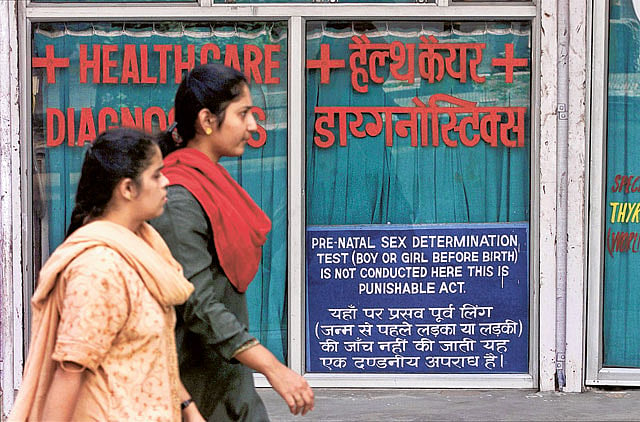
New Delhi: Ever wondered why female foeticide is so prevalent in all parts of India? The answer lies in the conviction rate of people found guilty of killing the girl child.
Finding fault with the government's strategy of cracking down on clinics, social activists feel the performance of the government is lacklustre.
"If one million abortions are done every year, why aren't even ten doctors punished?" they ask.
Activist Nirmal Chhaya said: "The government needs to take a proactive role in curbing sex pre-selection by severely punishing those found disobeying the law. But the tragedy is that the vigilance authorities do not know their own role and the action they are supposed to take."
Even the Delhi government's claim that society welcomes the girl child cuts no ice with Chhaya.
While the government contends that the sex ratio is the highest since the beginning of the century, the activist ridicules the claim.
"The sex ratio in Delhi has been on a decline since 1901 when the figure was 862 females per 1,000 males. Currently, the number may be 914, but it still shows [the] female birth ratio is just about 46 per cent," she said.
At least 1,370 girls are aborted every day in India. And the surprise revelation is that it is not the poor and least literate people and communities who kill the girl child. The practice is prevalent among the rich and educated.
Delhi and Chandigarh bear the ignominy of killing the girl child as much as the prosperous agrarian states of Punjab and Haryana. Uttar Pradesh has a better sex ratio, while Bihar betters the national average. The ratio has fallen across the country except in a handful of states and Union Territories including Himachal Pradesh, Gujarat, Tamil Nadu, Mizoram and the Andaman and Nicobar Islands.
Shocking statistics
Incidentally, the number of girl children has continued to fall despite the Pre-Conception and Pre-Natal Diagnostic Technique (Prohibition of Sex Selection) Act being in force since 1996. A Thomson Reuters Foundation study revealed that up to 50 million girls have been missing over the last century due to female infanticide and foeticide.
It suggested that selective abortion had spread from a handful of states to most parts of the country.
The study also mentioned that selective abortion was more common if the first child is a girl or also if the family already has one or more daughters and no son.
Dr N. Hamsa, executive director of Women Power Connect (WPC), said: "The menace of female foeticide is alarming. Pressure from the government and people's desire to reduce family size has unfortunately coincided with advances in medical technology, which has had devastating effects. If families want to have two children, the norm is that one must surely be a boy."
According to WPC, the Pre-Natal Diagnostic Technique Act is yet to be effectively implemented and has lots of gaps. For one, it is focused on technology and medical professionals and does not take care of the root causes, which are socio-cultural in nature.
Also, there is no separate manpower for its implementation, monitoring and supervision in the inspection work of genetic clinics and centres.
Sign up for the Daily Briefing
Get the latest news and updates straight to your inbox
Network Links
GN StoreDownload our app
© Al Nisr Publishing LLC 2026. All rights reserved.