Nandini Harinath served as the deputy operations director for Mangalyaan, India's maiden Mars Orbiter Mission.
A sari from Mars: How an Indian ISRO scientist's outfit reached the Smithsonian US museum
A garment worn during a pivotal Mangalyaan milestone is now part of space history
Last updated:
3 MIN READ
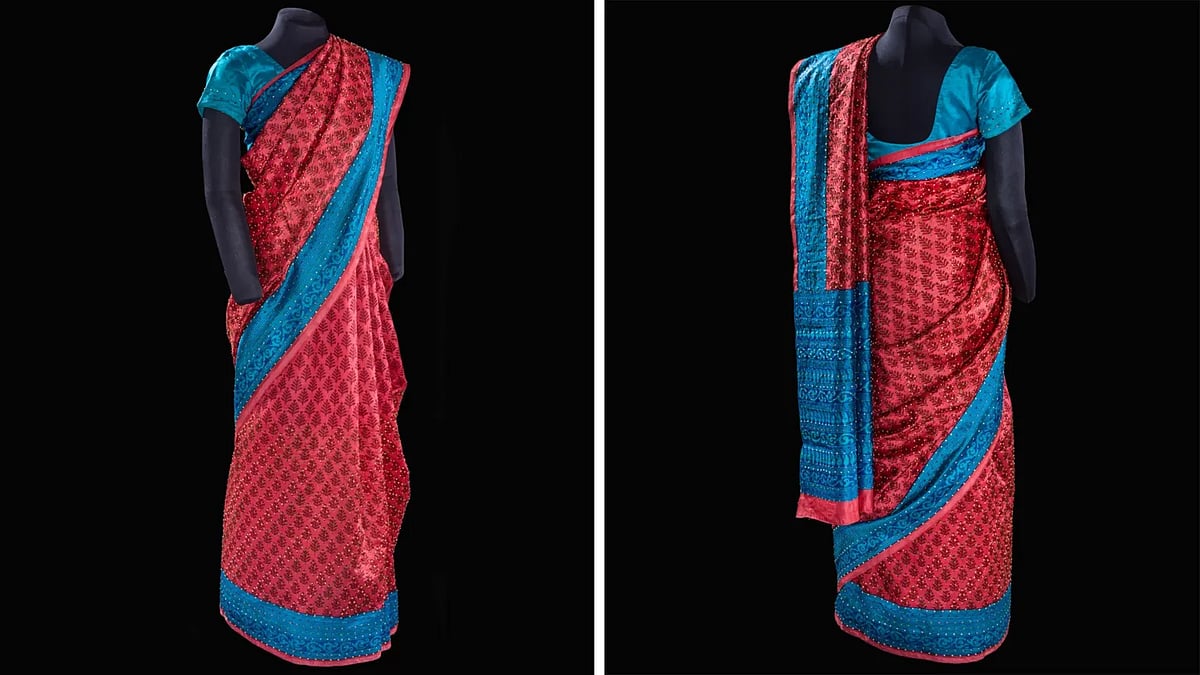
Inside the Smithsonian National Air and Space Museum in Washington DC, between objects that have touched the edges of human possibility, there is a red and blue silk sari.
Smithsonian’s National Air and Space Museum
Dubai: Inside the Smithsonian National Air and Space Museum in Washington DC, between objects that have touched the edges of human possibility, there is a red and blue silk sari.
It is draped on a mannequin, its colours vivid, its patterns intricate. It belongs to Nandini Harinath, one of India's most celebrated space scientists. And it went, in a sense, to Mars.
The Smithsonian has added the sari to its collection, recognising India's Mars mission and the women who helped shape it. The garment is now on display in the museum's Futures in Space gallery, placed alongside some of the most significant artefacts in the history of space exploration, including the blue t-shirt Sally Ride wore in 1983 when she became the first American woman in space.
The most critical day
Nandini Harinath served as the deputy operations director for Mangalyaan, India's maiden Mars Orbiter Mission. She wore the sari on December 1, 2013, the day Mangalyaan successfully left Earth's orbit and began its 300-day journey to Mars. For Nandini, it was not a casual choice. Saris, particularly those gifted by her father, had long been her go-to outfit for significant days at work or whenever she represented India's space agency.
"It was a do-or-die moment, the most critical operation in the mission," she said in a 2016 interview. "We had to decide where the spacecraft goes, how it goes and when it goes. The success of the mission depended on what we did that day."
Mangalyaan was successfully placed in Martian orbit on September 24, 2014. India became the first country in Asia, the fourth in the world, and the first to succeed on its very first attempt. The mission was intended to last six to ten months but Mangalyaan continued operating for almost eight years.
The photograph that changed everything
The moment India reached Mars, a photograph went around the world. Women scientists in bright saris were captured celebrating inside the ISRO control room, challenging the global stereotype that rocket science was a male preserve. The image was striking precisely because it was so unexpected to so many people outside India, where it simply reflected an everyday reality.
Matt Shindell, space history curator at the Smithsonian, described the image as very compelling. He reached out to Nandini in 2020 to discuss what object could best represent India's Mars mission and her role in it. The answer was the sari she had worn on that defining day.
Once the sari and its matching blue blouse arrived at the museum, textiles conservator Beth Knight watched YouTube videos to learn how to drape it correctly on the mannequin.
What the sari represents
The Smithsonian acknowledged that the saris worn by ISRO's women scientists were not just regular workday outfits. They represent India's success and its place in space exploration. Shindell described the sari as carrying two distinct meanings.
"One, it's a symbol of India's national pride in its first Mars mission and the country's successful space programme. The second is her personal story, which is inspiring, as her success could encourage more women to pursue careers in science."
This is the first object Shindell has collected from India for the museum's interplanetary science collection, and its very first sari.
Nandini's career at ISRO has spanned over 20 years and more than 14 missions. In recent years she has led the operations team overseeing Chandrayaan-3 and Aditya L1. ISRO was, famously, the only organisation she ever applied to.
The display invites museum visitors to use a touchscreen to find out more about the exhibits. "I'm overjoyed that visitors are watching the sari and wanting to find out more about it," Shindell said.
Dreams, as the Smithsonian puts it, do not always wear lab coats. Sometimes, they wear saris and reach Mars.
Network Links
GN StoreAbout Gulf NewsTerms & ConditionsReach by GNSitemapContact usPrivacy PolicyGN FocusHave your sayWork with usAdvertise with usGulf News epaperPrinting Services
Download our app
© Al Nisr Publishing LLC 2026. All rights reserved.