There's a deep sense of pride among Singapore's residents; in a recent survey by Singapore's Urban Redevelopment Authority (URA), more than 80 per cent said that it's a great place to live, work and play.
But this didn't happen by chance, says Cheong Koon Hean, chief executive officer of URA: "We take a long-term and comprehensive approach to planning to ensure that land is safeguarded for economic growth as well as a quality living environment. Only through careful planning would it be possible to enjoy a good quality of life in one of the most densely populated cities in the world."
Meticulous urban planning has played a key role in Singapore's development, from the 1820s when Sir Stamford Raffles implemented the ‘Raffles Town Plan', to the 1960s when then-Prime Minister, Lee Kuan Yew, launched the first Tree Planting Day.
A key consideration for planners has been Singapore's limited size. With a land area of about 700 square kilometres anda population of more than 4.84 million, the challenge has been to create an optimum living environment, while looking towards the island's future economic development.
"As a small island with scarce land resources and no hinterland, Singapore has to plan resources in a way that enables our developmental needs to be met in an economically, environmentally and socially sustainable manner," says Hean. >
As well as housing, the island also has to accommodate a variety of land uses, such as industry and commerce, and water processing and waste disposal.
Thinking ahead
Given the island's limitations, the government has taken a long-term approach to ensure its myriad needs are met. The planning process brings together a number of government agencies involved in Singapore's economic, infrastructural, environmental and social development, with major proposals assessed by an inter-agency committee. Implementation is a priority, so when plans are made they have to be both feasible and have the mechanisms in place to make this so.
Currently, the government is implementing the Master Plan 2008, which has four main aims: to enhance Singapore as a residential destination by creating new housing types and locations; to enhance the island's reputation as a business hub by creating new and targeted business districts outside of the main city; to safeguard Singapore's unique identity and heritage; and to showcase Singapore as a vibrant leisure destination for all, as part of the island-wide Leisure Plan.
Demonstrating the URA's commitment to long-term planning is one of Singapore's flagship projects, Marina Bay. The land was reclaimed three decades ago for the expansion of the city's central business district. "The financial district is shaping up very well," says Hean. "[It] will generate quality office space in a prime downtown location that can rival those in leading financial centres [such as] Tokyo, New York and London."
Here you will also find the Marina Bay Sands integrated resort, a vast leisure complex that is due to open in June, featuring luxury accommodation, world-class shopping and restaurants, vibrant nightlife and a vast ‘Skypark' that sits atop the towers of the Marina Bay Sands hotel.
At the planning stage, the government set aside a 100 hectares of land for the Gardens by the Bay, which is currently in development. When it is completed, there will be three interconnected waterfront gardens forming a loop around urban developments. The gardens will feature an array of recreational activities, such as dragon boat racing. "Having the Gardens by the Bay will not only enhance the quality of the environment in the new downtown," says Hean, "it will enhance the aesthetic and economic value of the surrounding development, similar to Central Park in New York and Hyde Park in London."
Green zones
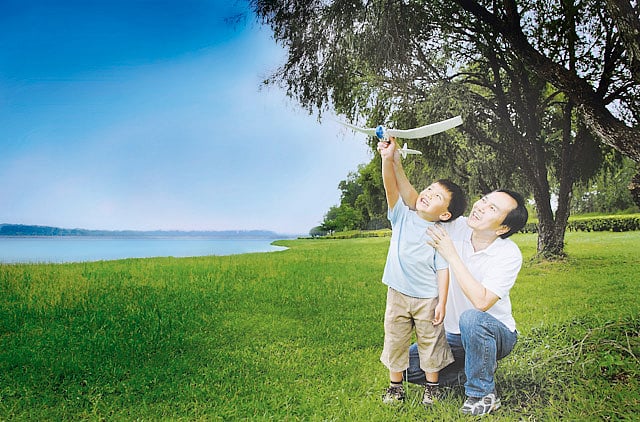
The creation of green space is an important part of the URA's master plan. Known as the ‘Garden City', Singapore's lush reputation is a testament to careful planning that dates back decades. "In our land use plans, we deliberately set aside land for parks and greenery," says Hean. There are four types of parks and nature areas, from neighbourhood parks to national nature reserves, which the Leisure Plan has linked through a vast network of park connectors. "Our greenery plans cover all parts of our island and as we plan for each area, we ensure that parks and greenery are provided in tandem with development. Greenery is an important priority for planning. It is not an afterthought," she says.
Having cemented its reputationat the forefront of urban planning, Singapore's URA is now called uponby other countries to impart its expertise. "They are interested to learn about URA's role in shaping Singapore's urban landscape," says Hean. This has led to the formation of the URA International Group, which collaborates with Singapore-based companies to provide urban planning strategies for cities in countries such asthe UAE, India, South Africa and China.
Sign up for the Daily Briefing
Get the latest news and updates straight to your inbox
Network Links
GN StoreDownload our app
© Al Nisr Publishing LLC 2026. All rights reserved.