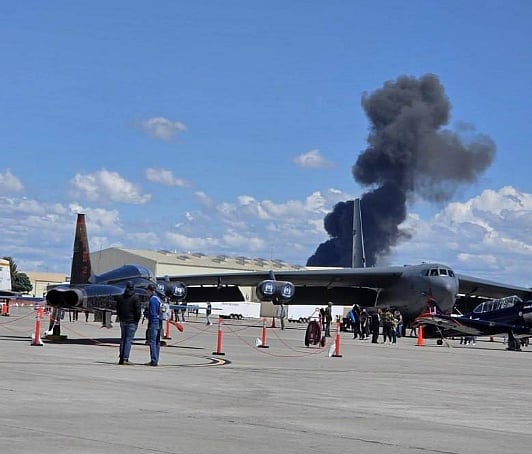
Los Angeles: All four crew members ejected safely after two Navy jets collided on Sunday during an air show at Mountain Home Air Force Base in western Idaho, officials said.
The two US Navy EA-18G Growlers from the Electronic Attack Squadron 129 in Whidbey Island, Washington, were performing an aerial demonstration when they collided, said Cmdr. Amelia Umayam, spokesperson for Naval Air Forces, US Pacific Fleet.
Get updated faster and for FREE: Download the Gulf News app now - simply click here.
The crash is under investigation, Umayam said. Base officials confirmed the crew members were in stable condition. No other injuries were reported.
“Everyone is safe, and I think that’s the most important thing,” said Kim Sykes, marketing director with Silver Wings of Idaho, which helped organise the air show.
Planes fell to the ground together
The base announced an immediate lockdown following the crash. The remainder of the air show was cancelled.
Videos posted online by spectators showed four parachutes opening in the sky as the aircraft plummeted to the ground near the base, about 50 miles (80 kilometres) south of Boise.
The EA-18G Growler is a variant of the F/A-18 Super Hornet fighter jet equipped with sophisticated electronic warfare systems.
Shane Ogden said he was filming the two jets as they flew close together. The footage appeared to show the aircraft making contact before spinning in tandem as the crew members ejected and their parachutes opened. The planes then fell together and exploded in a fireball upon impact, while the crew members drifted safely to the ground nearby.
“I was just filming, thinking they were going to split apart, and then that happened, so I kept filming,” Ogden said in a text message. He added that he left soon after the crash to avoid obstructing emergency responders.
The National Weather Service reported good visibility and winds gusting up to 29mph (47kph) around the time of the crash.
Organisers said the air show, which featured flying demonstrations and parachute jumps, was intended as a celebration of aviation history and modern military capabilities. The US Air Force Thunderbirds demonstration squadron headlined the event on both days.
Little room for error
Aviation safety expert Jeff Guzzetti said it was remarkable that both crews were able to eject safely, noting that the way the planes collided may have given them enough time to escape. The aircraft appeared to remain locked together in midair before falling to the ground.
“Crews usually don’t have a chance to eject in a midair collision,” Guzzetti said.
“It appears to be a pilot issue to me. It doesn’t look like it was a mechanical malfunction,” he added. “Rendezvousing with another airplane in formation flight is challenging, and it has to be done just right to prevent exactly this kind of thing.”
John Cox, an aviation expert and CEO of Safety Operating Systems, said pilots performing at air shows are highly skilled, but mistakes can have severe consequences.
“Air show flying is demanding. It has very little tolerance,” he said. “The people who do it are very good, and there’s a small margin for error. I’m glad everybody was able to get out.”
Air show safety under scrutiny
This year’s Gunfighter Skies event was the first held at the base since 2018, when a hang glider pilot died in a crash during an air show performance.
In 2003, a Thunderbirds aircraft crashed while attempting a manoeuvre. The pilot, who was not injured, managed to steer the plane away from spectators and eject less than a second before impact.
The air show industry has spent years working to improve safety standards at the roughly 200 events held annually across the United States.
John Cudahy, president and CEO of the International Council of Air Shows, said there was an average of 3.8 deaths per year at US air shows between 1991 and 2006. Since 2017, that figure has fallen to an average of 1.1 deaths annually, including a 2022 crash in Dallas that killed six people when two vintage planes collided.
There were no air show fatalities in 2025 or 2023, and no spectator has been killed at a US air show since 1952.
“Safety-wise, we’ve enjoyed an unprecedented period with very few accidents,” Cudahy said.
Investigators may be able to quickly determine what caused Sunday’s crash because the crews of both aircraft survived and can describe what they saw and experienced before the collision. The US Navy will lead the investigation, meaning fewer details may be released publicly compared with civilian aviation accidents.
The Iran conflict has also led to the cancellation of some air shows this year at bases where military units are involved in missions linked to the war.
Network Links
GN StoreDownload our app
© Al Nisr Publishing LLC 2026. All rights reserved.