UN General Assembly 2026: Trump, Iran war, Gaza, Ukraine and 8 things to watch
High-stakes meetings and global crises dominate diplomacy’s biggest gathering in New York
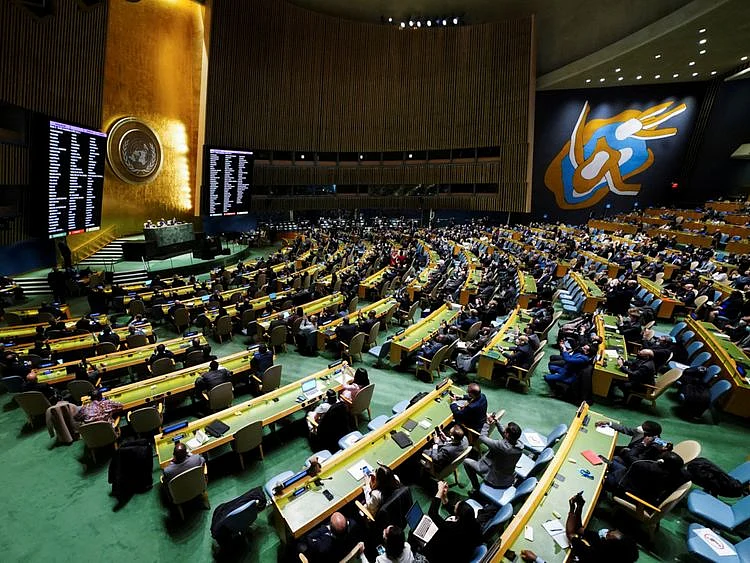
Dubai: World leaders converge on New York this week for a United Nations General Assembly unlike most before it — with the United States and Iran at war, fighting continuing in Ukraine, tensions rising across the Middle East and questions mounting over the UN’s ability to influence any of them.
The high-level General Debate of the 81st General Assembly begins on Tuesday, September 22, bringing nearly 130 heads of state and government to the UN headquarters. It continues through Saturday before concluding on Monday, September 28.
This year’s theme — “Restoring trust, managing transformation: A United Nations that delivers for all” — comes at a particularly difficult moment for multilateral diplomacy.
But much of the real diplomacy will happen away from the famous green-marble podium, as leaders hold bilateral meetings and smaller gatherings on the sidelines.
Here are eight things to watch.
1. What will Trump tell Gulf leaders about the Iran war?
This could be one of the most consequential meetings of the week for the region.
US President Donald Trump is expected to meet leaders of the Gulf Cooperation Council on Tuesday as Washington considers its next steps in the war with Iran.
The meeting is expected to include the UAE, Saudi Arabia, Qatar, Kuwait, Bahrain and Oman and focus heavily on Iran and the future of the conflict. Reuters reported earlier that discussions were expected to cover US plans for a postwar strategy.
The meeting comes as the conflict approaches seven months, while Houthi attacks and threats to crucial shipping routes have added another layer of uncertainty. Reuters says Iran is expected to loom large over Trump’s meetings in New York.
2. Could Trump and Pezeshkian meet?
Iranian President Masoud Pezeshkian is expected to travel to New York on Tuesday, putting the presidents of two countries currently at war in the same city.
Washington has approved visas for Pezeshkian, Foreign Minister Abbas Araqchi and other members of Iran’s core delegation under its obligations as host of the United Nations. The delegation will face restrictions on its movements and purchases while in New York.
Whether the presence of both presidents produces diplomacy remains an open question.
Trump has publicly indicated he would be open to meeting Pezeshkian, but no such meeting has been announced.
That possibility alone gives this UNGA an unusual dimension: diplomacy taking place while the two countries remain actively at war.
3. Is there an opening for an Iran deal?
That will be closely watched throughout the week.
Trump has said he hopes the war may be approaching an end and has repeatedly said Iran wants a deal. Tehran and Washington have maintained intermittent diplomatic contacts during the conflict, but their positions remain far apart.
The arrival of Pezeshkian and Araqchi in New York provides opportunities for direct or mediated diplomacy that would be much harder to arrange under normal circumstances.
The question is whether UNGA becomes the setting for movement towards negotiations — or merely another stage for Washington and Tehran to set out their competing demands.
4. What will Trump say from the UN podium?
Trump addresses the General Assembly on Tuesday morning.
According to US Ambassador to the UN Mike Waltz, Trump is expected to discuss how his administration has approached international conflicts and reiterate Washington’s position that Iran must not acquire a nuclear weapon.
His speech will be closely watched for signals about whether Washington is leaning towards renewed diplomacy with Tehran or further military pressure.
It also comes against a complicated relationship between Trump and the United Nations, an institution he has repeatedly criticised.
5. Can Trump and Zelensky move the Ukraine war?
Ukraine will provide another major diplomatic test.
Ukrainian President Volodymyr Zelensky has said he and Trump have agreed to meet in New York, with Reuters reporting that their talks are expected Tuesday.
The meeting follows recent contacts between Washington, Kyiv and Moscow as efforts continue to find a path towards ending the war.
Russian Foreign Minister Sergey Lavrov is also expected to meet US Secretary of State Marco Rubio during the gathering, according to CNN’s UNGA preview.
6. What happens on Gaza and Palestinian statehood?
The Israeli-Palestinian conflict will again be prominent.
France plans to convene a follow-up meeting on the two-state solution after France and several other Western governments recognised a Palestinian state during last year’s UNGA proceedings.
Palestinian Authority President Mahmoud Abbas is scheduled to speak Thursday, but Washington has denied him a visa. He is therefore expected to address the assembly remotely.
Israeli Prime Minister Benjamin Netanyahu is also due to address the gathering on Thursday, according to the preliminary programme cited by CNN.
7. Why is AI suddenly a big UN issue?
Artificial intelligence has moved rapidly up the UN agenda.
The Security Council is scheduled to discuss AI on Wednesday, while the United States is also hosting a separate event on the technology.
Outgoing UN Secretary-General António Guterres has said AI will be a major subject in his discussions with world leaders during the week.
The debate is increasingly moving beyond the opportunities created by AI to questions about regulation, security, misinformation and how governments can retain oversight of increasingly powerful systems.
8. Who will replace Guterres?
Behind all the immediate crises is another battle with long-term consequences for the UN itself.
Guterres leaves office at the end of the year after a decade as secretary-general, making this his final General Assembly as UN chief.
The contest to succeed him is already under way. An informal Security Council straw poll was held last week, although the eventual choice will require agreement among the major powers before going to the General Assembly.
Who takes over will inherit an institution confronting wars in several regions, growing great-power rivalry, pressure on its finances and persistent questions about whether the UN can still translate diplomacy into action.
For all the speeches delivered from the General Assembly podium this week, the biggest developments may therefore come in the rooms and corridors around it — particularly if the gathering produces movement on the Iran war.

Sign up for the Daily Briefing
Get the latest news and updates straight to your inbox
Network Links
GN StoreDownload our app
© Al Nisr Publishing LLC 2026. All rights reserved.