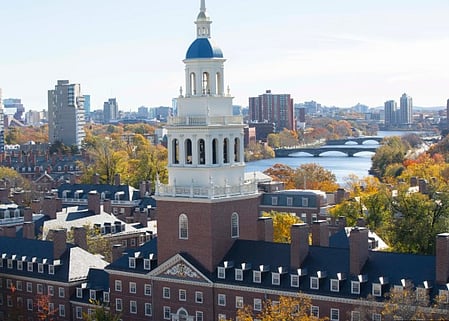
President Donald Trump’s administration expanded its campaign against elite universities, threatening to scrutinise billions of dollars of federal funding for Harvard University, weeks after freezing money meant for Columbia University.
The review, part of efforts to combat antisemitism on college campuses, includes $8.7 billion in grants and $255.6 million in contracts, according to a statement on Monday from agencies including the Department of Education and the Department of Health and Human Services.
“Harvard has served as a symbol of the American Dream for generations - the pinnacle aspiration for students all over the world to work hard and earn admission to the storied institution,” said Secretary of Education Linda McMahon. “Harvard’s failure to protect students on campus from antisemitic discrimination - all while promoting divisive ideologies over free inquiry - has put its reputation in serious jeopardy.”
Harvard President Alan Garber responded in a statement by saying that if the funding is stopped it will “halt life-saving research and imperil important scientific research and innovation.”
He also acknowleged the need to combat antisemitism on campus, noting that he has experienced it directly while serving as president.
The focus on Harvard comes after the government signalled it would seek drastic changes at the nation’s top universities, which were roiled by pro-Palestinian student protests in the wake of the Oct. 7, 2023, attack by Hamas on Israel and the Jewish state’s retaliatory response in Gaza. The administration has targeted billions of dollars of funds that flows through programs such as National Institutes of Health, while the Department of Education has started probes into 60 schools to see if they’re violating Title VI of the Civil Rights Act by failing to protect Jewish students.
The crackdown has caused concern among faculty and students that the government is suppressing free speech and that funding cuts will damage research and innovation.
Jeffrey Flier, the former dean of Harvard’s medical school and co-president of the Council on Academic Freedom, said that Harvard needed to change, but that ultimatums from the government are “a major threat to academic freedom.”
Larry Summers, Harvard’s former president, said in a post on X that while the administration is right in saying universities have wrongly accepted antisemitism on campus, suddenly withdrawing federal resources is likely unconstitutional and threatens “prosperity and national security.”
The administration in March canceled $400 million in federal grants and contracts at Columbia, days after warning the school that it was reviewing the funding as part of investigations into potential civil-rights violations. Trump had posted on Truth Social that he would stop “all federal funding” for any college or school that allows “illegal protests” and threatened to imprison or deport foreign students.
In recent weeks several students, or former students, have been detained by immigration agents, including Mahmoud Khalil, who led anti-Israel protests at Columbia, and Tufts PhD student Rumeysa Ozturk, from Turkey, who was snatched off the street by plainclothes officers and has been sent to a facility in Louisiana.
Columbia agreed to a list of demands to restore federal funding, including a ban on masks, expanded campus police powers and a review of its Middle East, South Asian and African Studies department. That infuriated some faculty who saw it as capitulation. Interim president, Katrina Armstrong, then abruptly stepped down last week to return to her role as Chief Executive Officer of Columbia University’s Irving Medical Centre, days after conservative media reported that she downplayed the changes in a zoom meeting with faculty.
Universities have also faced financial threats over their diversity, equity and inclusion programs, while the administration froze $175 million in funding to the University of Pennsylvania, citing policies allowing transgender athletes to compete in women’s sports.
That’s spurred a scramble to cut DEI programmes, fire some employees and take a harder line on protests.
Harvard has long been a target of conservatives distrustful of its apparently liberal-leaning biases. But its troubles escalated almost immediately after the Oct. 7 attacks, when its newly installed president, Claudine Gay, was widely slammed for being slow to distance the school from student groups who blamed the Hamas offensive solely on Israel. She was forced to resign months later after allegations of plagiarism and for delivering widely derided testimony before Congress, where she failed to condemn calls for genocide against Jews as a violation of university policy.
Powerful donors, including billionaire Len Blavatnik, paused donations over antisemitism, while Ken Griffin said he was no longer interested in giving more to his alma mater until the university resumed “its role educating young American men and women to be leaders and problem solvers.”
Cash gifts fell 15% to less than $1.2 billion during the fiscal year ended June 30, according to Harvard’s financial report.
Garber, a physician and economist who replaced Gay, has worked to address the controversies. He announced task forces to combat antisemitism and Islamophobia and said the school would no longer issue official statements about public matters that don’t directly affect its core function.
Harvard has also taken steps to discipline those who violate its policies, including banning law students and faculty from the library after silent protests last fall and the termination of a librarian who ripped down a poster of Israeli hostages at a pro-Palestinian rally.
The Harvard Crimson reported that the faculty leaders of the Center for Middle Eastern Studies - professor of Turkish Studies Cemal Kafadar and history professor Rosie Bsheer - are being forced to leave their posts. The centre has been criticised for programming that has been called antisemitic. That came days after Harvard said in a university publication that its School of Public Health had suspended a partnership it has with Birzeit University in the West Bank, while it undergoes a review that began last summer.
Harvard, the wealthiest college in the US with a $53 billion endowment, said in March it would freeze faculty and staff hiring to preserve financial flexibility until leaders “better understand how changes in federal policy will take shape and can assess the scale of their impact.”
Sign up for the Daily Briefing
Get the latest news and updates straight to your inbox
Network Links
GN StoreDownload our app
© Al Nisr Publishing LLC 2026. All rights reserved.