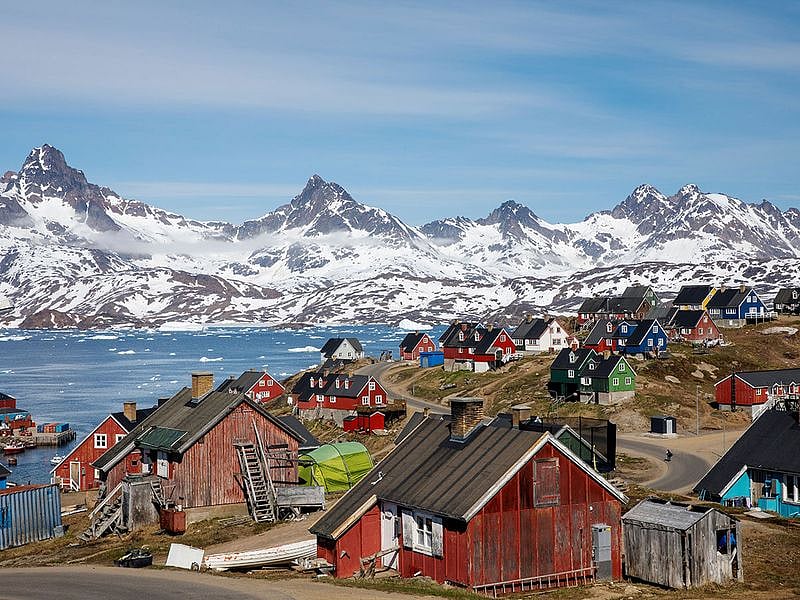
US President Donald Trump said on Wednesday that "massive" oil, gas and mineral exploration was preparing to begin in Greenland, without giving details of prospective American involvement.
"Massive Oil, Gas, and Mineral Exploration is getting ready to begin in our new and beautiful Greenland!" Trump said in a post on Truth Social, adding that "the amount of easily available Oil is far greater than that of almost... anywhere in the World."
Why Greenland matters
Greenland, a self-governing territory within the Kingdom of Denmark, occupies a strategically important position between North America and Europe.
Its location matters for Arctic defence, surveillance, shipping routes and access to natural resources.
The island also contains deposits of minerals used in electronics, renewable-energy technologies, electric vehicles and military equipment.
A 2023 survey cited by Reuters found that 25 of the European Commission’s 34 designated critical raw materials occur in Greenland.
These include rare-earth elements and other minerals that Western governments want to source from outside China, which dominates important parts of global rare-earth processing and supply chains.
But the presence of mineral deposits does not automatically make them commercially viable.
Arctic projects can face difficult weather, limited infrastructure, high transport costs, environmental restrictions and lengthy permitting procedures.
Oil exploration faces a major hurdle
Greenland decided in 2021 to stop issuing new oil and gas exploration licences, citing environmental concerns, climate change and doubts about the economic viability of additional exploration.
Existing licences were not automatically cancelled.
An existing exploration licence does not necessarily authorise drilling immediately, and permission to explore does not amount to permission to produce oil commercially.
Environmental assessments, public consultations and further regulatory approvals may still be required.
The Jameson Land project
One project attracting attention is in Jameson Land, in eastern Greenland.
A UK-registered company, 80 Mile, holds existing exploration rights in the area, while US-listed Greenland Energy has sought to participate by providing funding for drilling.
Earlier reporting said the venture planned to spend about $60 million on two exploratory wells.
Greenland’s government has emphasised that the project must pass the applicable environmental assessment and approval process before drilling can proceed.
The project is not proof that Greenland has confirmed a major commercially recoverable oil discovery. Its purpose is to test whether potentially significant resources exist and can be developed economically.
There is no confirmation in Trump’s latest announcement that the Jameson Land venture is the project he was referring to.
What has changed in US-Greenland relations?
Trump’s announcement follows a September agreement involving the United States, Denmark and Greenland intended to ease tensions over his repeated demands for US control of the island.
The agreement expands the framework for US military access and operations in Greenland, while reaffirming Danish sovereignty and Greenlanders’ right to self-determination.
It provides for an expanded American military role, including plans for two additional bases and the proposed Golden Dome missile-defence system, according to the White House.
The security agreement is important context, but it should not be confused with an announcement of mineral or petroleum concessions. The publicly available details do not establish that it grants US companies unrestricted access to Greenland’s resources or automatically approves new drilling projects.
Greenlandic lawmakers have expressed support for the security arrangement, but some have questioned the lack of detail on its economic benefits and whether Greenland will receive guaranteed compensation.
Why the announcement matters for the US and China
The resource question is also geopolitical.
The United States wants to reduce vulnerabilities in supply chains for critical minerals, including materials used in advanced electronics, energy technologies and defence systems. Greenland’s deposits could eventually contribute to that effort, provided projects can attract investment and satisfy local legal and environmental requirements.
China’s role in rare-earth mining, separation and processing has made alternative sources strategically important to Washington and its allies. Greenland is therefore potentially valuable not only for what lies underground, but also for where it sits in the Arctic.
However, mineral projects can take years to move from exploration to production. A large geological resource may still be uneconomic if extraction, processing and transport costs are too high.
What to watch next
The next meaningful developments would be:
Project details: Whether Trump or the administration identifies specific exploration sites, companies, investors or funding commitments.
Greenlandic approvals: Whether existing oil projects secure environmental clearances and permission to drill.
Mineral investment: Whether companies announce financing, feasibility studies or construction plans for specific deposits.
Local consent: How Greenland’s government and communities respond to projects that could affect land, wildlife, livelihoods and future economic independence.
US-Denmark relations: Whether the new security framework leads to further commercial cooperation without undermining Greenland’s self-government.
Trump’s announcement highlights Greenland’s potential as a source of energy and critical minerals, while reinforcing the island’s strategic importance to the United States. But it is not yet evidence that a new US-backed resource boom has begun.
Sign up for the Daily Briefing
Get the latest news and updates straight to your inbox
Network Links
GN StoreDownload our app
© Al Nisr Publishing LLC 2026. All rights reserved.