Stanford graduation disrupted as students walk out during Sundar Pichai speech over Israel deal
Walkout follows protests over Google’s contracts linked to Israeli operations in Gaza war
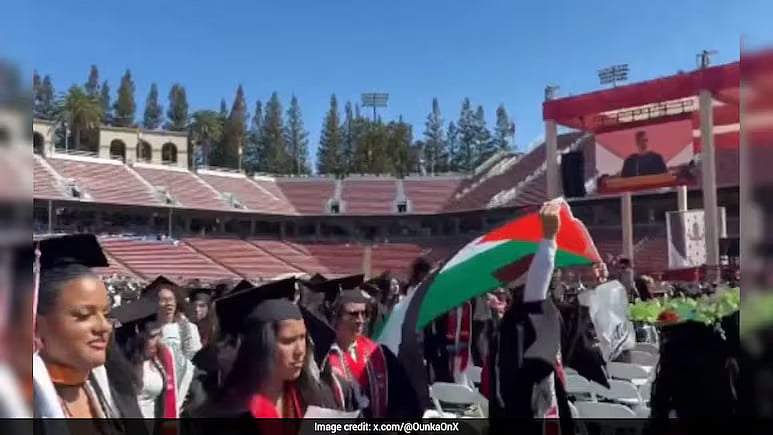
Dubai: Stanford University’s 2026 graduation ceremony was disrupted on Sunday when around 200 students walked out in protest as Google CEO Sundar Pichai took the stage, turning a celebration for thousands of graduates into a demonstration over the company’s ties to Israeli government contracts.
As Pichai was introduced at the Californian university, students stood up from their seats, waved Palestinian flags, blew whistles and chanted slogans. Many wore keffiyehs, a traditional Palestinian scarf, while others began leaving the stadium in their graduation gowns.
Videos from the ceremony showed groups of students exiting the venue as some booed from the stands. Despite the disruption, Pichai continued his address, with the majority of the graduating class remaining seated.
The protest was organised by Students for Justice in Palestine and No Tech for Apartheid, groups that have repeatedly criticised Google’s contracts with the Israeli military and US government agencies.
The demonstration was also linked to Project Nimbus, a $1.2 billion cloud-computing deal between Google, Amazon and the Israeli government. Critics have argued that the project supports Israel’s military and surveillance capabilities amid the ongoing war in Gaza.
What is Project Nimbus?
A $1.2 billion cloud computing contract
Involves Google, Amazon and the Israeli government
Provides cloud infrastructure and data services
Criticised by activists over alleged military applications
Has been a focal point of US campus protests since the Gaza war
After leaving the main ceremony, many of the protesting students gathered at a separate event titled the “People’s Commencement,” where speakers criticised Stanford’s corporate ties and broader tech industry involvement in military contracts.
The walkout came as Stanford President Jonathan Levin introduced Pichai, describing him as a leader who has shaped one of the world’s most influential technology companies. Pichai is a Stanford alumnus, having earned a master’s degree in materials science and engineering in 1995 before joining Google in 2004.
Largely unfazed
As the protests unfolded, some students booed during the introduction, while others left the stadium chanting slogans including “free, free Palestine.”
Speaking at the ceremony, Pichai appeared largely unfazed by the disruption and delivered a conventional commencement address focused on optimism, decision-making and career advice for graduates. He did not directly address artificial intelligence, a subject that has increasingly dominated speeches by tech executives at university events.
Earlier this year, several technology leaders, including former Google CEO Eric Schmidt, were booed at university commencements after speaking about AI, as concerns grow among students about job displacement and the rapid expansion of artificial intelligence tools.
Pichai had previously acknowledged in a podcast interview that tech leaders have increasingly faced pushback at graduation ceremonies, particularly when discussing AI. He said he remained optimistic about the next generation and their ability to shape emerging technologies responsibly.
“I’ve always been extraordinarily optimistic about the next generation,” he said. “AI doesn’t change that. These graduates are actually both going to be a big part of driving that progress and also dealing with the impact.”
Sunday’s ceremony began as a traditional Stanford commencement, with thousands of students arriving in academic robes and participating in long-standing campus rituals, including the university’s playful “Wacky Walk,” where graduates often wear costumes on their way to their seats.
Some students arrived in inflatable costumes and themed outfits as part of the tradition, which is a hallmark of Stanford graduation celebrations.
However, the atmosphere shifted as Pichai prepared to speak, with chants and walkouts breaking the celebratory tone of the event.
Tensions on US campuses
While a majority of students remained seated, the visible protest highlighted ongoing tensions on US campuses over the Israel-Gaza conflict and the role of major technology companies in government contracts linked to military and surveillance systems.
The protest reflects broader activism at Stanford and other US universities, where students have called for divestment from companies involved in supporting Israel’s military operations in Gaza.
Stanford has seen repeated demonstrations over the past two years, including sit-ins, arrests and hunger strikes linked to the same movement.
As the ceremony concluded, graduates who remained in the stadium heard Pichai deliver a familiar message of optimism and perseverance, urging them to embrace difficult challenges and make thoughtful choices in their careers.
Outside the main event, the parallel “People’s Commencement” continued under oak trees on campus, where speakers criticised corporate influence in education and highlighted activism as a form of education itself.
The split events underscored a deeper divide on campus between institutional celebration and political protest, turning a graduation ceremony into a reflection of wider global tensions playing out far beyond Stanford’s campus.

Sign up for the Daily Briefing
Get the latest news and updates straight to your inbox
Network Links
GN StoreDownload our app
© Al Nisr Publishing LLC 2026. All rights reserved.