SpaceX catches Starship for first time: Why it matters for humanity
Historic breakthrough could transform space travel and future Moon missions
Last updated:
5 MIN READ
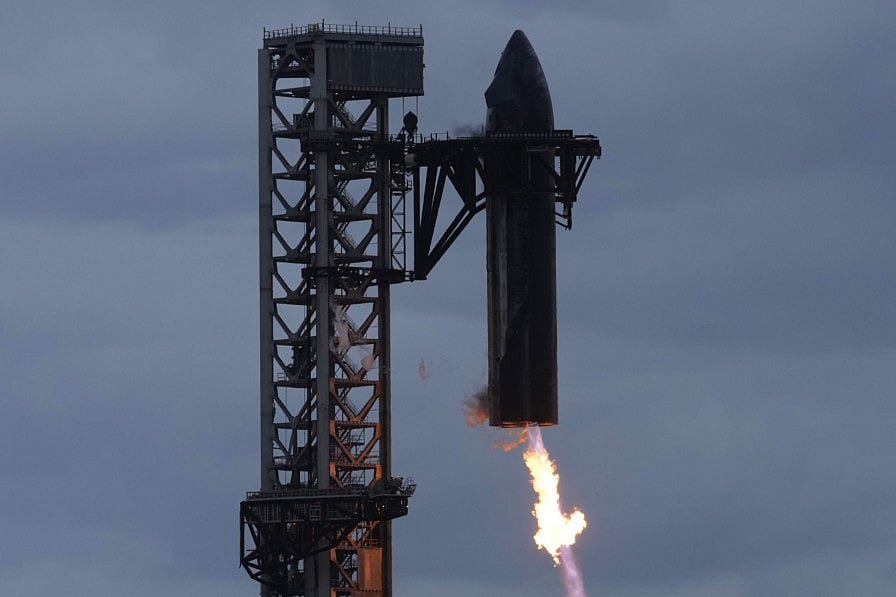
SpaceX's mega rocket Starship successfully returns to be captured at its launch pad after a test flight from Starbase, Texas, Saturday, Nov. 14, 2026.
AP
Dubai: Imagine an aircraft that could fly only once before being discarded. Every journey would require building an entirely new plane, making air travel extraordinarily expensive. That is essentially the problem space engineers have struggled with for decades.
Now, Elon Musk’s SpaceX has taken a major step towards changing that.
In a historic achievement on Saturday, SpaceX successfully caught its Starship spacecraft as it returned from orbit, using giant mechanical arms attached to a launch tower in Texas.
The feat could transform space exploration by making spacecraft reusable, reducing the cost of missions and bringing humanity closer to establishing a sustained presence on the Moon and eventually Mars.
AT A GLANCE: SpaceX’s historic Starship catch
What happened? SpaceX caught a Starship spacecraft returning from orbit for the first time.
When? November 14, 2026, at Starbase, Texas.
How? Giant mechanical arms caught the descending spacecraft.
Mission: 22 hours in space, 14 Earth orbits, 26 satellites deployed.
Why significant? A major step towards fully reusable spacecraft and cheaper space travel.
What went wrong? The Super Heavy booster was lost during its return.
What next? Prove repeated reuse, master orbital refuelling and prepare for Moon missions.
Long-term goal: More affordable space access and eventual human missions to Mars.
But what exactly happened, why does it matter, and how soon could ordinary people benefit?
What exactly did SpaceX achieve?
For the first time, SpaceX successfully recovered a Starship spacecraft returning from orbit by catching it with giant mechanical arms at its launch pad.
After spending approximately 22 hours in space, completing 14 orbits of Earth and deploying 26 Starlink satellites, the spacecraft re-entered Earth’s atmosphere.
It survived extreme temperatures before descending vertically towards the launch tower at Starbase in Texas.
Two enormous mechanical arms, nicknamed “chopsticks”, caught the spacecraft and secured it above the launch pad.
Unlike previous missions in which spacecraft splashed down or were discarded, this Starship returned to its launch site intact.
Why is catching Starship such a big achievement?
SpaceX has previously demonstrated that rocket boosters can be recovered and reused.
But recovering a spacecraft returning from orbit is considerably more challenging.
Starship travels at orbital speeds and must survive intense heating during atmospheric re-entry before slowing down and positioning itself precisely for capture.
The successful manoeuvre demonstrated that an orbital spacecraft can return to its launch site without landing in the ocean or relying on a conventional runway.
Aerospace expert Clayton Swope of the Center for Strategic and International Studies described the mission as a major technical achievement that demonstrated the feasibility of a fully reusable Starship system.
How could this make space travel cheaper?
Today, building and launching spacecraft is enormously expensive, partly because major components are often discarded after a single mission.
Reusability changes that equation.
Consider commercial aviation: Airlines do not manufacture a new aircraft for every flight. Instead, they maintain and reuse the same planes thousands of times.
SpaceX wants to apply a similar principle to space transportation.
If Starship and its booster can be recovered, inspected, refuelled and relaunched repeatedly, the cost of transporting satellites, equipment and eventually people into space could fall substantially.
However, SpaceX has not yet demonstrated routine reuse of a recovered Starship, and the actual savings remain to be established.
How will this benefit ordinary people?
The benefits could extend well beyond astronauts and space tourists.
Lower launch costs could make it easier to deploy satellites supporting internet connectivity, communications, navigation and Earth observation.
More affordable access to space could also help scientists launch research instruments and improve the monitoring of weather systems, natural disasters and environmental changes.
For communities in remote areas, expanding satellite networks could potentially improve access to communications and digital services.
These benefits would depend on how reliably and economically reusable spacecraft operate, rather than on Saturday’s successful recovery alone.
Does this bring humans closer to returning to the Moon?
Yes, although several major challenges remain.
NASA is counting on a version of Starship to serve as a lunar lander under its Artemis programme, which aims to return astronauts to the Moon and establish a longer-term human presence there.
A reusable spacecraft could eventually help transport equipment, supplies and personnel needed for sustained lunar exploration.
NASA Administrator Jared Isaacman welcomed Saturday’s recovery, describing it as “almost magic”.
The achievement demonstrates progress towards the technologies needed for future missions, but Starship must still prove that it can perform complex operations, including refuelling in space.
What about Elon Musk’s dream of reaching Mars?
Musk envisions Starship eventually transporting large numbers of people and substantial quantities of equipment to Mars.
The spacecraft’s enormous size and planned reusability are central to that ambition.
Instead of launching a separate spacecraft for every mission, SpaceX hopes to develop a transportation system capable of making repeated journeys.
Such a system could eventually carry habitats, scientific equipment and supplies needed for a human settlement.
However, travelling to Mars presents challenges far beyond returning from Earth orbit, including long-duration life support, radiation exposure, orbital refuelling and safe landings on another planet.
Saturday’s achievement is an important technological step, not proof that human settlement on Mars is imminent.
Was the entire mission successful?
Not completely.
Although Starship returned safely, the Super Heavy booster — the enormous first stage that propels the spacecraft towards orbit — experienced a technical problem during its descent on Friday.
Instead of returning to the launch tower, it splashed down in the Gulf of Mexico and was destroyed.
SpaceX has previously caught returning boosters successfully, but it has yet to demonstrate reliable recovery and reuse of both major components together.
That remains essential to its vision of fully reusable space transportation.
What happens next?
SpaceX engineers will examine the recovered spacecraft, particularly its heat shield, engines and other critical systems, to determine how well they survived the mission.
The next challenge is proving that Starship can be recovered repeatedly and prepared for another flight without extensive rebuilding.
SpaceX must also demonstrate reliable booster recovery, orbital refuelling and safe operations carrying sensitive equipment and eventually people.
Musk has predicted that Starship launches could eventually take place more than once an hour, but that ambitious target remains unproven.
For now, the success represents a significant milestone in the decades-long effort to make space transportation reusable.
The bigger question is no longer simply whether a spacecraft can return safely from orbit. It is whether spacecraft can eventually operate as routinely as aircraft — opening space exploration to possibilities that today remain prohibitively expensive.

A Senior Associate Editor with more than 30 years in the media, Stephen N.R. curates, edits and publishes impactful stories for Gulf News — both in print and online — focusing on Middle East politics, student issues and explainers on global topics. Stephen has spent most of his career in journalism, working behind the scenes — shaping headlines, editing copy and putting together newspaper pages with precision. For the past many years, he has brought that same dedication to the Gulf News digital team, where he curates stories, crafts explainers and helps keep both the web and print editions sharp and engaging.
Sign up for the Daily Briefing
Get the latest news and updates straight to your inbox
Network Links
GN StoreAbout Gulf NewsTerms & ConditionsReach by GNSitemapContact usPrivacy PolicyGN FocusHave your sayWork with usAdvertise with usGulf News epaperPrinting Services
Download our app
© Al Nisr Publishing LLC 2026. All rights reserved.