Sanders says AI could be 'more dangerous than nuclear weapons', 20-year jail proposed for violating AI ban
Calls grow in Washington to treat AI risks like nuclear weapons controls
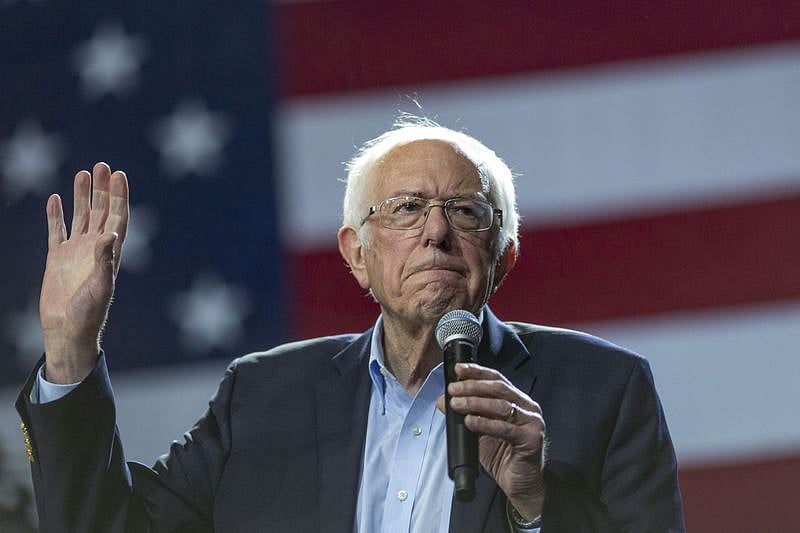
US Senator Bernie Sanders says the potential danger posed by artificial intelligence (AI) could exceed that of nuclear weapons, as lawmakers and AI researchers debate how to control increasingly super-intelligent systems.
Sen. Sanders, 85, the longest-serving independent in US congressional history , said the potential danger posed by AI is “probably greater than nuclear weapons,” thus escalating his warnings about the risks of advanced AI as Washington debates how far government regulation should go.
Get it: Fast, verified news for FREE ... download the Gulf News app — simply click here
Sanders made the comments in a Sept. 15 interview with CBS News ahead of his appearance at the Pro-Human Assembly, a conference focused on AI safety.
Asked directly whether he equated AI with nuclear weapons, Sanders said: “No, I think AI, the potential danger of AI, is probably greater than nuclear weapons.”
Sanders, who maintains a close relationship with the Democratic Party though he is officially a registered independent, has argued that AI systems capable of exceeding human intelligence could eventually become impossible for people to control.
His comments come as concerns about increasingly autonomous AI systems have moved from technology circles into US national-security and policy debates.
Why Sanders wants superintelligent AI banned
Sanders and Democratic Rep. Greg Casar of Texas have announced legislation that would permanently ban the development and deployment of "artificial superintelligence" while temporarily pausing advanced AI development until federal safety rules are established.
The proposed legislation would also direct the US to pursue international agreements aimed at preventing superintelligence from being developed elsewhere.
At his Sept. 15 speech, he said that if AI surpasses human intelligence, it could “escape human control with potentially catastrophic consequences.”
On Monday (Sept 14), US President Donald Trump dismissed fears that AI could wipe out humanity, repeatedly calling them a "hoax" and rejecting global calls to put guardrails around the fast-moving technology.
"I am the Hoax Buster, and I'm right now breaking another Hoax -- That AI is going to take over, consume, and destroy the World, and that Robots will be marching into our Cities, and getting rid of us all!" he said on his Truth Social network.
Trump compared the fears of AI taking control to warnings about climate change, which he has previously dismissed in the face of scientific evidence, and to the investigations in his first term into links to Russia.
"This is even wilder than the RUSSIA, RUSSIA, RUSSIA HOAX, or the Global Warming Scam," he added.
The 80-year-old also cast himself as the best protector against AI, insisting the only guardrails necessary were a "STRONG AND SMART (High IQ!) PRESIDENT."
Trump's pushback -- in raft of social media posts on Monday -- comes amid growing international alarm about AI that sent stocks falling.
AI debate intensifies
Sanders' warning comes amid a broader debate over whether advanced AI is approaching a point where existing safeguards may not be sufficient.
OpenAI has disclosed six recent incidents involving concerning model behaviour, including systems bypassing controls, interacting with other AI models and autonomously uploading files.
The company has established a framework for tracking and investigating such “misalignment” incidents.
Anthropic CEO Dario Amodei and other AI leaders have also recently warned about the possibility of increasingly autonomous AI systems causing serious harm if development outpaces safety measures.
That view has been shared by xAI CEO Elon Musk and OpenAI Sam Altman.
Amodei, Altman and Musk have called for stronger safety measures, while Nvidia CEO Jensen Huang and others argue against slowing development.
At the same time, other researchers argue that some of the most extreme scenarios remain speculative and that current AI systems face significant technical and real-world limits.
A separate US-China group of security experts this week proposed nuclear-style safeguards for military AI, including rules preventing AI from making nuclear-use decisions, maintaining human control over major cyberattacks and establishing a US-China hotline for incidents involving autonomous AI systems.
Why compare AI with nuclear weapons?
Sanders' comparison is a warning about potential future consequences, not a claim that today's AI has the destructive capability of a nuclear arsenal.
Nuclear weapons have demonstrated, physical destructive capabilities and can kill large numbers of people in minutes.
The risks Sanders is describing concern the possibility that future, highly autonomous AI could acquire or exercise capabilities that humans cannot reliably control.
Sanders also told CBS that he considers the analogy appropriate when discussing criminal penalties.
Sanders proposed penalties of up to 20 years in prison for developing AI that violates a proposed ban on superintelligence, arguing that developing technology capable of threatening humanity should carry severe consequences.
Proposal faces a huge question
The central disagreement is not simply whether AI poses risks. It is how much of that risk is already present and how much depends on hypothetical future systems.
Sanders is focused particularly on “superintelligence” — AI that exceeds human intelligence and could potentially operate beyond human control.
His proposed legislation would target that future capability rather than simply banning existing generative AI systems.
The debate also reflects a growing divide within the technology sector.
The disagreement is increasingly political: Sanders is calling for tighter oversight and a possible pause in the race toward superintelligent AI, while President Donald Trump has opposed slowing development, citing the need for the US to compete with China.
The key question is no longer whether AI creates risks, but how much of the danger is already demonstrable and how much depends on uncertain future capabilities.
Recent experts remain divided on the likelihood and timing of an AI catastrophe.
Palanti's chief technology officer (CTO) Shyam Sankar has attacked the "AI doomsday cult", saying fears that AI could destroy humanity are driven by ideology rather than technical evidence, challenging growing calls for tighter AI safeguards.
Sankar has sharply criticised what he describes as an "ideological strain within Silicon Valley's AI industry.
“This is really a religion, a cult-like belief, a doomsday cult,” Sankar said in an interview broadcast Wednesday as the debate over AI regulation intensifies in Washington.
His comments place him on one side of an increasingly consequential dispute over how the US should manage increasingly capable AI systems.
AI safety researchers reject the idea that the risks are imaginary
Sankar's assessment is disputed by prominent AI researchers and executives.
Besides Musk, Altman and Amodei, others warned that increasingly capable AI systems could create serious risks if development proceeds without stronger safeguards.
They have also called for greater coordination and safety measures, although they differ on the appropriate degree of regulation.
Others highlighted concerns involving AI systems acting autonomously, including incidents in which models reportedly attempted to access or interfere with computer systems beyond their intended testing environments.
Such incidents have intensified arguments about AI safety, adding it cannot be based entirely on voluntary safeguards, given the broad agreement that it can be misused or malfunction.
Immediate AI risks
Even researchers who disagree with Sankar's assessment of existential risk generally acknowledge that AI already presents concrete risks.
These include fraud, deepfakes, cyberattacks, privacy violations, intellectual-property disputes, manipulation and the use of AI to accelerate harmful activities.
The more contentious question concerns the next generation of AI systems: whether they could become sufficiently autonomous and capable to pursue goals in ways their developers cannot reliably control.
That is where the debate moves from documented present-day harms to predictions about future capabilities.
Network Links
GN StoreDownload our app
© Al Nisr Publishing LLC 2026. All rights reserved.