Pembroke Pines, Florida: Hispanic voters in key states surged to cast their ballots in the final days of early voting this weekend, a demonstration of political power that lifted Hillary Clinton’s presidential hopes and threatened to block Donald Trump’s path to the White House.
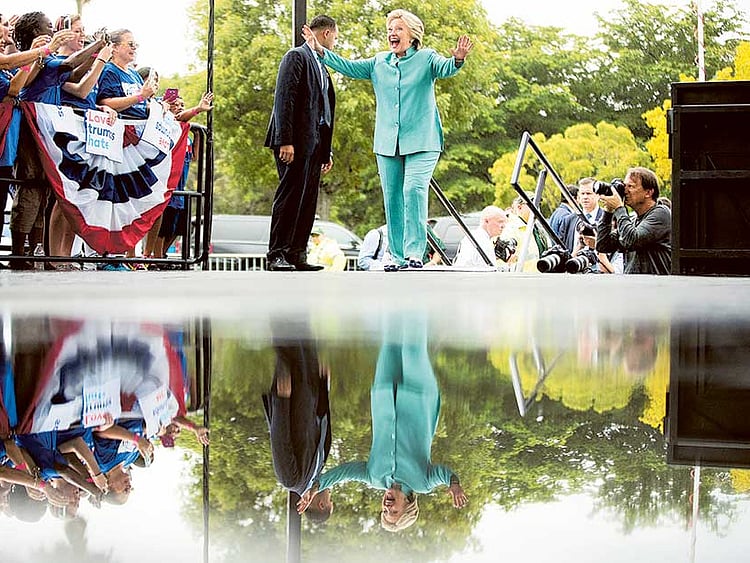
In Florida, energised by the groundswell of Latino support and hoping to drive even more voters to the polls, Clinton visited a handful of immigrant communities on Saturday and rallied Democrats in a town filled with Hispanic and Caribbean migrants.
“We are seeing tremendous momentum, large numbers of people turning out, breaking records,” Clinton said here in Pembroke Pines before cutting her remarks short when torrential afternoon rain began falling on the mixed-race crowd. Before taking the stage, she greeted voters at a heavily Cuban early voting centre in West Miami and then stopped in at her storefront field office in Miami’s Little Haiti.
Indeed, even as she fought a rearguard action to defend a series of more heavily white states that appear to have tightened — making trips to Michigan, Pennsylvania and New Hampshire — Clinton appeared to find a growing advantage in the more diverse presidential battlegrounds.
This long, unpredictable and often downright bizarre election was, in other words, ending along the lines it had been contested all along: with Americans sharply divided along demographic lines between the two candidates. But Democrats continued to hold the upper hand, thanks in part to the changing nature of the electorate in the most crucial states: Florida and a cluster of states in the South and West.
Cuban endorsement
Trump also began the day in this state, rallying supporters in Tampa, where he recognised Hispanic supporters in his audience and declared “the Cubans just endorsed me”, citing an award he had been given by a group of Cuban-Americans. Without explaining what he meant, Trump said: “The Hispanic vote is turning out to be much different than people thought.”
He also continued to assail Clinton over her use of a private email server as secretary of state, highlighting the Federal Bureau of Investigation’s (FBI’s) apparent discovery of messages on a computer used by Huma Abedin, a long-time Clinton aide, and her estranged husband, former Rep. Anthony D. Weiner. But, continuing a recent pattern, Trump hurtled claims at Clinton that were highly speculative.
“Anthony Weiner has probably every classified email ever sent,” said Trump. “And, knowing this guy, he probably studied every single one, in between using his machine for other purposes.”
The FBI is investigating whether Weiner sent sexually explicit text messages to a 15 year old.
Trump also stopped on Saturday in North Carolina and planned to take advantage of the time-zone differences by flying west for evening rallies in Colorado and Nevada.
By holding events in those four increasingly diverse states, he was signalling a refusal to concede any ground to Clinton and rejecting the strategy of past presidential candidates who have fought within the confines of a narrower electoral map in the campaign’s final hours.
He even announced on Saturday morning that he planned to add a stop in Minnesota, long a Democratic bulwark and a state that until now he has not bothered even contesting.
But the evidence from polling and the early voting turnout seemed to indicate he was facing the possibility of sweeping losses in states with sizeable Hispanic populations, most likely affected by the racially-tinged language he has used since beginning his campaign more than 16 months ago, when he claimed the ranks of Mexican migrants were filled with rapists and drug dealers.
Reverse psychology
“The story of this election may be the mobilisation of the Hispanic vote,” said Sen. Lindsey Graham of South Carolina, an anti-Trump Republican who has pleaded with his party to do more to win over Latinos. “And they didn’t come out for anybody as much as they came out against what they saw as racism. So Trump deserves the award for Hispanic turnout. He did more to get them out than any Democrat has ever done.”
In Florida, at least 200,000 more Hispanics had voted early as of Friday than they did during the entire early voting period four years ago, according to an analysis by Steve Schale, a Democratic strategist who helped run President Barack Obama’s two campaigns here.
But it was not just Florida where Hispanics were poised to send a powerful message. In Nevada, which has the fastest-growing Latino population in the West, Democrats appeared to have built a fearsome advantage in Las Vegas’ Clark County at the end of early voting on Friday, largely because of a surge of votes from Mexican-Americans. The early voting period was extended until 10pm at one Hispanic grocery store in Las Vegas, where the images of hundreds of voters waiting in line ricocheted across the internet.
Hispanic turnout also soared during the early voting period in Arizona, which has voted for a Democrat for president only once since 1952 and where Clinton’s campaign made a late push with television advertising and rallies to snatch the state from the Republicans. The Latino share of the early vote was 3 per cent higher in Arizona than what it was four years ago, according to an analysis by Catalist, a Democratic data firm.
The same study found that as of the end of early voting Thursday, five states with surging Hispanic populations — Arizona, Colorado, Florida, North Carolina and Nevada — had already cast ballots equivalent to more than 50 per cent of their total turnout from 2012.
Sign up for the Daily Briefing
Get the latest news and updates straight to your inbox
Network Links
GN StoreDownload our app
© Al Nisr Publishing LLC 2026. All rights reserved.