Reid Wiseman, Victor Glover, Christina Koch, and Jeremy Hanson
How Artemis II astronauts could change how we see Earth forever
The astronauts are about to see the side of the Moon no human has ever set eyes on
Last updated:
6 MIN READ
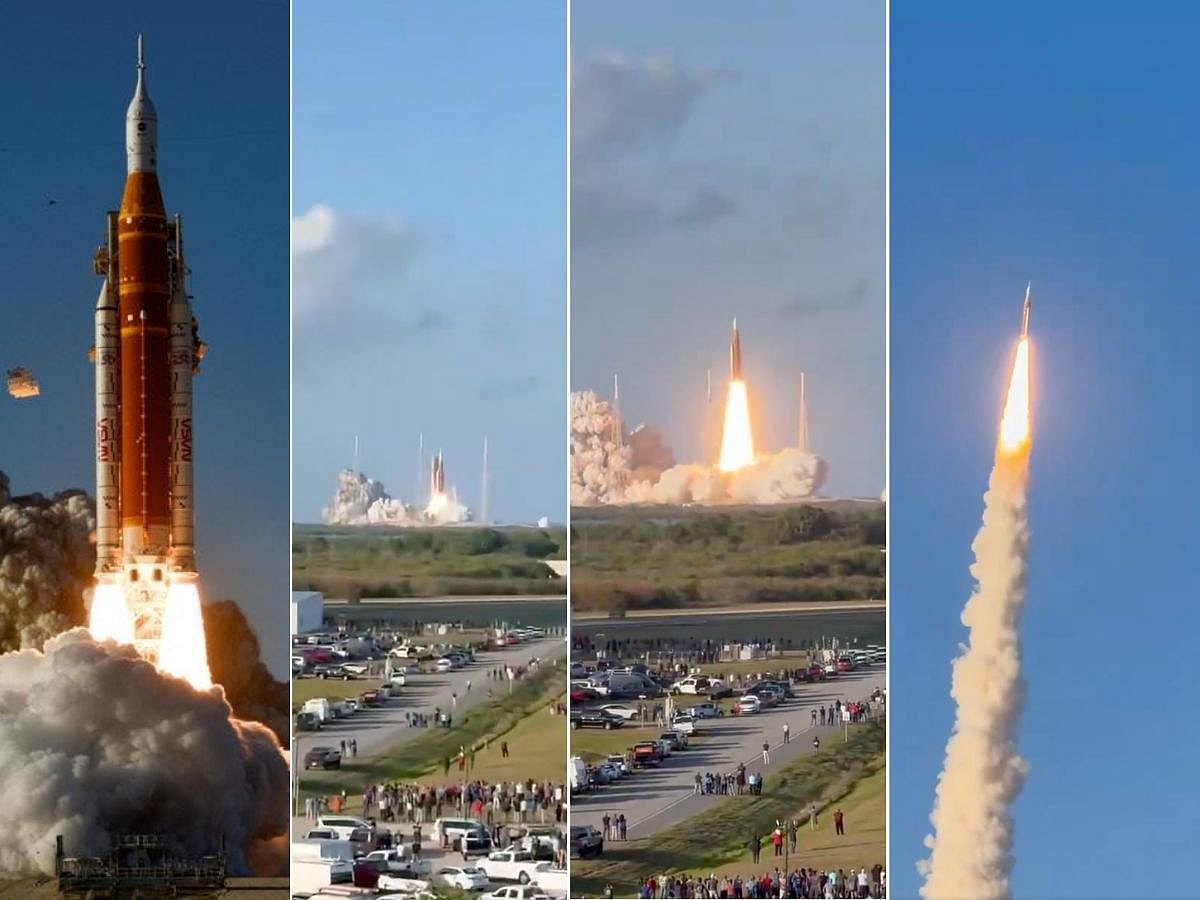
With Artemis II, humans will for the first time orbit the Moon’s "far side" with their eyes, giving humanity a visceral, real‑time view of regions robotic missions have only mapped from afar. It's also the first human mission to fly around the Moon since Apollo, which ended 53 years ago.
X | @DonaldJTrumpJr
NASA’s Artemis II crewed mission lifted off late on Wednesday (April 1) on the Space Launch System (SLS) rocket to begin their journey around the Moon.
The SLS rocket lifted the Orion spacecraft and its four‑person crew — Reid Wiseman, Victor Glover, Christina Koch, and Jeremy Hanson — from Nasa's Kennedy Space Centre in Florida beyond Earth’s atmosphere, the start of a 10‑day mission.
Here's what to know about the mission:
Also Read
Apollo vs. Artemis: What to know about NASA’s return to the moonLiftoff: Nasa launches first crewed Moon mission in over 50 yearsUAE to the Moon: New milestone for Rashid Rover 2 ahead of historic far side Moon landingChinese lunar explorer land on the far side of the moonWhat makes the mission unique?
As the spacecraft flies by the mysterious "far side" of the Moon — the hemisphere that always faces away from Earth — the astronauts will see a region that even the Apollo astronauts could never behold, because of the low‑equatorial orbits their capsules followed.
What technical milestone is the Artemis II mission expected to accomplish?
The Artemis II team's journey will mark the first time humans have ventured into the Moon’s vicinity in over 50 years — potentially kicking off a new wave of lunar exploration that could answer some of the oldest questions about Earth’s natural satellite.
DIFFERENT VIEW OF THE MOON: During 10-day journey, the crew is expected to catch a glimpse of parts of the Moon's surface no human has ever seen with the naked eye.
“We’ve been looking at the Moon throughout human history, and the Moon has been visited by astronauts and a number of robotic missions,” said Jeff Andrews‑Hanna, a professor in the Lunar and Planetary Laboratory at the University of Arizona.
“Yet there’s still so many things we don’t understand about the Moon on a very first‑order level.”
What Apollo told us — and what it missed
The Apollo missions in the late 1960s and early 1970s brought back crucial rock and soil samples that became the foundation of our modern understanding of the Moon.
Those samples revealed insights into the Moon’s origin and composition —and more recent analysis of untouched Apollo rocks, as well as samples retrieved by robotic missions like Chang’e‑5, uncovered the surprising discovery of water trapped in rocks once thought to be bone‑dry.
But Apollo astronauts only visited a handful of sites near the lunar equator on the near side, where the terrain was flat and missions could stay within range of communication satellites.
That means the Apollo samples aren’t fully representative of the Moon’s wildly diverse surface.
Artemis II is unique because of the following:
It is the first crewed mission to the Moon in over 50 years (Humans have not been to the Moon since 1972.
It is the first to test the Space Launch System (SLS) rocket and Orion spacecraft with humans on board.
It will take four astronauts further into deep space than ever before (there have only been 24 humans ever who have journeyed into “deep” space. Those were the 24 Apollo astronauts who, from 1968 to 1972, launched from the largest rockets ever built to take a multi-day journey to the Moon)
It will pave the way for long-term lunar exploration and future Mars missions.
Why the Artemis missions matter
The broader Artemis programme aims to visit different regions of the Moon, including around the poles and the far side, to build a more complete picture of its composition and geology.
Doing so could help explain why the near and far sides differ, how much water the Moon contains, and how the silvery orb has evolved over billions of years.
MOON'S ORIGIN THEORY: A leading theory is that the Moon formed when a Mars‑size object slammed into Earth, ejecting a molten blob of material into space that eventually coalesced into the Moon. Studying the Moon today could test that idea — and even shed light on lost chapters of Earth’s early history.
“I think of the Moon as the eighth continent of Earth,” said Noah Petro, chief of NASA’s Planetary, Geology, Geophysics and Geochemistry Laboratory at Goddard Space Flight Center. “When we study the Moon, we’re actually really studying an extension of the Earth.”
The promise of the unexpected
Beyond confirming theories, there’s also the chance of surprise discoveries.
“We will have surprises,” Petro said. “That’s why we explore. If we knew what we would find, we wouldn’t have to go.”
Petro leads the science team for Artemis IV, which aims to return astronauts to the lunar surface in 2028 — a mission that could finally bring back new samples from regions far beyond the Apollo landing zones.
How Apollo rewrote the Moon’s origin story
Whenever a spacecraft lands on a planet or asteroid, the most valuable thing it can often do is bring back a sample to Earth, said Barbara Cohen, project scientist for Artemis V, another planned lunar landing later this decade.
Apollo’s samples forced scientists to rewrite textbooks.
Before the landings, experts debated whether the Moon formed elsewhere in the solar system and was captured by Earth, or whether it separated from the rapidly spinning early Earth like a blob of material.
Why is anorthosite from the Moon important?
But the Apollo rocks contained anorthosite, a type of white igneous rock rare to see alone on Earth but common on the Moon’s near side.
“What you need is a really big magma pond that slowly crystallises and all of the anorthosite will float up to the top of the pond if it’s cooling slowly enough,” said Carolyn Crow, assistant professor of geological sciences at the University of Colorado Boulder.
A piece of White Mountain anorthosite mineral is seen at the Greenland School of Minerals and Petroleum in Sisimiut, Greenland on February 2, 2026.
The widespread presence of anorthosite suggested the Moon was once a global magma ocean.
Combined with isotope data from Apollo rocks that match Earth’s mantle, scientists converged on the idea that the Moon formed from debris ejected by a giant impact between Earth and a Mars‑size object.
What Artemis II could change
With Artemis II, humans will for the first time orbit the Moon’s far side with their eyes, giving humanity a visceral, real‑time view of regions robotic missions have only mapped from afar.
SUBSEQUENT ARTEMIS MISSIONS: Later Artemis missions — III, IV, and V — could then return samples from those far‑side and polar regions, potentially revealing new clues about lunar water, geology, and bombardment history.
In the end, Artemis II won’t just be a technical milestone; it could be the first step in revising humanity’s understanding of both the Moon — and the early Earth.
Artemis II mission timeline:
Day 0: Liftoff (April 1, 2026, at 22:35 UTC)
NASA’s Artemis II successfully blasts off, launching toward the Moon in the first crewed lunar voyage in 53 years.
The SLS rocket lifts the Orion spacecraft and its four‑person crew beyond Earth’s atmosphere, beginning the 10‑day mission.
Day 1: Outbound coast and rest
Total mission duration: 10 days.
The crew will stay about 5,000 miles from the Moon’s surface at closest.
Astronauts will sleep in two four‑hour blocks per day, a schedule designed to keep them alert during the long transit.
Day 2: Breaking free of Earth
Orion’s engines fire to accelerate the spacecraft to escape velocity, officially sending it on its path toward the Moon.
Days 3–5: Midcourse toward the Moon
The crew fine‑tunes the spacecraft’s approach to the Moon, making small trajectory corrections to ensure the flyby happens at the right distance and angle.
Day 6: Flyby at the Moon
The Orion capsule swings by the Moon, dipping about 250,000 miles from Earth, the farthest any humans have traveled.
The Moon will be roughly 5,000 miles beneath the spacecraft—close enough for detailed views but not for landing.
Days 6–7: Turning back home
The crew adjusts Orion’s trajectory again, this time setting up the return path to Earth rather than a lunar orbit or landing.
Day 8–9: Cruise back to Earth
Orion coasts through deep space on its way home, with the crew conducting tests, collecting data, and preparing for reentry.
Day 10: Reentry and splashdown
The astronauts put on their proper suits and secure the capsule for the violent plunge back into Earth’s atmosphere.
Orion reenters at about 25,000 miles per hour, the fastest human reentry in decades.
A pair of parachutes (with backups staged just in case) will slow the capsule down to a gentle 17 miles per hour.
The Orion capsule splashes down off the coast of San Diego, California, concluding the first human mission to fly around the Moon since Apollo.
Sign up for the Daily Briefing
Get the latest news and updates straight to your inbox
Network Links
GN StoreAbout Gulf NewsTerms & ConditionsReach by GNSitemapContact usPrivacy PolicyGN FocusHave your sayWork with usAdvertise with usGulf News epaperPrinting Services
Download our app
© Al Nisr Publishing LLC 2026. All rights reserved.