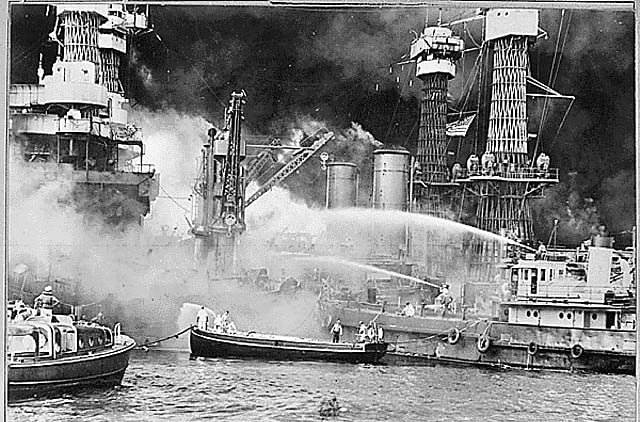
Pearl Harbor, Hawaii: Seventy years after Pearl Harbor, the wreck of the ‘Arizona', the giant battleship sunk by Japanese warplanes, still leaks oil, evoking for some the tears of the thousand sailors who went down with their ship on that day of "infamy".
On December 7, 1941 at dawn, Japan awakened the American "sleeping giant", bombing the US Pacific Fleet anchored in Hawaii. In two hours, some 20 ships were sunk or damaged and 164 planes destroyed.
Denouncing "a date which will live in infamy", president Franklin Roosevelt declared war on Japan, changing the course of the Second World War at a time when many of his countrymen had hoped to escape the conflict.
Of the 2,400 Americans who died at Pearl Harbor, nearly half, exactly 1,177, were killed in a matter of seconds aboard the Arizona, when a bomb detonated the ship's munitions depot, igniting a conflagration that burned for three days.
Still visible
Today, the wreck is still visible, one of its rusty turrets rising above the surface, flying an American flag. Every day, hundreds of visitors view it from a bridge-like memorial built over the wreck.
"It's a huge piece of history. It's very powerful," said Gord Woodward, a Canadian tourist, as he looked down on the memorial on what is officially designated a war grave.
What never fails to impress tourists are the drops of oil that rise to the surface every 20 to 30 seconds.
"Some people call them black tears, as if the men were still crying inside the ship," said a guide at the memorial. Before the attack, the Arizona's fuel tanks had been filled with 5,700 tonnes of fuel, ready to cast off in the event of war.
Part of its fuel tanks were destroyed by the explosion, but those in the rear were only punctured, explains Daniel Martinez, a historian attached to the memorial. Since then, the ship has been leaking oil at a rate of 3.5 litres a day. "We don't really know how much oil is left in there," he said, adding that "environmentally, it's not causing a huge problem".
Martinez, who has dived several times into the ship's hull, said inside each of the ship's six submerged levels floats a ribbon of oil one to three feet thick, rising gently towards the surface.
The wreck, he said, has become a reef attracting thousands of species of fish. "There are two sea turtles that live in there," he said.
The historian acknowledges that a slick could spread through the harbour if the wreck were to crack open, releasing its residual fuel.
"We're very much aware of this possibility but it seems that the strength of the ship will prevent a massive escape of oil," he said.
Studies have determined that the ship's metal structure, built during World War I, could last another 600 to 800 years.
If worst comes to worst, the wreckage can be completely encircled with barriers within 30 minutes to contain the oil, he assured.
Today, a hundred survivors of the Japanese attack, including seven who were on board the Arizona, will parade in a commemorative ceremony at the naval base, which is still active.
As flags are lowered to half mast throughout the United States, a minute of silence will be observed at 7.55am, when the first bombs landed.
In the afternoon, the ashes of Vernon Olson, an Arizona survivor who died last year, will be released in the ship's interior. Since 1941, about 30 former sailors have rejoined their comrades in this underwater grave.
Sign up for the Daily Briefing
Get the latest news and updates straight to your inbox
Network Links
GN StoreDownload our app
© Al Nisr Publishing LLC 2026. All rights reserved.