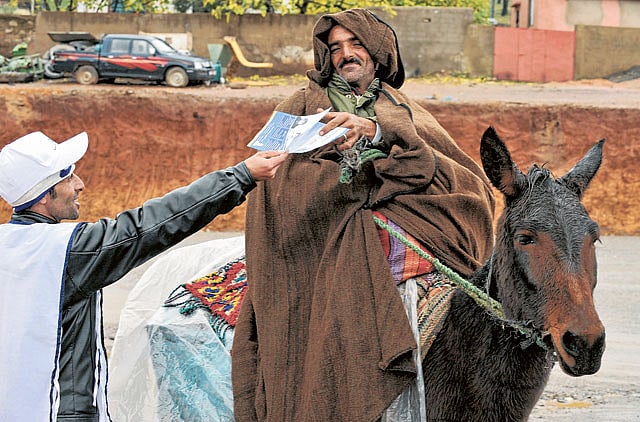
Rabat: Once seen as a threat to this North African kingdom, Morocco's Islamist party may now be key to the government's credibility.
The opposition Islamist Justice and Development Party (PJD) is poised for a strong showing in tomorrow's legislative elections — the second elections prompted by Arab world uprisings this year. Facing a protest movement calling for a boycott of the vote, Morocco's rulers are ready to embrace the once-feared PJD to restore confidence in the system.
While Morocco's own Arab Spring protests never seemed to truly threaten the ruling system, they still prompted King Mohammad VI to introduce constitutional reforms and hold early elections.
With the victory of an Islamist party in Tunisia's elections last month, and religious movements in Egypt and Libya set to compete in contests there, eyes are now on how Morocco's PJD it will do tomorrow. Victory would solidify the sense that the choice of the newly empowered masses of the Arab world is an Islamist one.
Though once described by Morocco's secular elite as a threat to the country's way of life, the PJD has cast itself as a moderate, anti-corruption crusading party ready to work within the system and, most importantly, fully supporting the monarchy.
Pro-democracy demonstrations across North Africa and the Middle East have shaken up Morocco's politics, casting doubt on a decades-old system in which multiparty elections were held but left all power in the hands of the king and his allies.
"In 2002, we were in third place, in 2007 we were in second place, so if today we aspire to first place, it is only natural," Abdelilah Benkirane, the secretary general of Morocco's PJD, told The Associated Press.
Landing between 20 and 30 per cent of the vote "is reasonable", Benkirane said. That would translate into more than 100 of Parliament's 395 seats, a huge jump from its current 47.
Governing coalitions
The likelihood of such an outcome is hard to gauge, because polls are not allowed. Morocco's complex proportional representational system lends itself to fractured parliaments with many parties which are then assembled into governing coalitions by the king's advisers. In parliament, the PJD initially focused its efforts on social and religious issues like the Islamic headscarf for women and the sale of alcohol, but has since adjusted its message to focus on issues with wider resonance, like fighting corruption and combating rampant unemployment.
At a glance
- Population: 32 million. The population of disputed territory Western Sahara is around 385,000. Morocco is a largely traditional society but not an overtly conservative one. The Islamic headscarf, for example, is less in evidence on city streets than in nearby Libya or Egypt.
- Ethnic groups: Arab 70 per cent, Berber 30 per cent.
- Religion: Mainly Sunnis (99 per cent). There are Christian and Jewish minorities.
- Language: Most people speak Darija, a mixture of Arabic, European and Berber languages. Arabic is the country's official language. Berber languages are spoken in mountainous areas and the south, and many Moroccans also speak French or Spanish.
- Demand for reforms: In March, protests inspired by the revolts in Tunisia and Egypt led King Mohammad VI to initiate a series of reforms. Under the reforms, approved in a July 1 referendum, the monarch devolved significant political powers to the prime minister and parliament, though he remained head of state and the military.
- Political system: Morocco's complex proportional representational system lends itself to fractured parliaments. There are more than a dozen political parties participating in tomorrow's elections from across the political spectrum contesting parliaments 395 seats. This year, several political parties as well as the youth-driven pro-democracy February 20 movement are calling for a boycott, claiming the system is rigged. Unlike in 2007, there is no campaign against the Islamists in the state-dominated press and instead there are just calls for everyone to come out and vote.
Sign up for the Daily Briefing
Get the latest news and updates straight to your inbox
Network Links
GN StoreDownload our app
© Al Nisr Publishing LLC 2026. All rights reserved.