New United Nations High Commissioner for Human Rights, South African judge Navanethem (Navi) Pillay poses in her office at the Palais Wilson, headquarters of the specialised UN agency as she takes up her post on September 1, 2008 in Geneva.
From apartheid to Nobel Peace Prize: The remarkable life of Navi Pillay
Daughter of South African bus driver became pioneering judge and global human rights voice
Last updated:
4 MIN READ
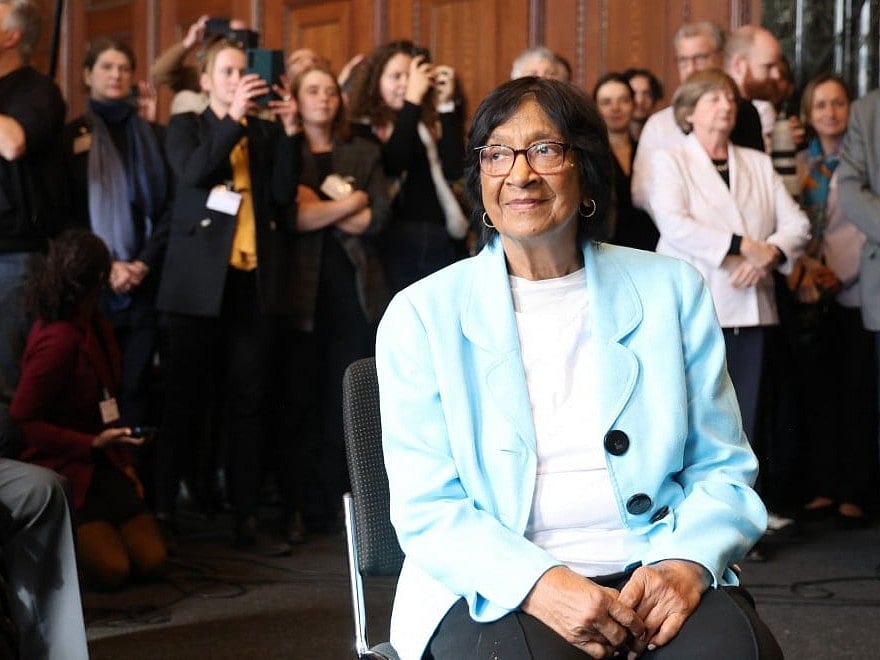
South African lawyer and champion of international law Navi Pillay is pictured after she was awarded the 2026 Nobel Peace Prize, on October 9, 2026 at the historic Courtroom 600 of Nuremberg's Palace of Justice, venue of the 1945-1946 Nuremberg Trials against leaders of defeated Nazi Germany, in Nuremberg, southern Germany, where she was attending the Nuremberg Forum 2026 conference of the International Nuremberg Principles Academy.
AFP
Before Navanethem “Navi” Pillay became one of the world’s most prominent human rights jurists, she was a young girl growing up in a poor Indian neighbourhood of Durban, South Africa, where racial discrimination shaped almost every aspect of daily life.
The daughter of a bus driver, she would go on to challenge the apartheid system, defend political prisoners, become South Africa’s first non-white woman High Court judge and help establish legal precedents that changed how the world prosecutes genocide and sexual violence.
On Friday, that extraordinary journey culminated in the 2026 Nobel Peace Prize, awarded to the 85-year-old for her lifelong contribution to international justice.
The Norwegian Nobel Committee praised Pillay for helping strengthen international law and ensuring that perpetrators of war crimes, crimes against humanity and genocide could be held accountable.
Childhood under apartheid
Born on September 23, 1941, in Durban, Pillay grew up in a family of Indian Tamil origin at a time when South Africa’s apartheid system enforced racial segregation and denied the country’s non-white population basic rights.
Her family had limited financial means, but education offered a path forward.
According to a profile published by Harvard Law School, Pillay was raised in a poor Indian community in Durban and later became the first South African to earn a Doctor of Juridical Science degree from Harvard.
She studied at the University of Natal, graduating with a Bachelor of Arts in 1963 and a law degree in 1965.
She later obtained a master’s degree in law from Harvard in 1982 and a doctorate in 1988, according to South African History Online.
Taking on apartheid
In 1967, Pillay became the first woman to establish a law practice in South Africa’s Natal province.
It was a remarkable achievement in a country where racial and gender discrimination severely restricted professional opportunities.
She represented anti-apartheid activists, trade unionists and political prisoners, challenging the legal machinery that sustained white minority rule.
Among those whose rights she defended were prisoners held on Robben Island, including Nelson Mandela, according to the Associated Press.
Her legal work helped establish protections for political detainees, including safeguards against solitary confinement and recognition of prisoners’ rights to due process.
According to the Gruber Foundation, which later honoured her human rights work, Pillay’s opposition to apartheid was so pronounced that authorities denied her a passport for many years.
Harvard Law School recalled that during her 28 years practising as a lawyer under apartheid, she was not permitted to enter a judge’s chambers because of racial restrictions.
Breaking barriers in South Africa
The end of apartheid opened another chapter in Pillay’s career.
In 1995, after South Africa’s transition to democracy, President Nelson Mandela appointed her to the country’s High Court, making her its first non-white woman judge.
The appointment represented a striking transformation for a lawyer who had spent decades challenging a legal system that discriminated against her.
But her judicial career in South Africa was brief. That same year, she was elected to serve on the United Nations International Criminal Tribunal for Rwanda, established to prosecute those responsible for the 1994 genocide.
Changing international law
Pillay spent eight years at the Rwanda tribunal, including four years as its president from 1999 to 2003.
Her work there became one of the defining achievements of her career.
She played a significant role in the landmark prosecution of Jean-Paul Akayesu, a former Rwandan local official, in which the tribunal established that rape and sexual violence could constitute acts of genocide.
The ruling helped transform international criminal law by recognising sexual violence as a weapon of genocide rather than merely an incidental consequence of armed conflict.
The tribunal also established important precedents concerning propaganda and incitement to genocide.
According to the Nobel Committee, Pillay’s contribution helped expand the legal tools available to prosecute atrocities and hold perpetrators accountable.
From Rwanda to the United Nations
In 2003, Pillay became a judge at the International Criminal Court, the permanent tribunal established to prosecute genocide, war crimes and crimes against humanity.
Five years later, she was appointed United Nations High Commissioner for Human Rights, serving from 2008 until 2014.
The position made her one of the world’s most prominent voices on human rights abuses.
Her responsibilities extended across conflicts and humanitarian crises, with the UN’s human rights office monitoring violations and pressing governments to uphold international standards.
Pillay consistently argued that governments and individuals must be held accountable under the law, regardless of their political influence or position.
Gaza investigation and controversy
In more recent years, Pillay attracted international attention as chair of the UN Independent International Commission of Inquiry on the Occupied Palestinian Territory and Israel.
The commission, established by the UN Human Rights Council in 2021, concluded in 2025 that Israel had committed genocide in Gaza.
Israel rejected the findings, accusing the commission of bias and denying allegations of genocide.
The commission also accused Hamas of war crimes and violations of international humanitarian law during its October 7, 2023, attacks on Israel, according to AP.
Pillay has rejected accusations of antisemitism, pointing to her history of working alongside Jewish lawyers in South Africa’s struggle against apartheid.
The Nobel Committee clarified on Friday that its decision to honour Pillay did not constitute a judgment on whether Israel had committed genocide. That question remains a matter for international judicial proceedings.
Still serving international justice
Even at 85, Pillay remains active in international law.
She serves as an ad hoc judge at the International Court of Justice in proceedings brought by Gambia against Myanmar over allegations of genocide against the Rohingya Muslim minority.
Her career has taken her from South Africa’s apartheid-era courtrooms to some of the world’s most consequential international tribunals.
Speaking after the Nobel announcement in Nuremberg, Germany, on Friday, Pillay appeared both moved and amused by the recognition.
According to AFP, she joked about sharing the prize with US President Donald Trump, who has repeatedly expressed his desire to win the Nobel Peace Prize.
- with inputs from AP and AFP

Alex has been on the frontline of global headlines for nearly 30 years. A Senior Associate Editor, he’s part newsroom veteran and part globe-trotting correspondent. His credentials? He was part of the select group of journalists who covered Pope Francis’ historic visit to the UAE - flying with the pontiff himself. With 27 years on the ground in the Middle East, Alex is one of the most trusted voices in the region when it comes to decoding politics and power plays. He breaks down global affairs into slick, 60-second news - his morning reels are practically a daily ritual for audiences across the UAE. Sharp. Grounded. Fast. Insightful. That’s Alex at his best, bringing a steady editorial hand to every story he tells.
Sign up for the Daily Briefing
Get the latest news and updates straight to your inbox
Network Links
GN StoreAbout Gulf NewsTerms & ConditionsReach by GNSitemapContact usPrivacy PolicyGN FocusHave your sayWork with usAdvertise with usGulf News epaperPrinting Services
Download our app
© Al Nisr Publishing LLC 2026. All rights reserved.