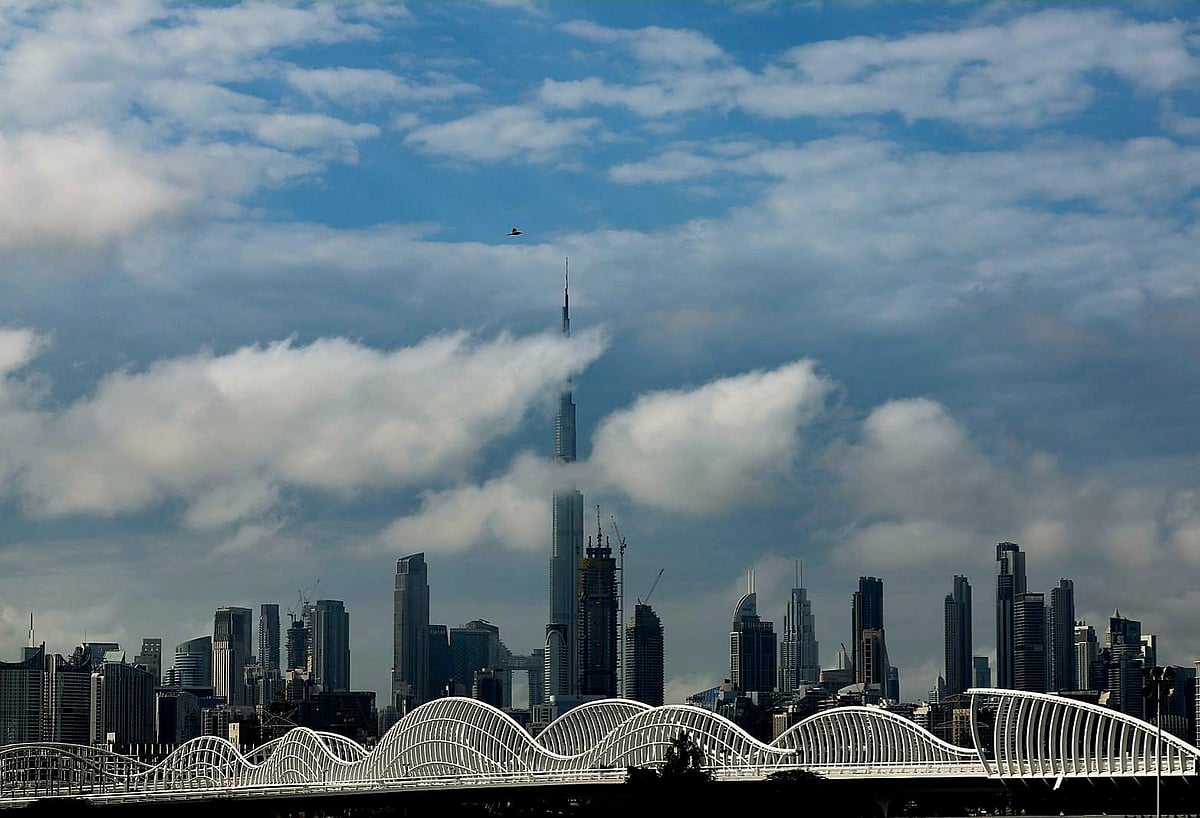
Dubai: Parts of the UAE woke up Thursday to a brief pause in precipitation. Roads were drying, skies lightening. It felt, briefly, like the deluge might be over.
It isn't. Not yet.
Thursday daytime is bringing some relief as the influence of the low-pressure system temporarily weakens, with rainfall during this window becoming more scattered, falling primarily over the islands and parts of the northern regions in intervals. But the National Center of Meteorology (NCM) has issued a formal weather alert for Abu Dhabi emirate – including Abu Dhabi city, Al Ain, and Al Dhafra - from Thursday night through to 4pm on Friday afternoon.
The peak of this final wave arrives tonight.
Heavy rain, strong winds and thunderstorms are forecast to peak Thursday night into Friday morning, with waterlogging possible across the UAE. After that, conditions are expected to ease from Friday night onward, with clearer skies arriving by Saturday, though cooler temperatures and northwesterly winds will follow in the days ahead.
Stay updated: Get the latest faster by downloading the Gulf News app - it's completely free. Click here for Apple or here for Android. You can also find it us on the Huawei AppGallery
What has actually happened this week?
This isn't a single storm. It’s a system that has moved across the country in waves since the weekend, hitting different areas at different times with varying intensities.
The NCM said the latest rain band began over western parts of the country before moving overnight towards Al Dhafra and Abu Dhabi, spreading by daytime to northern areas, Al Ain and eastern regions.
Monday, March 23 produced the most significant single-day readings of the weather event. Rainfall totals almost reached annual levels in parts of Abu Dhabi and Ajman, with gauges recording up to 93.3mm. To put that in context, the March 2026 peak of 93.3mm at Al Manama, while near-historic for March, is roughly a third of what Khatm Al Shakla received in a single day during the April 2024 event.
Why is the weather so different across the UAE?
This is the question most people have been asking all week. Someone in Fujairah is posting sunny skies on social media while someone else in Abu Dhabi is watching hail pummel their car. How?
The answer starts with understanding what a low-pressure system actually is and what it isn't.
The NCM said a surface low-pressure system, combined with an extension of an upper-air low-pressure trough, is driving the unsettled conditions, increasing cloud formation and the probability of convective rainfall over scattered areas.
The critical word there is scattered. A low-pressure system doesn't switch rain on uniformly across a map. It creates the atmospheric conditions, falling pressure, rising air, and cooling moisture that allow storms to form. But whether a storm actually develops in a specific spot depends on local factors: how much moisture is present at lower altitudes, how the terrain pushes air upward, and where wind patterns are converging.
NCM clarified that rainfall will not occur continuously in one area; it may stop for an hour or two and then start again with the arrival of new cloud masses.
These are convective storms, they build fast, release their energy, and move on. They don't blanket a region evenly. They form in pockets.
The geography factor
The UAE's shape and terrain make this patchwork effect even more pronounced.
The western and central regions; Abu Dhabi, Al Dhafra, Al Ain, sit on flat, open land. Moist air pushing in from the Arabian Gulf and Arabian Sea travels across this terrain without obstruction, allowing large storm cells to develop and linger. Dr. Ahmed Habib, a meteorologist at the NCM, noted that some areas may experience more intense rainfall due to their geographical structure, and urged people to avoid being in valleys and low-lying areas.
The eastern Emirates sit behind the Hajar Mountains. When moist air is forced upward by those mountains, it cools and can trigger rainfall on the windward side. On the other side, the leeward side, that same air descends and warms, which suppresses cloud formation. The result: one side of the mountains can be wet, the other dry, sometimes at the same moment.
Areas in between including parts of Dubai and the northern emirates, sit in a transitional zone. They may catch storms as the system passes through, or may experience only cloud cover and a few scattered drops.
Why some places just see clouds and others stay sunny
Cloud cover without rain happens when the atmosphere has enough moisture and instability at higher altitudes to build clouds, but conditions at lower levels aren't quite right to push that moisture all the way to the ground. The clouds form, the sky goes grey, and the rain either doesn't develop or evaporates before it lands, a phenomenon meteorologists call virga.
Areas at the outer edges of the system or positioned where local wind patterns redirect moisture elsewhere can remain largely unaffected. The system has a centre and outer bands. Not every point in the country sits in the active core at the same time.
What else to watch for tonight
An AccuWeather international forecaster warned of strong wind, isolated tornadoes and areas of flash flooding as possibilities through tonight. Tornadoes are rare in the UAE but not unheard of the same wind shear that drives severe thunderstorms can, in the right conditions, create rotation. A waterspout is just a tornado that occurs over water, so all that is needed is for the funnel cloud to develop over land instead. It remains an outside possibility, not a certainty.
What to expect now
Tonight is the one to watch. Strong winds up to 50kph could lift sand and dust, reducing visibility and creating dangerous driving conditions across affected areas. Authorities have advised the public to drive carefully, adhere to modified speed limits, avoid valleys, and prepare for reduced visibility. Sea conditions remain rough on both the Gulf and the Sea of Oman.
By Saturday, it should be over. The system will have moved east, the skies will clear, and temperatures will drop a few degrees before climbing again next week.
Until then check official updates before heading out. What the sky looks like from your window right now may not be what it looks like in an hour.
Sign up for the Daily Briefing
Get the latest news and updates straight to your inbox
Network Links
GN StoreDownload our app
© Al Nisr Publishing LLC 2026. All rights reserved.