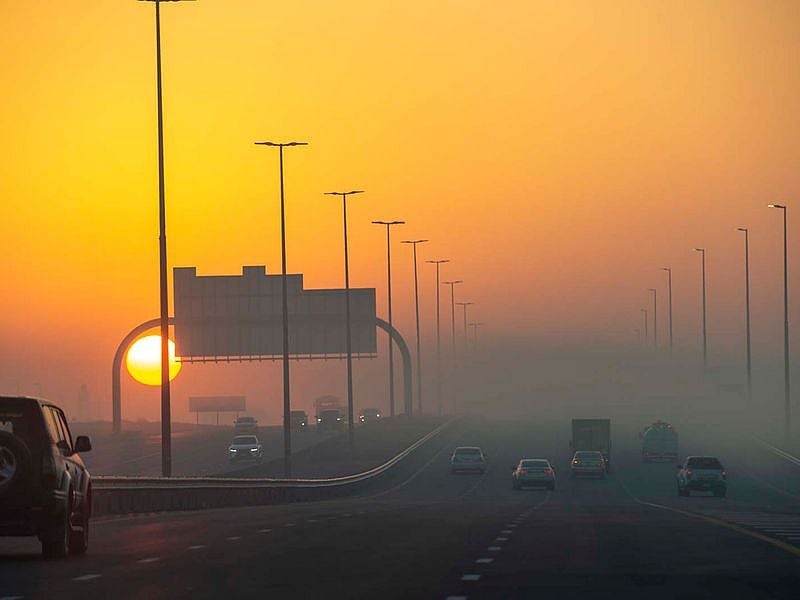
Beyond the fog at Mleiha desert in Sharjah
Dubai: Summer in the UAE is not completely over, but the weather is already shifting into the pattern that brings fog back to the roads. UAE's National Centre of Meteorology (NCM) issued a fog alert for September 2, 2026, from 1am to 8:30am, warning of reduced horizontal visibility in some coastal and internal areas.
According to the NCM, relative humidity is rising to around 90 per cent overnight in both coastal and inland areas as September opens, with a chance of fog or mist forming over some coastal and internal areas overnight and into the early morning. On Wednesday, September 2, the NCM forecasts fair to partly cloudy skies, convective clouds possible over eastern areas by afternoon, and daytime highs still in the low to mid 40s inland.
Get updated faster and for FREE: Download the Gulf News app now - simply click here.
Temperatures are easing only gradually. Moisture in the air is not. That mismatch, hot days followed by increasingly humid nights, is exactly what produces fog at this point in the calendar.
The science behind September fog
Fog forming in a desert climate can seem contradictory, but the mechanics are well understood. Warm, moisture laden air moves in from the Arabian Gulf and the Arabian Sea during the evening. After sunset, the desert surface loses its heat quickly through radiative cooling, and the air just above the ground cools along with it. Once that air becomes saturated, water vapour condenses into countless tiny droplets suspended near the surface. Meteorologists call this radiation fog, and it accounts for around 95 per cent of all fog recorded in the UAE.
Wind speed matters here. Research based on data from Abu Dhabi International Airport shows that a light breeze, roughly five knots, actually helps fog form and settle. Anything stronger tends to break it apart before it can thicken.
The other necessary ingredient is dust. Fine sand and dust particles suspended in the atmosphere act as condensation nuclei, giving water vapour something to cling to as it turns into droplets. Without that dust load, much of the country's fog simply would not form.
Emirati astronomer Ibrahim Al Jarwan, Chairman of the Emirates Astronomy Society, has linked the current spell to the seasonal calendar rather than to anything unusual. He noted that August and September typically bring high humidity levels as the peak summer season winds down.
That lines up with a much older tradition. The UAE entered what is known as Suhail season on August 24, a date tied to the star Canopus becoming visible before dawn and traditionally associated across the Arabian Peninsula with the slow retreat of summer heat. The shift is gradual rather than immediate. Temperatures stay elevated, but humidity becomes more noticeable, and early morning fog and dew grow more frequent in the weeks that follow.
Why humidity is the deciding factor
Every NCM bulletin during fog season leans heavily on one figure: relative humidity. That is not incidental. Humidity, and specifically how close the air temperature sits to the dew point, is what actually decides whether a given night produces fog.
Dew point is the temperature at which air becomes fully saturated with moisture. When the overnight air temperature drops down to meet the dew point, water vapour begins condensing into droplets. The narrower that gap, the more likely fog becomes.
In early September, the Arabian Gulf is still carrying the heat of a full summer, so evaporation keeps pumping moisture into the lower atmosphere. Sea breezes carry that humid air inland through the day. Once night falls and winds turn calm, the desert floor sheds its heat rapidly and the air temperature slides toward a dew point that is already sitting high. When the two meet, fog forms.
This is why a forecast reading of 90 per cent humidity functions as an informal fog warning, even on a day when the thermometer is still touching 45 degrees.
Where fog is most likely to form
Fog does not spread evenly across the UAE. It tends to concentrate in specific pockets, largely dictated by geography.
Researchers at Khalifa University's Environmental and Geophysical Sciences Lab have identified the Sweihan desert and the areas southwest of Abu Dhabi as two of the country's primary fog formation zones, a result of how quickly open desert surfaces lose heat overnight. Fog typically builds first in these areas before expanding outward.
Historical NCM records show that in one such event, fog extended across Sweihan in Al Ain, Al Fayah in Abu Dhabi, Madinat Zayed, Ghayathi and Liwa in the Al Dhafra region, along the Abu Dhabi to Al Ain and Al Ain to Dubai roads, at Al Maktoum International Airport, on the Ghantoot road, and across Jebel Ali, Al Minhad and Saih Al Salam in Dubai, as well as the Mleiha road, Sheikh Mohamed bin Zayed Road and Emirates Road in Sharjah.
Al Dhafra in particular appears repeatedly in NCM alerts, with fog reported forming across its coastal and western stretches on multiple occasions, prompting red and yellow warnings.
For commuters, the practical picture is this: the open desert corridors linking Abu Dhabi, Al Ain and Dubai, along with the towns of Al Dhafra and the low lying inter emirate highways, carry the greatest risk of dense fog. Coastal city areas including parts of Dubai and Sharjah are not immune, as several mornings this year have shown, but it is the desert stretches where visibility tends to fall fastest and stay down longest.
How authorities respond when visibility drops
The response from UAE authorities is fast and, in parts, automated. The NCM's own alert system uses a colour coded scale. A yellow alert calls for awareness and careful driving, orange signals a need for higher preparedness, and red marks conditions of extreme danger. These alerts are also pushed directly to residents' phones through the national early warning system, which is run in coordination with the National Emergency Crisis and Disaster Management Authority.
Traffic authorities across the emirates mirror this response. During dense fog mornings, Abu Dhabi Police, Dubai Police, Dubai's Roads and Transport Authority, and Sharjah Police issue public advisories, urging drivers to expect delays, switch on headlights, and avoid sudden lane changes in low visibility.
The NCM's guidance for driving in thick fog
The National Centre of Meteorology maintains a standing set of safety messages for periods of thick fog, published on its website. The core guidance includes the following.
Stay alert to changing conditions by following official weather bulletins and licensed media rather than relying on habit or memory of a familiar route. Exercise the utmost care while driving in areas of poor visibility, and follow any instructions issued for fog affected roads in the early morning. If conditions make driving impossible, it is best to stop the vehicle off the road, clear of moving traffic, rather than attempting to continue.
Leave a generous gap between your vehicle and the one ahead. Reduce speed on entering a foggy stretch, and avoid overtaking the vehicle in front unless it is genuinely necessary. Keep out of the leftmost lane, which is designated for traffic moving at the posted speed limit. If you must stop, do not do so on the shoulder of the road, but move to a genuinely safe location away from traffic and activate your hazard lights there. Reserve hazard lights for emergencies and otherwise rely on low beam headlights.
Concentrate solely on the road ahead, and use ground markings as a guide through reduced visibility. Do not accelerate back to normal speed the moment fog appears to clear, since conditions can return without warning. Parents are advised to delay outdoor trips with children during periods of bad weather, and drivers are reminded to stay informed of local conditions and avoid using their phones altogether while driving through fog.
What the rest of September is likely to bring
Forecasts through late August and into the first days of September have followed a consistent structure: hot, largely fair days with convective cloud building over eastern and southern areas by afternoon and an occasional chance of rain, followed by rising humidity after dark and a renewed chance of fog or mist forming somewhere along the coast or inland before sunrise.
The NCM expects temperatures to ease gradually as the month progresses, but that is precisely the condition under which fog tends to increase rather than fade. Cooler nights settling over ground still holding the moisture of a full summer close the gap to the dew point more quickly, not less.
For anyone regularly using the Abu Dhabi to Dubai or Abu Dhabi to Al Ain routes, the sensible habit for the coming weeks is straightforward. Check the NCM's forecast before setting out early, and build a little extra time into any journey that begins before 9am.
Sign up for the Daily Briefing
Get the latest news and updates straight to your inbox
Network Links
GN StoreAbout Gulf NewsTerms & ConditionsReach by GNSitemapContact usPrivacy PolicyGN FocusHave your sayWork with usAdvertise with usGulf News epaperPrinting Services
Download our app
© Al Nisr Publishing LLC 2026. All rights reserved.