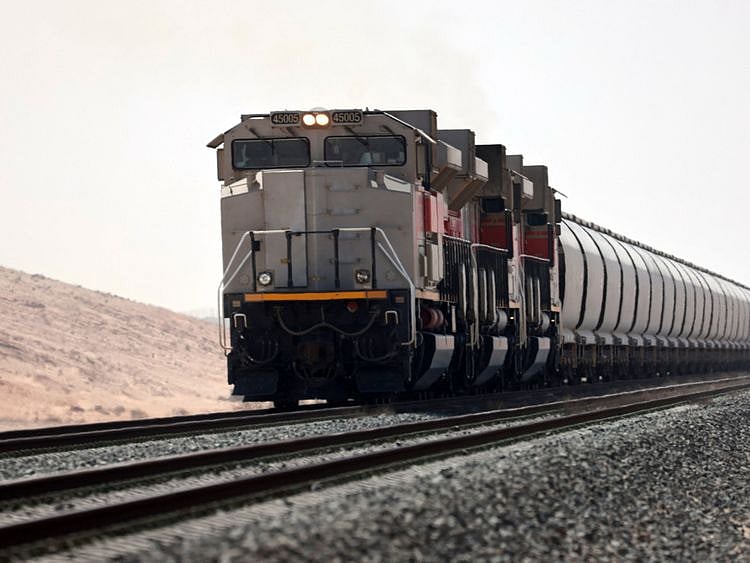
Abu Dhabi: Etihad Rail on Monday launched a national awareness campaign encouraging logistics providers, manufacturers and heavy industries to move long-haul freight from road to rail, as growing industrial activity puts added strain on the UAE’s road networks.
The campaign comes at a time when the country’s logistics and manufacturing sectors are expanding rapidly, increasing pressure on delivery timelines, operating costs and transport reliability. Etihad Rail says rail freight is not a future concept but a working solution already supporting businesses across the UAE.
A network built for scale
Etihad Rail’s freight network stretches nearly 900 kilometres, linking key ports, industrial areas and logistics hubs. Designed for bulk and high-volume cargo, the system operates on fixed schedules along dedicated rail corridors, offering a level of predictability that is increasingly difficult to maintain on busy highways.
Each freight train can carry the equivalent of up to 300 heavy trucks, reducing traffic on major routes while helping manufacturers stick to tight production schedules.
“For heavy industry, logistics is no longer just about speed — it’s about certainty,” said Omar Alsebeyi, Acting CEO of Etihad Rail Freight. “Congestion, delays and cost swings have real consequences. Rail addresses these issues by offering reliable, large-scale transport every day.”
Supporting, not replacing, road transport
Etihad Rail stressed that the campaign is not aimed at replacing road freight but at creating a better balance between road and rail.
“Road transport remains essential, especially for last-mile delivery,” Alsebeyi said. “Rail removes long-haul and bulk movements from the roads, easing congestion and allowing trucks to focus on where they are most effective.”
The company says rail freight helps businesses stabilise transport costs, reduce the need for large inventory buffers and plan production with greater confidence — benefits that grow as shipment volumes increase.
Industry engagement and long-term vision
The campaign will run across trade publications, industry events and digital platforms, supported by real-world case studies. These examples highlight how rail freight is already improving efficiency in sectors such as construction materials, petrochemicals, metals and containerised cargo.
Etihad Rail said the initiative also aligns with national efforts to strengthen supply chains, boost industrial competitiveness and prepare the logistics sector for rising trade volumes.
“The UAE has built a rail network to support growth for decades,” Alsebeyi said. “Rail freight is ready, reliable and scalable. The opportunity now is for industry to fully benefit from it.”
As industrial output continues to rise, Etihad Rail believes companies that adopt rail freight early will gain long-term advantages through lower costs, improved reliability and reduced pressure on the country’s road network.
Network Links
GN StoreDownload our app
© Al Nisr Publishing LLC 2026. All rights reserved.