Muhammed Sajjad KP, known as UAE weatherman, wearing his raincoat with his storm chaser logo.
How the UAE Weatherman predicts rain hours before it reaches the UAE
He says radar shows where rain has been, while clouds reveal where it is about to begin
Last updated:
6 MIN READ
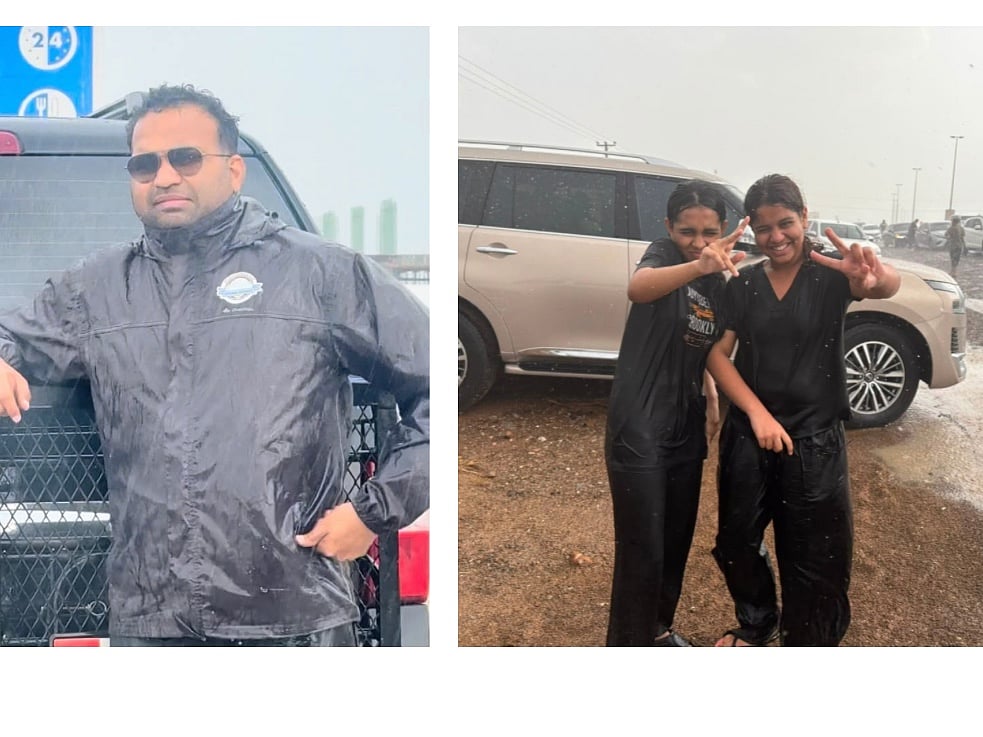
Tuesday drew over a hundred people. Whole families, in from across the emirates on the strength of coordinates posted hours earlier by Mohammad Sajjad (left) to chase rain across UAE.
Dubai: The most useful thing Muhammed Sajjad KP, known as UAE weatherman, will tell you about chasing rain in the UAE is that the rain radar isn't live updates.
"If you see this radar on the application, and then drive towards those spots, you'll not get rain as we wish," he says, "because these radars are updating after five to fifteen minutes."
The problem is time. Rain falls, the radar detects it, the system updates, the app refreshes. By then you are twenty minutes away, and by the time you arrive the shower is finished and the road is drying.
"You can't see the rain, actually," he says. "So we always chase the clouds, not rain."
That distinction is his whole method. I spent Tuesday with him chasing rain across UAE finding out how he does it in practice.
Monitoring the weather
Two things, running in parallel.
The first is satellite imagery from the European Centre for Medium-Range Weather Forecasts, which shows him the last three hours of atmospheric development. Not where rain is, but where the atmosphere is organising itself into something that might produce it.
He narrows down areas where clouds will form and chases the cloud formation.
Forecast by Muhammed Sajjad: Tuesday 4-Aug-2026, 12.35 PM
Very good chances of rain with strong downdraft winds, blowing dust, thunder, lightning, small hail, and stormy conditions across the western, southern, central, and eastern Emirates (marked in red) Rain may extend to all cities marked in green.
The second is NCM's own data and the rain.ae feed, which he uses as he drives as confirmation rather than direction.
"So we always chase the clouds," he repeats. "We wait for the clouds to develop, then we wait for that."
"The government radar is just for showing how much rain is falling, or how much rain there will be in that area, for people who drive, not like us. Maybe they go to mountain areas, so they can see the radar and understand there is some chance of flash flooding."
How it rains in the UAE
Everything starts with two kinds of wind.
"There is wind coming from the Arabian Gulf, that is Abu Dhabi to Ras Al Khaimah," he explains. "And there is the Oman Sea, like Fujairah and Dibba. From these two seas, there is wind coming in the afternoon. It's called naseem al bahar in Arabic. The sea breeze comes, it's very humid."
Both arrive carrying moisture. Somewhere over the interior they meet.
"These two winds bring humidity from the sea and collide, one from the Arabian Gulf, another from the Oman Sea. Wherever they collide, the cloud develops."
That is the target. Not a rain cell on a screen, but the line where two breezes are about to run into each other.
Collision alone is not enough, though, and this is where his forecasting gets genuinely technical. Pressure has to be low, because under high pressure nothing forms. Temperature has to cooperate through every layer of the atmosphere, not just at ground level, because cumulonimbus builds in the upper layers and needs humidity up there to keep climbing.
"When forecasting the weather, we have to check everything," he says. "Then only will the forecast be successful."
How far ahead he can see
It depends entirely on the system.
"This is up to Sunday," he told me, showing a forecast running seven days out. "Because the system is very powerful, we can forecast like this. If the system is weakened, we can't even forecast the next day."
That variability explains why his followers sometimes get a week's warning and sometimes a few hours.
Hameed Ali and his wife, Aneesa Hameed and children, who have been chasing rain with Sajjad for five years.
How we chased rain on Tuesday
He had asked to meet me at the meet-up point near Sharjah Mosque somewhere on Maliha road. When I got there and the sky was clear I was starting to get skeptical, will we or won't we, see rain today.
Then he told me we are going to head to Manama, near Fujairah, then moved to Mleiha in Sharjah. I didn't know we would be heading somewhere that far but with a 100 per cent track record of his rain chase escapades I didn't question and trusted the expert.
Our convoy went from Sharjah to Fujairah, Manama, where we drove Sajjad kept a sharp eye on the clouds and monitored the radar and rain.ae to ensure we were on the right track.
As we got closer and the sky started to darken, I felt the excitement in the air along with us as the wind picked up and before I knew it, we saw the first rain drops land on our car as we headed to our location.
When droplets started to fall, I asked him, "Are we not going to stop for the rain?"
"This rain? This is nothing for us, we are heading to the heavy storm spot right ahead," Sajjad laughed had as he responded. And soon we had reached our spot and as he said the storm was strong enough to blow me away.
After it passed, we hopped into our cars to hit the next spot as Sajjad looked up towards the clouds again.
It wasn't so far off, and we stopped at a spot near Manama where we got to witness sun showers.
Shawka, another spot which was getting storms, we never reached, as there was traffic. That was the reason Shawka was out of our reach.
"This always happens," Sajjad said. "We sometimes miss the showers due to traffic, because these areas have one-way roads, and to get to the wadis we sometimes get stuck. So we have to choose our next best spot."
For all the satellite modelling and layer-by-layer atmospheric analysis, the limiting factor on a given afternoon can be a single-lane road with a queue on it.
Residents enjoying heavy rain on Tuesday near Manama, Fujairah.
He is known as the cloud-whisperer
There is a reason why he no longer shares his live location openly.
He did once, and more than 400 people arrived, and it became impossible to manage safely.
Even now, with a day's notice and a more selective approach, Tuesday drew over a hundred people. Whole families, in from across the emirates on the strength of coordinates posted hours earlier. He is, in this particular crowd, a celebrity. People queued to have their photographs taken with him.
Muhammed Sajjad KP (wearing sunglasses in the middle), with residents who came to chase rain on Tuesday.
Where the moisture comes from
None of this water is local, and the source is further away than most people assume.
"These clouds develop due to the monsoon, which originally starts from Madagascar," he says. "The southwest monsoon forms here, and it will travel through Somalia and reach Salalah. Salalah is also getting rain. It's like Kerala, the same weather in Salalah. Always rain and greenish because of this monsoon."
One arm continues to Kerala, Lakshadweep and Sri Lanka. The rest of that moisture sits over the Arabian Sea, close enough for the sea breezes to carry inland.
How he became UAE weatherman
He arrived from Kerala in August 2015, straight out of three days of unbroken monsoon rain and into 50C.
"I couldn't adjust," he says. He asked around about when it might rain here and was told to wait until November or December. Six months.
So he went looking. NCM's website gave him satellite imagery. A radar app gave him a map. And the radar app, repeatedly, gave him wet roads and no rain.
"When I reached, I could see some drops on the road, that's it," he says. "The radar detects and updates after five to fifteen minutes. So I'm reaching after twenty, twenty-five minutes."
The frustration is what turned him into a forecaster. "Then I started to think about how these clouds are developing," he says. "I started to learn forecasting, how weather forecasting works. Everything I learned on the internet."
He began posting as Kerala Rain Forecaster around 2016, in Malayalam, and lost non-Malayali followers because of the language. UAE Weatherman, in English, followed in February 2022. He now has close to 300,000 followers across platforms. He also was awarded Golden Visa for his work.
"Then I started to chase rain with my own forecast," he says. "My forecast rain, my forecast clouds, and I drive to the spot where the clouds will start to form. I go to the empty area, and the clouds start there. Then the rain starts. So I always get the first drop."
Sign up for the Daily Briefing
Get the latest news and updates straight to your inbox
Network Links
GN StoreAbout Gulf NewsTerms & ConditionsReach by GNSitemapContact usPrivacy PolicyGN FocusHave your sayWork with usAdvertise with usGulf News epaperPrinting Services
Download our app
© Al Nisr Publishing LLC 2026. All rights reserved.