Heaven is a place on earth
Drive about 185 kilometres from Dubai to find yourself in the lap of an uninhibited nature reserve, complete with waterfalls, strange species and a different kind of night life
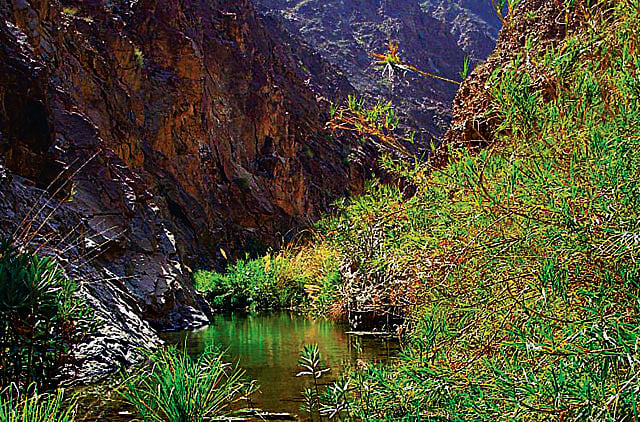
Silent, serene and full of mysteries: that’s how I imagined Wadi Wurayah.
The 129-square kilometre catchment area tucked away in the Hajjar Mountains near Fujairah was recently named a wetland of international importance, under the Ramsar Convention, the international treaty for the conservation of wetlands. It is the UAE’s first protected mountain area, so identified for its precious biodiversity, its archaeological significance and historical value.
The area is home to more than 100 species of mammals, birds, reptiles and amphibians, as well as more than 300 species of plants. It is also one of the few remaining places in the world where the endangered Arabian tahr still roams free.
I am well informed by Dr Christophe Tourenq, the Senior Conservation Manager at Emirates Wildlife Society (EWS), a non-profit environmental organisation that has been working with the World Wildlife Fund (WWF) since its establishment in 2001.
Further, another 55 new fauna species were discovered here this summer, of which 25 are believed to be new to modern science. So it was in eager anticipation that I drove 185 kilometres from Dubai to see this geological wonder first-hand. It is located in the eastern agricultural region, between the Masafi Mountains and the Gulf of Oman, it is home to the UAE’s only year-round waterfalls and is reportedly a great spot for swimming.
But all those promises of 300 water streams merging into a massive river, six hours of trekking to see the actual waterfall and a possible encounter with an Arabian fox had to be put aside due to the uninviting weather conditions.
There had been scanty showers in the eastern emirates and the meteorological department predicted rain over the weekend of our visit, too. I was warned that visiting the depths of the Wadi with rain clouds looming on the horizon would probably not be a wise idea. So we looked upon it from the outskirts.
The route to the Wadi by itself was colourful enough. Lazy dunes dotted with specks of green laced the Sharjah-Dhaid-Fujairah highway, a bustling Friday market greeted us at the Masafi junction and we followed the road through Fujairah and made our way towards Khor Fakkan. The Wadi lies onwards near Dibba. Everything is clearly signposted.
A right turn off the first roundabout a few kilometres into Dibba led into the picturesque Hajjar Mountains. The evening was cool and it was just an hour before sunset. We drove past a tall, white boundary wall as the mountains played hide and seek with the dusky sun. The sky was painted a beautiful orange-pink. As we crossed the last phone booth on the trail, the road curved to an immediate right, and up ahead was the viewing site.
There was no path there on, the place was fenced off. Many four wheel drives and some adventurous saloon cars stood at the helm of the peak. Visitors got down from the vehicles to see the place. It was majestic — a tasteful end to a committed trail. From the height we could see adventure mongers driving inside the Wadi, but this was not a safe thing to do considering the bad weather. Even a slight drizzle three kilometres away at the Masafi town could result in flash floods inside the Wadi, I was told.
We took pictures and allowed ourselves some time with nature. No concrete jungle, no disturbance of ringing phones — just the sound of silence. It’s little wonder the place is so popular with campers.
It begins to get dark so we climb into the car. There is so much that I have left unseen — I could have trekked deep inside the wilderness to find the rare fauna. Due to its perennial supply of fresh water, the Wadi is the only such habitat and ecosystem in the region. Less impacted by human intervention, it remains home to many nocturnal creatures. Work is in progress always as archaeologists and environmentalists from EWS-WWF maintain and monitor the rare inhabitants of this place. They study them by following their trails and by referring to the data collected from camera traps set up inside the Wadi. These motion-detecting cameras capture images of the creatures of the night and understand their migratory patterns.
My next trip will be towards the end of the year when the weather is cooler and the shy inhabitants of the Wadi will stay outdoors for longer. I might make a very early start or may even camp out by the river bed. But for now I bid the Wadi adieu and promise myself to come back again and explore!
— With inputs from Gulf News staff
Sign up for the Daily Briefing
Get the latest news and updates straight to your inbox
Network Links
GN StoreDownload our app
© Al Nisr Publishing LLC 2026. All rights reserved.