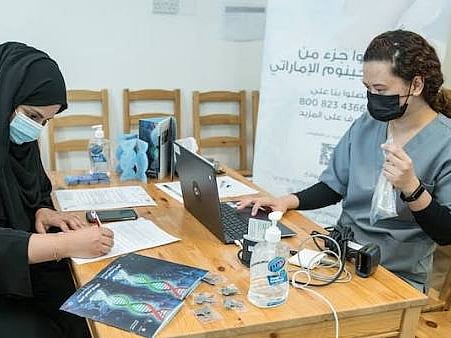
The UAE Genome Programme now has one million participants. The milestone marks a transition from collecting and analysing samples to translating genomic insights into clinical practice and advanced scientific research.
During 2025, the programme helped make a life-changing difference to more than 100 children by identifying health conditions at an early stage and enabling timely medical intervention.
Building on the achievement, the Emirates Genome Council approved its National Strategy for 2026–2031 in November 2026, with the aim of extending access to the programme to 100 per cent of UAE citizens.
Get updated faster and for FREE: Download the Gulf News app now - simply click here.
Genomic science is opening new horizons for the healthcare sector, enabling a deeper understanding of human genetic characteristics, inherited predispositions to certain diseases, and variations in individual responses to treatments. These advances are strengthening preventive screening, supporting early diagnosis and paving the way for more personalised therapies tailored to each individual.
Personalised genomic reports accessible through TAMM
As part of this strategy, approved by the Emirates Genome Council on November 10, 2026, the National Plan for 2026–2031 aims to extend the programme’s reach to 100 per cent of Emirati citizens.
Its initial objectives include making personalised genomic reports available to approximately 900,000 participants whose clinical data reviews are scheduled to be completed by December 2026, through the TAMM platform.
The plan also provides for the nationwide introduction of genetic screening for newborns, the development of a trusted research environment, the establishment of national prevention, diagnosis and treatment programmes, the updating of regulatory and legislative frameworks, and the development of national expertise alongside the attraction of international talent.
The personalised genomic reports contain detailed information on 214 inherited genomic conditions and health traits, supported by guidance to help participants understand their findings, their implications and any genetic predispositions that may require additional medical attention.
This information enables individuals and healthcare professionals to make better-informed decisions about preventive screening and determine appropriate medical follow-up based on each participant’s clinical assessment and medical history.
The programme emphasises that genomic findings do not constitute independent medical diagnoses. Rather, they provide indicative information that doctors can use to determine whether appropriate confirmatory tests are required.
Screening identifies more than 815 treatable genetic conditions in children
The application of genomic science extends to the earliest stages of life, with a nationwide newborn genetic screening programme scheduled to be introduced from June 2027.
The initiative aims to identify treatable genetic disorders at an early stage, enabling medical intervention during the first weeks of a child’s life.
The national programme builds on an initiative launched by Abu Dhabi in 2025 in collaboration with M42 Group. It uses whole-genome sequencing to screen for more than 815 treatable genetic conditions in children, making it one of the most comprehensive newborn genetic screening programmes worldwide.
During the past year, the initiative made a life-changing difference to more than 100 children by detecting health conditions early and ensuring timely medical intervention.
Samples are collected through a simple cheek swab from inside the child’s mouth, following consent from a parent or legal guardian. Strict safeguards are in place to protect genomic data, while participants will gain access to their personal accounts and information once they turn 18.
Comprehensive framework safeguards privacy and data security
The expanding use of genomic data is accompanied by a comprehensive framework designed to safeguard privacy and ensure secure data handling.
All data is managed in accordance with UAE legislation governing the protection of personal and health information. Its use is strictly limited to healthcare and scientific research purposes. The programme does not conduct tests relating to ancestry, family lineage or ethnic background.
Implemented in technical partnership with M42 Group, the programme’s data is stored within the Trusted Research Environment under the UAE’s sovereign cloud infrastructure, in a secure technological environment isolated from external networks.
The Trusted Research Environment enables approved research institutions and companies to access de-identified data for analysis and scientific studies, subject to strict controls designed to prevent the identification of participants.
Research findings can only be exported after completing the prescribed review and verification procedures.
AI-powered genomic guidance using an independent GPT model
To help participants better understand and benefit from their genomic reports, the programme uses artificial intelligence through an interactive conversational feature powered by a sovereign, pre-trained version of the GPT model.
The model complies with the standards of the Department of Health – Abu Dhabi and is hosted by Core42 through its Compass API.
The feature enables participants to ask questions in a straightforward language about their genetic traits and genomic findings and receive explanatory answers based on an approved knowledge base and trusted medical content.
The AI model does not directly analyse genomic data. Instead, it interprets participants’ questions, identifies the relevant traits listed in their reports, and matches them against the approved knowledge base to formulate its responses.
Participants’ personal data, genomic reports and conversations are not used to train or improve the AI model.
Research programme brings together two billion clinical records and 950,000 whole-genome sequences
On the scientific research front, the programme is strengthening the integration of genomic information with healthcare records.
On October 21, 2026, the Department of Health – Abu Dhabi launched the Trusted Research Environment, which brings together approximately 950,000 whole-genome sequences, more than two billion clinical records and insurance claims, and 14.5 million unified clinical records.
The platform enables approved research institutions to investigate the links between genetic characteristics and health conditions.
Plans are also in place to expand its data sources in the future to include information from the Abu Dhabi Biobank, medical imaging and wearable devices. This will further support the application of artificial intelligence in scientific discoveries and strengthen research collaboration at both local and international levels.
The practical value of this data is particularly evident in precision medicine applications. These include assessing genetic predispositions to certain types of cancer and identifying population groups that may benefit from early screening.
Another important application is pharmacogenomics, which helps doctors select the most appropriate medicines and dosages for individual patients based on their genetic make-up. This can improve treatment effectiveness while reducing the risk of potential adverse reactions.
Building healthcare readiness to translate genomic insights into clinical practice
Translating these advances into routine medical practice requires further strengthening the readiness of the healthcare system.
This includes developing referral pathways, ensuring the availability of confirmatory testing, upgrading laboratory capabilities and equipping medical professionals with the necessary expertise.
It also involves training family physicians to read and interpret genomic reports, explain their implications to patients and incorporate the findings into comprehensive clinical assessments.
The significance of the UAE Genome Programme lies not merely in the scale of its database, but also in its potential to deliver a lasting improvement in healthcare quality.
In the short term, personalised genomic reports can support preventive healthcare decisions and more precise medical follow-up.
Over the longer term, their impact will be measured over five to ten years and beyond through improvements in early diagnosis, reductions in preventable complications, better quality of life and a lower operational and financial burden on the healthcare system.
Ultimately, the UAE Genome Programme represents a major step towards a more proactive, predictive and personalised healthcare model, in which scientific innovation and genomic intelligence help doctors move beyond treating illnesses to identifying risks, preventing disease and improving health outcomes throughout people’s lives.

Sign up for the Daily Briefing
Get the latest news and updates straight to your inbox
Network Links
GN StoreDownload our app
© Al Nisr Publishing LLC 2026. All rights reserved.