The class of 2026 doctor of veterinary medicine students
How UAE vets could help protect public health, food security, and animal welfare
Demand grows for specialists across livestock, pets, wildlife, and public health
Last updated:
5 MIN READ
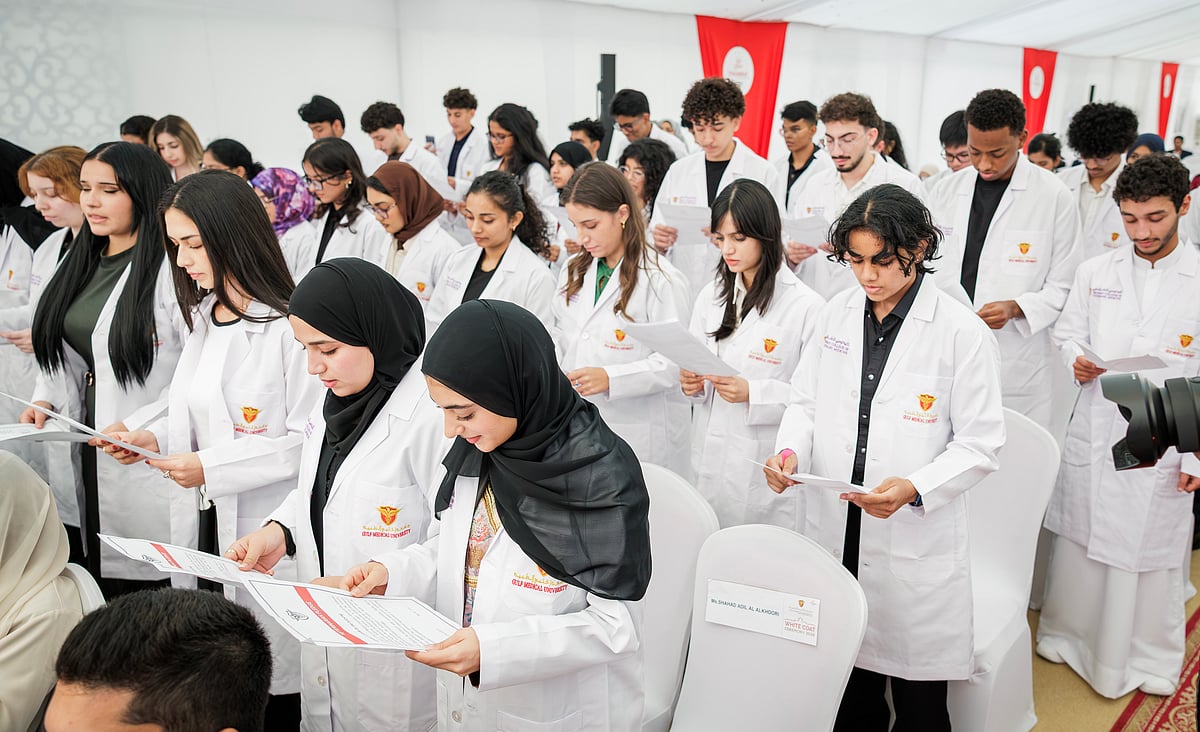
The white coat ceremony ran across morning and midday sessions at Thumbay grounds in Ajman on September 23
Supplied
Dubai: When most people think of veterinarians, they may picture a clinic, a sick pet, or a farm animal needing treatment. But veterinary medicine moves beyond the examination room. In the UAE, a new generation of locally trained vets is being prepared to work across animal health, food safety, disease surveillance, wildlife conservation, and public health.
The first step came on September 23, when Gulf Medical University (GMU) held its white coat ceremony at Thumbay grounds in Ajman and, for the first time, cloaked a class of future veterinarians.
The class of 2026 doctor of veterinary medicine students are the inaugural batch of Thumbay College of Veterinary Medicine, GMU’s seventh college.
For professor Mohammad Khalifeh, dean of Thumbay College of Veterinary Medicine, the significance of the programme goes beyond producing more clinicians.
“Most new infectious diseases in people start in animals. So the first person to see an outbreak coming is often a vet, not a doctor,” Khalifeh told Gulf News.
Get updated faster and for FREE: Download the Gulf News app now - simply click here.
The first line of warning
Veterinarians can be among the first professionals to notice changes in animal health that may signal a wider disease threat. Local training gives vets an understanding of the animals, farms, markets, and environmental conditions specific to the UAE.
“They know what a sick camel looks like before it becomes a public health story. Training locally also builds the network,” shared Khalifeh.
The programme aims to strengthen cooperation between different health professions. Veterinary students learn on the same campus as future doctors, pharmacists, and laboratory scientists.
“When they graduate, they already know who to call. That’s what preparedness really looks like, people who recognise a warning sign early and trust each other enough to act on it fast.”
The approach has reflected the World Health Organisaton’s “One Health” model, which recognises the links between human, animal, and environmental health.
Professor Mohammad Khalifeh, dean of Thumbay College of Veterinary Medicine
Protecting people by protecting animals
Veterinary care has a direct impact on the wider community.
“A well-trained vet does more than treat. They teach owners, advise farmers, and spot neglect or disease before it spreads. Every one of those conversations raises the standard of care around them,” described Khalifeh.
Measures such as vaccination, parasite prevention, responsible breeding, and humane handling can help protect both animals and the people around them.
“Welfare and safety go together. A vaccinated, healthy, properly handled animal is safer for the family that owns it and for everyone nearby.”
Rabies control is one example where animal health and human health are closely linked. Other preventive measures can reduce disease risks and improve the overall standard of animal care.
“When we train vets to high standards, we're really training thousands of better decisions across the community.”
From farms to the food chain
The veterinary profession also has an important role in food security. Veterinarians inspect meat and dairy products, help maintain livestock health, and monitor diseases that can affect food-producing animals.
“They monitor antibiotic use on farms, which matters enormously because resistance that starts in animals ends up in hospitals,” explained Khalifeh.
In addition, veterinarians can work in disease surveillance, laboratories, border control, wildlife conservation, and research.
For the UAE, this broad role has been relevant given the country's deep ties to camels, falcons, and horses, alongside livestock production, a growing pet sector, and wildlife conservation.
The new programme has therefore been designed to prepare students for more than companion-animal practice.
Filling gaps in animal welfare
The five-year doctor of veterinary medicine programme comprises 170 credits and includes 1,980 hours of clinical contact. Its final-year rotations cover companion animal, production animal, equine and camel, and diagnostic and public health practice.
The aim is to expose students to the range of animals and professional settings they may encounter in the UAE. That regional focus has been central to building a veterinary workforce that can meet local needs.
“The UAE has a big heart for animals and a lot of committed rescue groups. What's often missing is capacity, enough vets, enough specialists, and enough people who stay and build careers here,” exclaimed Khalifeh.
He has identified shelter medicine, rehabilitation, behaviour, and care for exotic and wildlife species as areas where demand is ahead of the available talent.
The programme is already bringing animal physiotherapy into its curriculum, while Thumbay Veterinary Hospital has been planned to open next year as a teaching hospital.
Khalifeh has expressed hope that the new generation will view animal welfare and rescue medicine as professional areas of veterinary practice.
“I want our graduates to see rescue and welfare work as a real speciality, not charity on the side. If they carry that mindset into practice, the animals with the least will get some of the best care in the region.”
A first step for a home-grown workforce
The first veterinary cohort has represented an early step in developing a locally trained workforce for a sector that touches animal welfare, public health, and food security.
The veterinary white coats have been presented by Dr. Kaltham Ali Kayaf, director of animal health and development at the Ministry of Climate Change and Environment. Shahad Adil Al Alkhoori and Mohamed Rashid Almehrzi have received the white coat on behalf of the class.
“Walking up to receive the white coat for my whole class was a moment I'll carry for the rest of my life. We're the first. There's no one ahead of us to copy, so every standard we set becomes the tradition for those who follow. I've loved animals since I was a child, and now I get to become the vet I always wished our community had more of,” remarked Al Alkhoori.
Shahad Adil Al Alkhoori (fourth from left)
“When I put on the coat, I felt the weight of it. Animals are part of our heritage here, from camels and falcons to horses and livestock. Caring for them properly is caring for our culture and our food security. I'm proud to be in the first batch, and prouder still to be doing it at home in the UAE,” added Almehrzi.
Mohamed Rashid Almehrzi (fourth from left)
The programme is open to Grade 12 graduates with biology and chemistry, with applications for the next intake open.
For the students beginning the five-year journey, the white coat has marked the start of a profession whose responsibilities extend beyond treating animals.
As Khalifeh puts it, the veterinarian can be “a quiet guardian of public health,” while also helping protect the animals, food systems, and welfare standards that are increasingly important to the UAE.
Network Links
GN StoreAbout Gulf NewsTerms & ConditionsReach by GNSitemapContact usPrivacy PolicyGN FocusHave your sayWork with usAdvertise with usGulf News epaperPrinting Services
Download our app
© Al Nisr Publishing LLC 2026. All rights reserved.