Give your baby the best protection against damaging sunrays, with mild sunscreens that are hypoallergenic and moisturising.
Are you applying sunscreen correctly in the UAE? Dermatologists explain what most people get wrong
From SPF myths to hidden danger spots, dermatologists explain what to know
Last updated:
6 MIN READ
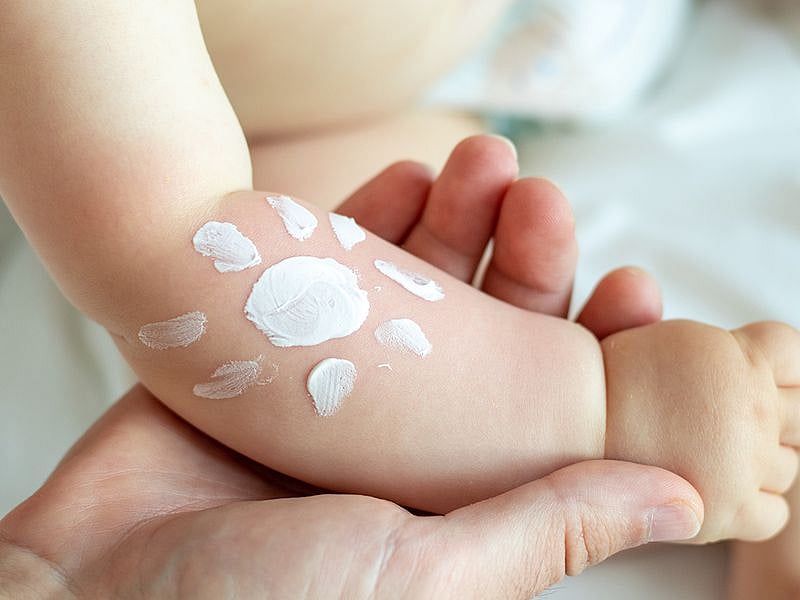
Mineral sunscreens are the best choice for babies. Choose one that's hypoallergenic, with a minimum of SPF30.
Shutterstock
Dubai: Sunscreen is one of those things most of us think we are doing right. We apply it in the morning, we feel covered, and we get on with the day. But according to dermatologists, the gap between how people think sunscreen works and how it actually works is significant, and in the UAE's intense UV climate, that gap has real consequences.
Here is what two specialists want you to know.
How much you actually need
The most common mistake is not applying enough, and most people fall well short of what is required for adequate protection.
Dr. Rehna Ahamed PK, Specialist Dermatologist at Aster Clinic Al Nahda Dubai, recommends using the two-finger method for the face and neck. "Apply generously using two finger units, meaning the middle finger and index finger, for the face and neck," she says. For the full body, the target is approximately 30 to 35ml, roughly a shot glass full. She also stresses not to forget easily missed spots. "Do not miss hidden areas like the back of the ear, neck, or upper part of the leg."
For children, Dr. Rehna recommends a mineral sunscreen containing zinc oxide or titanium dioxide, applied in a half shot glass quantity of around 15 to 17ml. "Mineral sunscreen sits on the skin and creates a barrier," she explains.
Dr. Radha Nilesh Patil, Specialist Dermatologist at Medcare Royal Speciality Hospital, reinforces the point. "Even a high-SPF product may not provide the expected level of protection if it is spread too thinly," she says. She recommends applying sunscreen around 30 minutes before going outside. "A practical approach is to apply sunscreen immediately after showering, which usually allows sufficient time before leaving the house."
Dr. Meeth Atawane, Specialist Dermatologist at RAK Hospital in Ras Al Khaimah, reinforces the point. "Most people apply far less sunscreen than they actually need," he says.
"For the face and neck, adults should use approximately two finger-lengths of sunscreen. For the entire body, around 30ml, roughly a shot-glass amount, is recommended per application." He adds that in the UAE, sunscreen should be applied 15 to 20 minutes before going outside and reapplied every two hours, with extra attention after sweating, swimming or prolonged outdoor activity.
SPF 30 or SPF 50: does it matter?
The short answer is that both work well, but how you use them matters more than which one you choose.
"SPF 30 blocks approximately 97 per cent of UVB rays, while SPF 50 blocks about 98 per cent," says Dr. Rehna. "For the UAE's high UV environment, I generally recommend a broad-spectrum SPF 50 for daily use, particularly for individuals who spend significant time outdoors, have sensitive skin, pigmentation concerns, or a history of skin cancer."
Dr. Radha agrees but places equal emphasis on habits over numbers. "Consistent application and reapplication often have a greater impact than the SPF number alone," she says. As a general guide, SPF 30 should be reapplied every two to three hours, while SPF 50 may allow a slightly longer window of three to four hours. However, both doctors stress that sweating, swimming or exercise shortens that window regardless of the SPF.
Dr. Atawane puts it as: "Consistent and correct application is far more important than simply choosing a higher SPF number," he says.
"In the UAE climate, where heat and sweating can reduce sunscreen effectiveness, regular reapplication and using enough product matter more than relying solely on SPF 50." He does, however, recommend SPF 50 as the better option in the UAE, particularly for individuals with melasma, pigmentation disorders, sensitive skin or those spending extended time outdoors.
In the UAE climate, where heat and sweating can reduce sunscreen effectiveness, regular reapplication and using enough product matter more than relying solely on SPF 50Dr. Meeth Atawane, Specialist Dermatologist at RAK Hospital in Ras Al Khaimah
The mistakes most people are making
Both doctors identified a strikingly similar list of common errors.
Applying too little. Applying once and assuming it lasts all day. Forgetting to reapply after sweating or outdoor activity. Relying on makeup with SPF as a substitute. Assuming darker skin tones do not need protection. And perhaps most critically, thinking sunscreen is only necessary at the beach.
Dr. Atawane flags one pattern he sees repeatedly. "Some individuals only use sunscreen at the beach or pool, while daily incidental sun exposure during driving, walking or outdoor errands can also contribute to tanning, pigmentation and premature ageing," he says. "Sunscreen gradually breaks down with sun exposure, sweating and friction from clothing or wiping the skin, which is why one morning application is never enough."
Dr. Radha adds, "Significant UV exposure can occur while commuting, exercising, dining outdoors, or carrying out routine daily tasks."
The spots you are almost certainly missing
Both dermatologists flagged the same consistently neglected areas: ears, eyelids, lips, back of the neck, scalp and hairline, hands, feet, under the chin and the sides of the face and jawline.
"Over time, repeated UV exposure to these areas can contribute to premature skin ageing, hyperpigmentation, melasma, fine lines, sunspots and an increased risk of precancerous skin lesions," says Dr. Rehna. "In a high-UV region, cumulative sun damage can occur even during routine daily activities like driving, walking between buildings, or outdoor commuting."
Dr. Atawane adds that men with thinning hair frequently neglect the scalp, a commonly overlooked area with significant sun exposure. "In the UAE, where UV levels remain high throughout most of the year, these effects tend to accumulate faster compared to regions with lower sun exposure," he says. "Long-term cumulative sun damage in unprotected areas increases the risk of skin cancers and precancerous lesions."
What about cloudy days and being indoors?
Do not skip sunscreen on either. "Up to 80 per cent of UV rays can penetrate through clouds, meaning sun damage can still occur on overcast days," says Dr. Rehna. "UVA rays can also pass through glass windows, contributing to skin ageing, pigmentation, and long-term skin damage."
Dr. Atawane echoes this firmly. "UVA rays, which are primarily responsible for pigmentation and premature ageing, can penetrate through glass windows," he says.
"People working near windows, driving frequently, or spending long hours in bright indoor environments in the UAE can still accumulate significant sun exposure over time. Daily sunscreen use should be considered a routine part of skincare regardless of weather conditions, especially in a country with consistently high UV indices like the UAE."
Dr. Radha puts it as: sunscreen is not a beach-day product. "The best approach combines sunscreen with practical steps such as seeking shade, wearing sunglasses, choosing protective clothing, wearing a wide-brimmed hat, and limiting prolonged exposure during the strongest sunlight hours. Small improvements in daily habits can make a meaningful difference to long-term skin health."
Network Links
GN StoreAbout Gulf NewsTerms & ConditionsReach by GNSitemapContact usPrivacy PolicyGN FocusHave your sayWork with usAdvertise with usGulf News epaperPrinting Services
Download our app
© Al Nisr Publishing LLC 2026. All rights reserved.