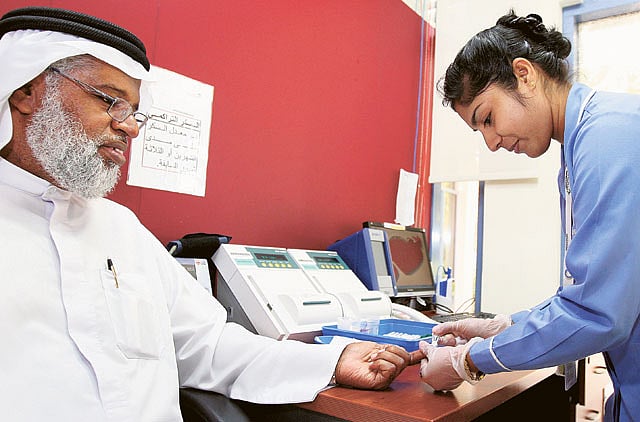
Dubai: The UAE has been ranked tenth on the International Diabetes Federation's (IDF) list of countries where diabetes is most prevalent.
That said it is then understandable why the Dubai Diabetes Centre (DDC) is set to relocate to a larger facility later this year to cater to increased demand for diabetes management. The new centre will also introduce a paediatric endocrinology department to accommodate treatment of the country's growing number of diabetics under the age of 18.
"There's been a huge response from the local population since we opened in 2009 which is why we are now running at full capacity with no room for expansion," said Dr Hamed Farooqi, director of the centre. "So one reason for the move is to meet demand and the second is to increase our local capacity."
The DDC was set up by the Dubai Health Authority (DHA) and is the only public facility in Dubai to offer comprehensive diabetic care. It is currently located on an 8,000 square foot plot in Latifa Hospital, formally known as Al Wasl Hospital. The new facility will span 22,000 square feet in the Shaikh Hamdan Bin Rashid Al Maktoum Award for Medical Sciences building on December 2nd Street, commonly known as Diyafah Street.
"Right now we have four adult endocrinologists, of which I am one, and we are planning to hire two more for the new centre," Farooqi said.
"The most unique element of the new centre will be the full paediatric endocrinology team."
He added endocrinology is the study of hormones produced by specific glands in the human body — under which the treatment of diabetes falls.
However, as in other fields of medicine, the treatment of adults and paediatrics falls under different specialisations.
"The Paediatric Department in the new centre will make us complete because now there is a vacuum as we're currently unable to see anyone under 18."
National problem
The DDC expansion comes as the latest IDF figures rank the UAE third globally when it comes to the number of people who are predicted to have diabetes by 2030.
This essentially indicates an escalating national problem.
The centre was initially set up by the DHA with a short-term goal of immediately tackling the UAE's prevalent diabetes problem. An agreement was signed with the Joslin Diabetes Centre, affiliated with Harvard Medical School. However, after the fulfilment of the contract with the Joslin Centre the DDC now operates on its own.
"The immediate response to the problem was obviously to get a known entity to come and set up a diabetes centre and start seeing patients as soon as possible," Farooqi said. "The centre's long-term goal has always been capacity building, to ensure there are more people here in Dubai to manage the country's diabetes problem in accordance with world standards."
As part of the DDC's goal for national capacity building, the centre recently set up an education programme with UAE University to initially train 10 local doctors working in the DHA's primary health care network for one year. Upon completion of the year-long training the doctors will be awarded an advanced diabetes management diploma from the university.
The DDC prides itself on its unique approach to comprehensive diabetes care through what Farooqi referred to as a "team approach".
"When someone comes in for diabetes management they are not just going to see a doctor across the table who will write a prescription," he said. "They will see a doctor and a dietician who will devise a personalised meal plan as every individual has different requirements."
In addition to the team of doctors and dieticians, the DDC also has nurse educators to walk patients through the process of monitoring their blood sugar levels through a glucometer.
The centre also has a retinal camera to take pictures of a patient's retina, which is typically damaged by diabetes.
"A patient's first visit is quite a long one because they spend an hour each with the doctor, nurse and dietician," Farooqi said.
"The whole idea is diabetes is a lifestyle disease; so if you educate a patient on what is happening in their body and how to adjust their diet and lifestyle then we see positive results."
He added although diabetes, especially Type 2, is not curable per se it is possible to keep it under control in order for individuals to live long healthy lives.
Electronic record
The DDC is one of the first DHA facilities to keep a fully electronic health records system that can be immediately retrieved and updated.
"If we are sent a patient from Hatta, for example, anybody inside DHA can see our note the moment the patient steps outside the clinic," he said.
"One of the major issues still prevalent worldwide is when a patient is sent to a specialist because as the treating physician you never know what the specialist has said."
Treatment at the DDC is free of charge for Emiratis. Expatriate government employees under the Enaya health insurance scheme can also be treated at the centre.
"I've also been recently notified that other insurance schemes are kicking in as some sort of arrangement is being made."
Diabetes
Insulin was discovered in Toronto in the summer of 1921 by Dr Frederick Grant Banting and Charles Best in a search for a cure for diabetes.
During the discovery phase, Dr Banting and Charles Best worked to produce and test the drug on dogs.
Dr Bertram Collip and John J. R. MacLeod joined the team when the insulin test worked and the purification stage started.
Dr Banting and John J. R. MacLeod were awarded the Nobel Prize in 1923 for their work and discovery of insulin. On January 23, 1922, the first successful test on a human patient with diabetes occurred. Insulin was given to dangerously ill Leonard Thompson, and his condition improved dramatically in just a few hours.
— University of Toronto
Sign up for the Daily Briefing
Get the latest news and updates straight to your inbox
Network Links
GN StoreDownload our app
© Al Nisr Publishing LLC 2026. All rights reserved.