First blow, blurred vision and ‘one last fight’: flydubai pilot reveals how cockpit attack began
Hero recounts terrifying descent as passengers screamed and crew fought to regain control
Dubai: It was an ordinary moment on what had, until then, been an ordinary flight from Dubai to Tel Aviv.
Machchhar’s co-pilot was praying, something the captain said was not unusual. Out of respect, Machchhar kept his eyes towards the front of the cockpit while his colleague prayed behind him.
Four or five minutes later, something slammed into the back of his head.
At first, the veteran pilot did not realise he was being attacked. He thought something catastrophic had happened to the aircraft.
“My first thought was that there was catastrophic damage to the aircraft, that something is not right,” Machchhar recalled.
Then came another blow. And another.
That was when he understood.
“It’s not the aircraft, it’s the other guy who is in the cockpit with me.”
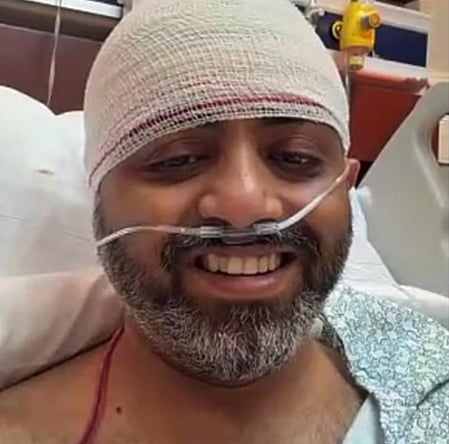
Speaking to Israeli Prime Minister Benjamin Netanyahu about Wednesday’s terrifying events aboard flydubai flight FZ1073, the seriously injured captain has now given one of the clearest accounts yet of the struggle inside the cockpit — and the moment he realised the lives of 174 people could depend on what he did next.
‘My vision was almost like nothing’
Machchhar tried to fight back, but the initial blows had left him badly injured.
“I did try and stop him, but because of his initial blows, my vision was almost like nothing, and I was completely blurred out,” he said.
His memories of what followed remain fragmented.
But one sensation is unmistakable: The aircraft was going down.
“At that point, the next feeling I had was that the aircraft was sharply going down,” he said.
Flight FZ1073 had been cruising at around 34,000 feet when it transmitted emergency signals and descended more than 17,000 feet.
Machchhar recalled managing at one point to open the cockpit door, only for it to be shut again.
Then he found himself on the cockpit floor.
“I felt the aircraft and the whooshing sound and people screaming,” he said.
‘I gave everything that I had’
Bloodied, his vision impaired and the aircraft descending, Machchhar believed he had one opportunity left.
“And as I was telling the Ambassador here, I had that one last fight left in me,” he said.
What drove him at that moment, he said, was partly instinct for survival.
“Call it personal or call it for people, I did it because if I didn’t do it, I was going to die.”
He summoned what strength remained.
“I pushed against everything ... I gave everything that I had and went for the door and opened the door.”
People outside were waiting.
“Thankfully, people were waiting to pounce back ... took over control and the rest is what you know.”
The Boeing 737-8, carrying 174 passengers, including 27 children, was eventually diverted to Prince Sultan Bin Abdel Aziz Airport in Tabuk, Saudi Arabia.
Videos circulated after the emergency showed Machchhar covered in blood, wearing an oxygen mask and lying on his back in the aircraft galley.
‘You saved so many souls’
Netanyahu praised Machchhar during their conversation, telling him his actions had resonated far beyond the aircraft.
“You saved so many souls,” Netanyahu said, calling him “a hero of Israel”, India and “the entire world”.
He told Machchhar he was amazed by his courage and “coolness of judgment under impossible conditions”.
Netanyahu said he wanted Captain Machchhar and Indian Prime Minister Narendra Modi, one of Israel's key international partners, to light a flame at a national ceremony for Israel's Independence Day next May, saying the role was usually reserved for Israeli citizens.
"You are a true hero of the brave peoples of India and Israel and you are a hero of the entire world," Netanyahu said in a video his office released of his telephone conversation with the hospitalised captain.
The conversation came a day after Modi spoke to the pilot by telephone.
Modi said Machchhar had demonstrated “immense courage and unwavering resolve” despite suffering serious injuries.
For the Mumbai-born pilot, the praise follows more than 13 years in commercial aviation.
Machchhar, who is in his mid-30s, has logged more than 9,500 flying hours. He joined flydubai in June 2022 after spending more than a decade with SpiceJet, where he also worked as a Line Training Captain. His brother is also a flydubai pilot.
Investigation continues
The UAE, which is leading the investigation, said on Saturday that preliminary findings showed the co-pilot had attempted to carry out a “terrorist act”.
UAE Attorney General Hamad Saif Al Shamsi said the captain was attacked inside the flight deck with a crash axe and that the co-pilot attempted to take control of the aircraft.
Media reports have identified the co-pilot as Omani citizen Hamam Al Hammami, although his identity has not been officially confirmed.
The Wall Street Journal reported, citing people familiar with the matter, that he had previously been barred from flying in Oman over concerns about radical ideological views. CNN, citing sources, also reported that concerns about his views had previously led to his removal from flight training. Authorities are continuing to investigate the motive, his background and any possible links.
But Machchhar’s account brings the focus back to the minutes inside the cockpit when there was little time to understand what was happening.
He had been struck repeatedly. His vision was blurred. He was on the floor. The aircraft was descending and he could hear the screams of passengers behind him.
Yet there was still the cockpit door.
And, as Machchhar put it, “one last fight” left in him.

Sign up for the Daily Briefing
Get the latest news and updates straight to your inbox
Network Links
GN StoreDownload our app
© Al Nisr Publishing LLC 2026. All rights reserved.