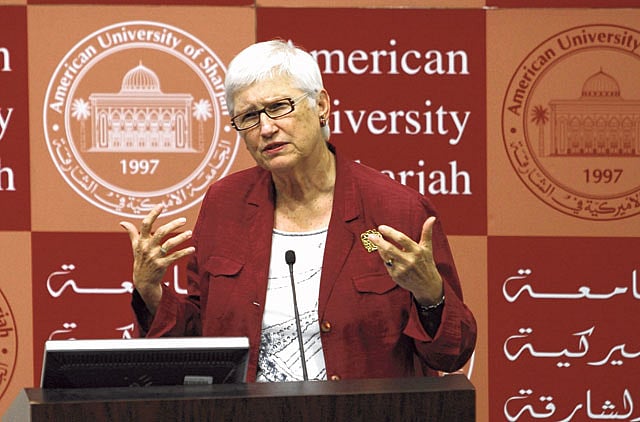
Obtaining an American-style liberal arts degree is a long way from gaining widespread acceptance and praise as a good start to a successful career in Middle Eastern and Central Asian cultures.
These sentiments were expressed by Dr Marcia Grant, Academic Planning Head of the Faculty of Arts and Sciences at Aga Khan University (AKU) in Pakistan, during a talk at the American University of Sharjah (AUS), last week.
"We have a lot of selling to do to explain what this [liberal arts] degree means," the US national said. "[If successful] it will soon be seen that liberal arts graduates are good at what they do and can earn as well as anybody from business or engineering," she added.
Cultural weaving
Dr Grant's talk explored the liberal arts education as a relevant academic model outside of its native US, and although she skimmed over the crucial topic of curriculum and course content, she added: "We will see these schools survive if they find a way to root themselves in the culture [of their respective country]".
"That would mean what is in the curriculum would be decided on by the professors with request from the students," she said.
Dr Grant reinforced this idea with an example of demands by AUS students for adding Western history and philosophy general courses to the already existing Middle Eastern history ones.
"[They've asked for these courses] to understand how Westerners think," she said. "It's important that students allow for many voices and ways to understand reality, and remember the richness of the liberal arts that existed in this region in the ninth century, weaving it into the whole curriculum," added Dr Grant.
Before taking up her post at AKU, one of Dr Grant's previous posts was the Founding Dean at Effat University for women in Jeddah, Saudi Arabia. She used the example of Effat University, established in 1999, as a successful liberal arts academic model, with all the additional experiences it offered.
"Looking back I think the single decision to require physical education was the most important academic decision I took as it had a great impact," she said.
New form of imperialism
"Mandatory physical education led to academic seriousness and truly created an atmosphere of academic excellence," added Dr Grant.
She acknowledged the popular criticisms of US liberal arts academic models, such as mandatory English instruction, which in some cases was viewed as a new form of imperialism.
"The thing about new liberal arts colleges is that they are all in the English language, which is criticised as another form of a globalisation, an imperialistic push of an educational model that brings this language," said Dr Grant.
"[However] what a liberal arts education really offers is allowing students to find out what they love and feel interested in, which takes a lot of courage in any culture anywhere," she added.
What is a liberal arts education?
A liberal arts model of university education is a four-year academic undergraduate programme that starts with two years of general education.
"The purpose, among others, is that students become broadly educated people," Dr Grant said. "The whole idea of the first two years of general education is the idea of giving students breadth… the idea of what an educated person would learn," she added.
The model's two years of general education followed by two years of specialisation is designed to expose students to history, art, literature, philosophy as well as the maths and sciences.
"It's the idea that we will learn about the different approaches to learning to know that each kind of knowledge on its own is limiting," Dr Grant said.
"I've found for myself that the general-education part of a liberal arts education is really what leads us to life-long learning," she added.
Sign up for the Daily Briefing
Get the latest news and updates straight to your inbox
Network Links
GN StoreDownload our app
© Al Nisr Publishing LLC 2026. All rights reserved.