External funding for Emiratis picks up
Apart from federal spending on training and qualifications for UAE nationals, private companies are increasingly eager to invest in them for recruitment and retention
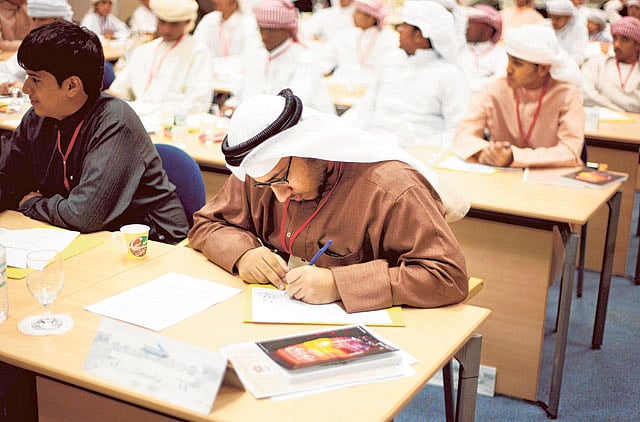
The UAE federal government, along with the governments of the individual emirates, is pushing for human resource development to ensure that the maximum number of Emiratis gain graduate employment.
Due to this drive, universities across the country have seen growth in the number of corporate sponsored students in higher education.
The University of Sharjah (UOS) has a student body of 10,000, almost half of whom are UAE nationals.
Dr Samy Mahmoud, Chancellor of UOS, reported a 10 per cent growth of students receiving private or government organisational support.
He said almost 50 per cent of the Emirati student body receives funding at the undergraduate and post graduate levels.
"We've noticed an increase in company sponsorships for Emirati students who want to study in our programmes," said Dr Mahmoud. "There is a federal and individual government body push for HR development at the top of the agenda, and we sense this when talking to officials at every level."
Interest shown
Apart from funding Emiratis for recruitment and retention in the workplace, foreign government bodies and companies are also funding students from federal universities to strengthen cultural ties with the UAE.
The Italian government recently awarded grants to six Emirati students to pursue post-graduate studies at universities in Italy and Abu Dhabi.
Emirates Foundation chief executive Peter Cleaves said the organisation's scholarship programmes in Italy "are attracting considerable attention from qualified Emiratis and we received a large number of applications for the 2010-2011 academic year".
The British government, too, has an interest in supporting cultural exchange with young Emiratis. Recently three medical students from UAE University were awarded scholarships from the British Council to work in research laboratories in the UK as part of the British Council Research Scholarship Programme.
The British Council indicated that the scholarship programme was not directed at emiratisation but building links between the two countries and providing opportunities to experience research in the UK. International finance organisations such as the Institute of Chartered Accountants in England and Wales (ICAEW) have launched their own scholarship programmes for Emiratis to attract them to accounting professions.
Amanda Line, Regional Director, ICAEW Middle East, said, "The UAE needs more qualified finance professionals, particularly Emiratis, with the right skills and the best qualifications."
Top performing students with an interest in business, finance and accounting are encouraged to apply with the chance to work for one of the Big Four accounting firms including Deloitte, Ernst & Young, KPMG or PwC. Unlike other scholarship programmes, the ICAEW does not expect recipients to stay with the companies they work for.
"It's practical... once they qualify they can work for whomever they like. They may go back to the family business or the public sector or they may even go abroad," said Line.
Private universities like the American University of Dubai (AUD) did not report a growth in corporate funded students and Al Ghurair University (AGU) does not.
"We do have lots of students sponsored by certain companies who simply send us a letter informing us of the arrangement," said Zeina Tannir, Associate Director of Admission. "However, I cannot see a growth per se." Dr Mahmoud added the aim of increased Emirati student financing seems to be secured employment for all graduates capable of performing well in certain industries.
"The government wants to make sure the youth are getting well paid jobs that require a high level of skills," he said. Company sponsorship is good for student retention figures.
Human capital
"Sponsorship really helps retain the students because it focuses them," said Dr Marshall Drummond, Provost of the Higher Colleges of Technology (HCT).
"It makes them serious students because they can see their future prospects and they feel a responsibility; it's a powerful thing to help students and companies succeed."
The HCTs largest pool of company sponsored students is at Abu Dhabi Men's College where, Dr Drummond estimates, 60 to 80 per cent of the men receive support.
Due to the fact that the HCTs only admit Emiratis and do not charge fees, student sponsorship entails a stipend of Dh2,000 to Dh5,000.
Dr Drummond added that with a government drive to build human capital it is imperative to keep a majority of UAE nationals in the country for higher education.
The Ministry of Higher Education and Scientific Research (MOHESR) reports that almost 2,115 Emiratis are currently pursuing higher education outside the UAE on scholarships provided by MOHESR.
"To build human capital, improving the people who are indigenous is important…it's dangerous to keep sending them abroad," said Dr Drummond.
He reported a slight decline in the preparation quality of students entering federal universities although the numbers of students admitted has increased.
Sign up for the Daily Briefing
Get the latest news and updates straight to your inbox
Network Links
GN StoreDownload our app
© Al Nisr Publishing LLC 2026. All rights reserved.