Over 200 dead as Trump pushes for regime change in Iran
After weeks of stalled diplomacy, Trump urges Iranians to rise up as casualties mount
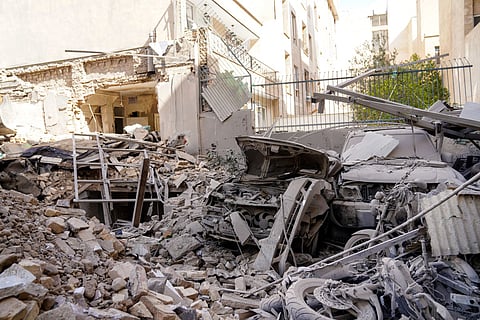
Dubai: At least 201 people were killed and 747 wounded in coordinated US and Israeli strikes across Iran, the Iranian Red Crescent said Saturday evening — the first official toll since the attacks began.
The humanitarian organisation said 24 of Iran’s 31 provinces were affected and that it had entered a nationwide state of alert, according to a statement carried by ISNA news agency.
The strikes mark the most serious escalation in years between Washington and Tehran and open a new chapter in direct US military intervention inside Iran.
Israeli evacuation warning
The Israeli military issued an evacuation warning for Iranians in an industrial area of the Isfahan region in the centre of the country, saying it would imminently attack "military infrastructure" there.
"Urgent alert to all people located in the 'Gey' industrial zone in the Isfahan region... in a few minutes, the Israeli army will attack military infrastructure in this zone," the military posted on its Persian-language X account, along with a map showing the targeted area, warning people to "immediately evacuate this area".
President Donald Trump, announcing what he called “major combat operations,” urged Iranians to rise up against their leadership.
“When we are finished, take over your government. It will be yours to take. This will be probably your only chance for generations,” Trump said in a video address.
Leadership targeted
Early strikes appeared to hit near the offices of Supreme Leader Ayatollah Ali Khamenei in Tehran, with smoke rising across parts of the capital. Iranian Foreign Minister Abbas Araghchi told NBC News that Khamenei and President Masoud Pezeshkian were alive “as far as I know,” calling the attack “unprovoked, illegal and absolutely illegitimate.”
US officials said members of Iran’s leadership were among the targets, though there was no confirmation that senior figures were killed.
Even if top leaders were eliminated, analysts note that regime change is far from guaranteed. Neither Washington nor Israel has publicly outlined what a post-clerical leadership scenario would look like.
Iran fires back
Iran retaliated by launching missiles and drones toward Israel and US military installations in Bahrain, Kuwait and Qatar. Exchanges of fire continued into the night.
Israel’s military said Iran fired “dozens” of missiles, many intercepted, with no serious injuries reported. Emergency services reported 89 lightly injured.
Saudi Arabia said attacks targeting Riyadh and its eastern region were repelled. Bahrain reported a missile attack near the US Navy’s Fifth Fleet headquarters. Kuwait confirmed drone strikes near its international airport and Ali A Salem air base.
Jordan said it intercepted 49 drones and ballistic missiles. Explosions were also heard in Qatar and the United Arab Emirates.
Flights across the Middle East were disrupted, and several US embassies in the region instructed staff to shelter in place.
Civilian casualties and infrastructure damage
In southern Iran, local officials reported at least 85 people killed after a girls’ school was struck. Iran’s state news agency IRNA later reported that 40 people were killed in that incident, without specifying whether they were students.
At least three explosions were also heard near Iran’s Intelligence Ministry building in northern Tehran, witnesses said.
The United Nations’ nuclear watchdog said it had seen “no evidence of radiological impact” at safeguarded nuclear facilities, despite Iranian requests for an urgent meeting of the International Atomic Energy Agency’s Board of Governors.
Iran was also reported to be experiencing a near-total internet blackout, according to monitoring group NetBlocks.
From nuclear talks to war
The immediate trigger appeared to be the collapse of the latest round of nuclear negotiations. But the strikes also reflect months of mounting tension.
American warships had been moving into the region, and Israeli and US strikes last June had already weakened Iran’s air defences and military leadership.
Trump justified the new operation by claiming Iran continued developing its nuclear programme, despite earlier asserting it had been “obliterated.” He also said he aimed to destroy Iran’s missile capabilities, weaken its naval forces and neutralise Tehran-backed regional proxies.
Democrats criticised the action as lacking congressional authorisation. The White House said congressional leaders from both parties had been briefed.
The UN Security Council scheduled an emergency meeting.
Regional and global impact
The conflict threatens to rattle global energy markets, particularly if Iran moves to disrupt the Strait of Hormuz — a chokepoint through which roughly one-third of global seaborne oil exports passed last year.
The Iranian-backed Houthis in Yemen vowed to resume attacks on Red Sea shipping routes and Israel.
With Iran’s regional proxy network weakened after months of conflict linked to Hamas’ October 2023 attack on Israel, Tehran now faces one of its most precarious moments since the 1979 Islamic Revolution.
Whether the strikes weaken the regime or harden it remains uncertain. But with hundreds dead, retaliation underway and global powers on edge, the confrontation has already moved beyond diplomacy into open warfare.
-- With AFP & AP inputs


