Courses give prisoners in Dubai chance for a fresh start
Dubai firmly believes in the importance of rehabilitating and educating prisoners to prepare them for society after they have served their jail terms
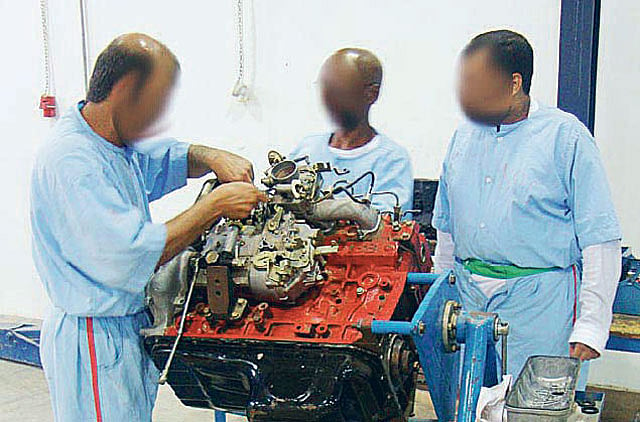
Dubai: The Dubai General Department of Correctional Institutions firmly believes in the importance of rehabilitating and educating prisoners to prepare them for society after they have served their jail terms.
"We don't believe in punishing people when they end up in our prisons, we believe in educating them and helping them acquire skills that might assist them when they finish their sentence," said Lieutenant Adel Al Suwaidi, Director, Department of Educating and Training Prisoners, General Department of Correctional Institutions.
Film-making
The Department has introduced a new rehabilitation programme for prisoners; which allows them to explore the areas of media production and film-making.
The programme includes six prisoners with backgrounds in media production or prisoners who are interested in the field. They experiment with various media tools such as broadcasting, film-making and design. Their work will be shown via a specialised TV channel set to be broadcast soon within the perimeters of Dubai Correctional Institutions.
"We have already made a 15-minute movie and some public service announcement videos that are filmed and produced entirely by the prisoners," a prisoner who is in charge of the programme but wished to stay anonymous said. "These videos will hopefully assist in spreading awareness about certain harmful habits and practices that many prisoners practised before they ended up in prison."
The Dubai Correctional Institutions have developed other programmes to rehabilitate and assist prisoners.
"Education and specifically religious education is important for us, because we believe it serves as an eye-opener and a form of therapy for the prisoners, Lieutenant Al Suwaidi said.
Reduced sentence
"We have many religious programmes and classes that serve both Arabic and non-Arabic speakers. The number of prisoners both male and female that attend the Quran memorising classes exceeded 280 in 2009."
The classes provide a way for prisoners to have their sentence reduced.
"Of course, this excludes prisoners who are sentenced to be executed or committed grave crimes such as intentional murder and drug smuggling," Lt Al Suwaidi said.
The number of prisoners (both men and women) who embraced Islam in 2009 was 139.
"Of course, we never force anyone to attend these classes or consider converting. The same way we provide religious education for Muslims; other religious sessions are available for other religions as well," Lt Al Suwaidi said.
Other forms of training and educating are available as well, but primarily for Emirati prisoners who do not face the threat of deportation.
"Usually a poor background and lack of opportunities is what forced these individuals to commit various crimes. A degree is given to all the prisoners benefiting from these programmes. The degree shows no sign that the prisoner completed his or her programme in a punitive establishment of any kind," Lt Al Suwaidi said.
"We provide programmes in carpentry and sewing to give the prisoners a skill that they might benefit from in the future instead of reverting to illegal ways to make a profit," said Captain Adel Al Hallawi, Director Department of Supplies and Services in the Department.
Sign up for the Daily Briefing
Get the latest news and updates straight to your inbox
Network Links
GN StoreDownload our app
© Al Nisr Publishing LLC 2026. All rights reserved.