Burning issue: Building tiles in UAE found to be flammable
Common tiles used on building exteriors across region tested, found to be helping blazes spread
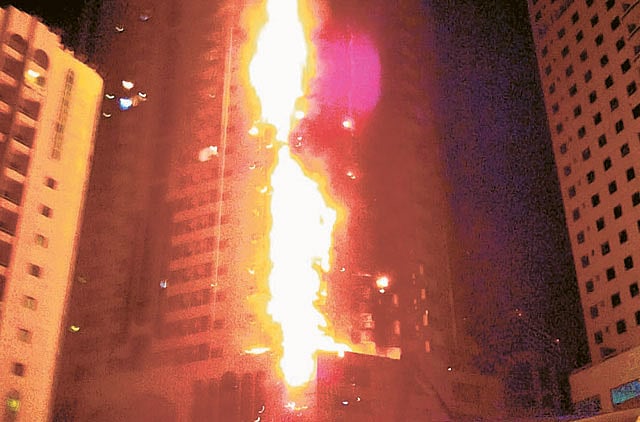
Dubai: A spate of high-rise fires in Sharjah over recent months has left hundreds of tenants in search of new homes, without possessions and wondering exactly why their homes went up in smoke.
The buildings were new, had adequate firefighting equipment and precautions inside, and Civil Defence officials reacted quickly to the blazes. But the exterior of the buildings went up in flames easily — far too easily.
"The building codes and regulations seem to cover the insides of buildings quite well, but the exterior seems to have been missed," explains Tom Bell-Wright, a civil and structural engineer who has been operating Thomas Bell-Wright International Consultants in Ras Al Khor since 1995. It's the only fully accredited fire-testing facility in the region.
'A wake-up call for everyone'
"We have been calling for stringent regulations on cladding systems and materials for a long time, and the recent fires in Sharjah are now a wake-up call for everyone," he says.
Gulf News approached Bell-Wright and his laboratory to conduct a non-scientific experiment using three samples of building cladding provided by Alubond, an Ajman-based manufacturer of the product used ubiquitously across the Middle East.
It's light, flexible, cheap to manufacture and provides a modern exterior finish used to bring architectural plans to fruition.
Using the three tiles, one with no fire-resistance properties, one with fire-retardant properties and one fire-resistant, Gulf News set the tiles alight using common barbecue fuel in three disposable barbecues. "The test isn't scientific, but it does give an indication of the properties of the three materials and does at least give indication of a scenario that is likely to happen," Bell-Wright explains.
His company had just completed a very realistic test on a sample fireproof door of the kind which is to be used in the expansion of Doha International Airport.
For three hours, the door, built into a wall to replicate a real-life scenario, was exposed to a room-sized furnace. The heat was removed, and the door was then sprayed with water as if firefighters were reacting to a real-life situation.
"The door has buckled slightly, but it has held as it was supposed to do," he explains.
Elsewhere on the facility, full-size mock-ups of sections of buildings are under construction. These will be subjected to a variety of tests including the effects of driving rain using an aircraft engine as a wind generator. "High-rise building facades have to keep the weather out and the people in," Bell-Wright explains.
His company has tested components for the Burj Khalifa and for numerous key buildings and developments around the region.
No regulatory requirement for testing
But there is no regulatory requirement for new buildings to be tested and the use of ‘Facade Consultants' is not nearly as prevalent as in North America and Western Europe.
"Only about 10 per cent of the buildings constructed are actually tested to ensure that the materials used in the construction of their exteriors can stand up to the rigours of their lifespan," he says.
"When you consider the number of new buildings which have gone up across the region in the past decade, I think there's a major issue going to arise."
He points out that his company, for example, would never recommend to its clients that the materials used in the exterior of buildings were not fire-resistant.
"There is no legal requirement in the UAE," he says.
"Abu Dhabi's are the most advanced, and the other emirates typically follow suit , but it's a very slow process."
According to Bell-Wright, fire requirements in the UAE focus on the interior of buildings, not the exterior.
Sign up for the Daily Briefing
Get the latest news and updates straight to your inbox
Network Links
GN StoreDownload our app
© Al Nisr Publishing LLC 2026. All rights reserved.