Youssef is 26 years old and came to Abu Dhabi in 2021 to chase his dreams.
Abu Dhabi: There is a sound Youssef Akram Fahsa has been carrying for most of his life, and it is not music.
It is water. Water falling slowly, without any hurry, into the stone basin of a fountain in the middle of a courtyard in Old Damascus. The sky is the only ceiling there. Jasmine climbs the walls as if it owns them, and green leaves lean out of old pots toward the light. In the ard diar (courtyard) of the old family house, mornings began with that sound and evenings ended with it, and the stone stayed cool no matter what the day had done.
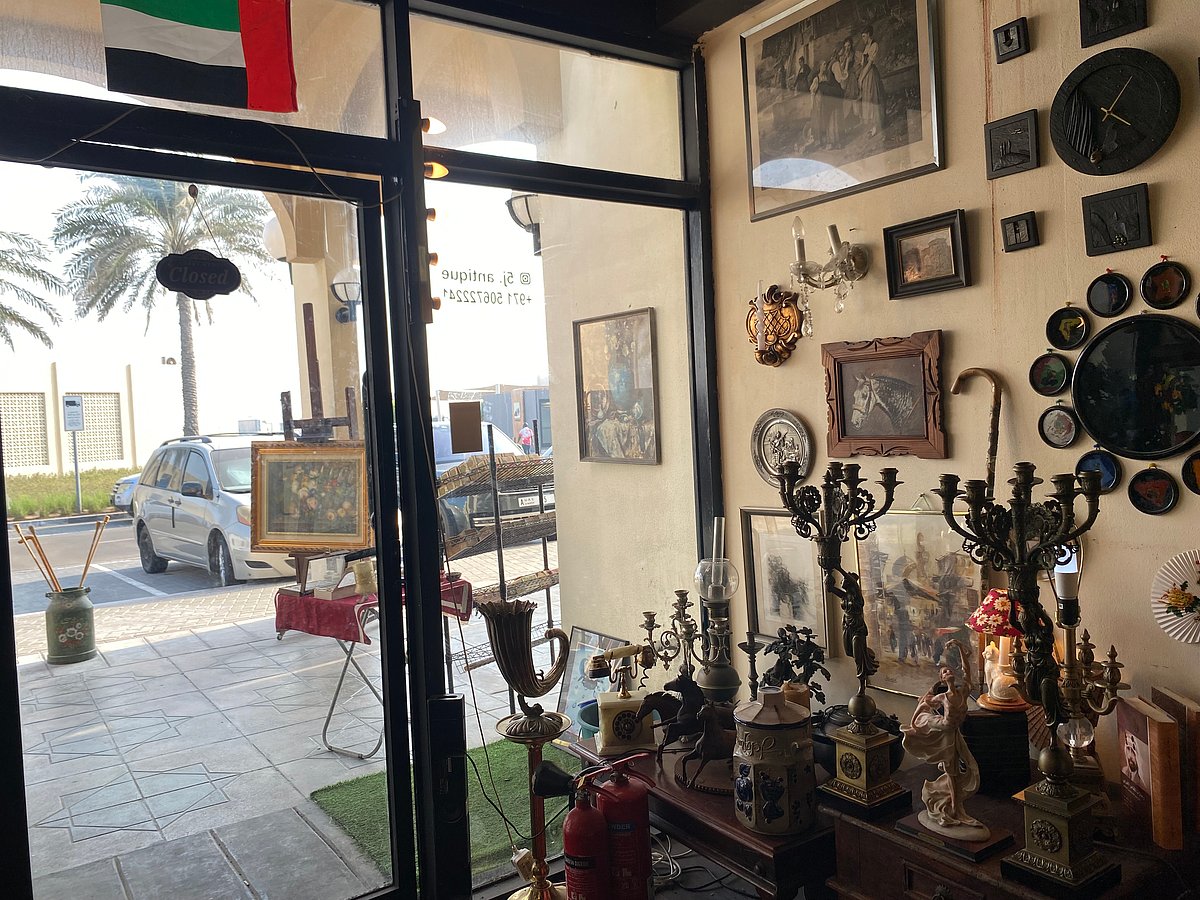
The house has been sold now, the way old houses are. But the sound never left him. So in Abu Dhabi, in a small shop at Mina Port where the city has always met the sea, Youssef has done the only thing a person can do with a sound like that. He has built it a room.
Every morning, before the shutters of Five J Antique are fully up, the street begins to hum. First comes an hour of Quran, then, without warning, Fairuz. Majida El Roumi. Fadel Shaker. The volume rises, and strangers who were only passing by stop on the pavement, heads tilted, as if somebody had opened a window into a house they used to live in.
Inside, in the shop, a young man in a quiet shirt is already at work, turning a very old watch over in his hands.
His name is Youssef Akram Fahsa. He is 26 years old. And he has been, as far as anyone can tell, an old soul since the day he was born.
The child who wouldn't play
Ask Youssef about his childhood in Syria and he does not tell you about football or cartoons. He tells you about cars.
Other boys were given toy cars and sent them crashing across the floor. Youssef was given the same cars and refused to let them touch the ground. He polished them. He lined them up on a shelf like exhibits. They were not toys to him; they were small objects with dignity, and dignity, he seemed to understand even then, should not be scuffed.
A few years later, when videogames swallowed his generation, he was nowhere near the gaming chair. He was at a table with a pencil, drawing mosaic patterns or writing poems. The children around him had a nickname for him, one that tells you everything about the child he was: Baba Youssef. Father Youssef. A boy of calm, of maturity, of stillness, already addressed like an elder.
It was never a performance. It came, he believes, from the house he grew up in. His eldest brother teaches mathematics. His sister teaches history. His mother stands in front of a classroom. The path was laid out for him like a carpet.
He stepped off it.
"I was never meant to follow the same path. I asked questions until the teachers got tired of me. I wanted to think beyond the curriculum." he said.
Fourteen years old, and a plank on his shoulder
Then the war came to Syria, and the carpet was rolled up for everyone.
With the security situation collapsing around his family, Youssef did something no fourteen-year-old should have to do. He went to work. He became a carpenter's apprentice, spending whole days hauling heavy timber and shaping it, while his mind slipped away to a place that did not yet exist: a shop of his own, with his own name above the door.
The money was not pocket money. His wages paid the rent of the family home and covered his siblings' school expenses. The boy who had polished toy cars was now quietly holding a household up on his shoulders.
It is the kind of story that is easy to turn into tragedy. Youssef does not. He talks about the carpentry the way a craftsman talks about a first teacher: with respect for what the wood taught him about patience, and about the beauty of making something with your hands.
When he left carpentry, he went looking for the other thing he loved. Clothes.
A boy who loved fabric
He found work with a clothing agency, starting in the warehouse. It was not glamorous. But within four months, he had memorized the barcodes of every item in the building. When the company realised what he was carrying in his head, they promoted him to manager.
Two years later he moved on to another clothing brand, where the owner noticed something else: Youssef had taste. Specific, stubborn, unfashionable-in-a-good-way taste. So, the owner opened a small shop for him, and let him fill it with the clothes he himself wished to wear.
This is a piece of cloth inside one of the Mosaic boxes, he sells.
It was a young man's first kingdom, and it did not last forever. In search of a bigger life, Youssef left Syria and tried his luck abroad: one year in Turkey, then Lebanon. Each stop sharpened him. None of them felt like home.
The country that made him calm
It was in Lebanon that he made the decision to come to Abu Dhabi.
He is precise about why. Not money. Not glamour. Safety. He describes the UAE as a deeply respectful country, one where a person can simply live. Then he said something that stops the conversation for a moment:
"There's a psychological comfort in Abu Dhabi. The people are refined, and they wish you well. The calm here reminds me of Syria."
He arrived in 2021. Within a short time, he met a Jordanian man who had lived in Abu Dhabi for years. They started talking, the way two strangers do when each suspects the other is secretly one of their own. And that was it: they discovered that they were both in love with antiques.
In 2023, they opened the shop.
Before that, the space had been something else entirely: a store of gifts and new things. They stripped it down, changed the decor, repainted the walls. Now it breathes differently. It is the kind of place where the clock on the wall has a biography.
Abu Dhabi has always been a city of arrivals. Ships came in, people came in, stories came in with them. Youssef simply belongs to the newest chapter of that old habit: a young man who stepped off the road from Damascus and Beirut carrying nothing but taste, patience and a deep suspicion of anything made yesterday. What he found here was a city generous enough to let him build a small, quiet world inside it, and curious enough to walk in.
Reviving history
Step inside and you understand quickly that Five J is not an ordinary shop, and Youssef is not an ordinary shopkeeper. On the floor sits a wine jug dated to 1668. It is 358 years old, give or take, and Youssef will not sell it. Not for any price nor to any person.
"I have pieces in the shop that I won't just sell to anyone," he said.
A wine jug from Germany dated to 1668. It is four hundred and fifty years old, give or take, and Youssef will not sell it. Not for any price nor to any person.
Nearby is a Persian sword from Isfahan, the blade and scabbard decorated with silver and gold, the handle carved from elephant tusk, an inscription running along the steel in Persian. He brought it from the Netherlands, after a trip.
a Persian sword from Isfahan, the blade and scabbard decorated with silver and gold, the handle carved from elephant tusk, an inscription running along the steel in Persian.
Then there is the uniform, and this is the piece Youssef's voice drops for. By his account, it belonged to a man from the inner circle of Hitler, someone who served close to him personally/ Every war left a mark on the cloth: a stamp pressed into the uniform, the last one carrying the year. Look closer and the lining still holds a dark stain where blood once soaked through. Inside, there are traces of sweat.
"This is a rare piece." he said.
A uniform from World War II.
Fifty-six years of ticking
For Youssef, watches are not accessories. They are his language.
The watch on his own wrist is 56 years old, one of only 20 ever made. It was created for the first marathon federation in Austria and Germany, ten pieces for Austrians, ten for Germans, then handed out as a prize in a very small circle. He brought it back from Frankfurt.
Elsewhere in the shop, behind glass, is an American military watch from the Vietnam War era, still carrying the date June 1974 on the back, stamped there by a soldier's world. It is hard to sell, and he knows it. He does not seem to mind.
Old watches that Youssef hides away.
Then there is the one he loves to explain, with the glee of a man holding a magic trick. In earlier wars, soldiers used magnetic fields to destroy military instruments, and this watch was built to resist them. It does not care about time passing, because it is has no battery. It winds itself.
And a Soviet watch, made in Russia, with the hard, honest face of the era.
He is not a collector who only looks. He takes them apart.
"I can open every piece of it, understand it, and put it all back together. I taught myself."
The rule of the story
Ask Youssef whether he wears branded watches and he answers like a philosopher.
"I do not care if it is a Rolex. I have no problem with the brand. But give me the story. A watch without a story, I do not wear."
That sentence is, in a way, the entire shop. For Youssef, an object without a past is just metal. An object with a past is a conversation.
This is where Youssef spends hours to fix and study watches.
He was like this as a boy. He remembers keeping every game he ever owned, never throwing anything away. Only later did he understand something about himself:
"The things hidden in a drawer for years begin to turn valuable, to mean something, and that the moment you wear or hold them you are carrying a small piece of someone else's life," he said.
How do you get those things?
The question follows him around. How does a 26-year-old get his hands on such objects? His answer is almost disarmingly simple.
Every four months, he flies to Europe. He does not go to markets. He goes to the antique shops owned by collectors, because those people did not open their doors for money. They opened them because they love the things inside.
He never touches what is on display. Instead, he walks up to the owner and says one sentence:
"Give me something you're hiding."
He says that the moment the collector hears it, they understand that the person standing in front of them is a collector too. A real one. And the piece changes hands, not as a sale, but as a passing of the torch. It moves from one guardian to another.
"Here, people believe in that."
He has his own way of knowing who to trust. He listens to the way people speak about their things. The pitch of the voice. The softness in it when they mention a watch.
Living in the old way
If you think the antiques stop at the shop door, you have not understood him.
When his family sold their old house in Old Damascus, the one with the courtyard, the fountain and the jasmine, and moved into a modern apartment, something in Youssef refused to follow. The apartment had clean walls and good light, and no water falling over stone. So he did what the people around him found baffling. He bought a house of his own in Syria. An old one. A house with a courtyard, built for a slower kind of living, because he wanted to keep living the old way.
He drives a vintage car. His one phone is for work only: no social media, no scrolling, no feed. He owns only things with a history, like the watch on his wrist, and he is perfectly happy about it.
On the side, he sells Syrian mosaic from a workshop he opened back home, where craftsmen make each piece by hand and send it to him. The boy who once drew mosaic patterns with a pencil now exports the real thing.
Mosaic exported from Youssef's very own workshop in Damascus, Syria.
And on quiet afternoons, he picks up a guitar and just plays. For hours. Customers who come in tell him they can feel something in the shop, a certain energy, and he smiles, because he knows what it is.
"In the end, we are all chasing something new. But people always look back for the old. In fashion, in music, in everything."
What the street is really listening to
Back on the pavement, Fairuz is still playing. A man in a pressed shirt has stopped outside the shop, one hand resting on the window frame. He isn't looking at anything. He is just listening. There is a word for what is on his face, and it is not nostalgia exactly. It is longing: for a voice, a kitchen, a country, a time.
Youssef knows that word well. He has built a shop out of it.
He does not call himself a businessman, or an expert, or even a collector. He is something much older than any of those. He is a keeper, someone who understands that the world is full of objects waiting for the right pair of hands to say: this one matters. Tell me its story.
The boy who polished the toy cars never really stopped.
He just found a bigger shelf, in a port city across the sea. And if you stand very still at the door of Five J Antique on a quiet morning, somewhere between the last verse of the Quran and the first note of Fairuz, you can almost hear a fountain.
Sign up for the Daily Briefing
Get the latest news and updates straight to your inbox
Network Links
GN StoreAbout Gulf NewsTerms & ConditionsReach by GNSitemapContact usPrivacy PolicyGN FocusHave your sayWork with usAdvertise with usGulf News epaperPrinting Services
Download our app
© Al Nisr Publishing LLC 2026. All rights reserved.