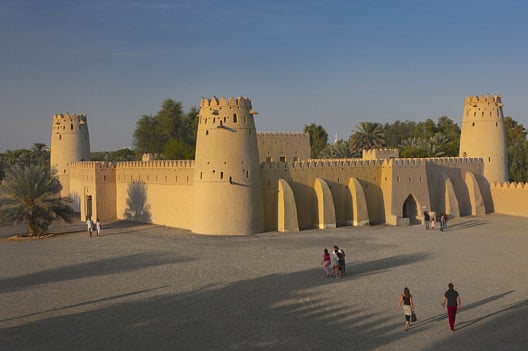
Built of sun-dried mud brick, early restoration work was done on the fort in 1985.
Al Ain: Beneath the mud plaster of Al Jahili Fort, hidden from every visitor, runs a network of chilled-water pipes. It is a quiet piece of engineering in a building that dates from the 1890s, and it exists for a simple reason: summer temperatures in Al Ain can reach 50°C.
The pipes are the heart of a 2007 conservation project that turned one of the UAE’s largest mud-brick forts into a year-round cultural destination, and won an international award for earthen architecture.
A summer retreat with a purpose
The fort was built on the orders of His Highness Sheikh Zayed bin Khalifa Al Nahyan, known as Zayed the First, who ruled Abu Dhabi from 1855 to 1909. Each summer the emirate’s rulers left the humid coast for Al Ain, with its drier air, fertile land and fresh water.
Sheikh Zayed owned a farm here, and the fort served both as his summer residence and as a means of keeping watch over the tribes of the area. Work began in 1891 and was completed in 1898.
An inscription over the south gate dates the inner square fort to this period. Alongside it stands a separate round tower of several tiers, each narrower than the one below. Together they are the oldest parts of the complex.
A history of many uses
After Sheikh Zayed’s passed away, his eldest son, His Highness Sheikh Khalifa bin Zayed bin Khalifa Al Nahyan, chose not to become ruler of Abu Dhabi and stayed in Al Ain, living in the fort with his family.
By the mid-twentieth century the fort had passed into military hands. The buildings had fallen into disrepair by 1955, when Sheikh Shakhbut offered them to the Trucial Oman Levies. Barracks and other buildings were added, and military use continued into the early 1970s, when the fort was handed to the Union Defence Force.
Al Jahili is one of the largest forts in the UAE and was built in the 1890s.
Restoration in the 1980s created a single large courtyard, now used for classical music concerts and public events, and added the present monumental entrance flanked by towers. The new work followed local tradition: mud-brick walls beneath palm-log roofs.
Old materials, new thinking
The 2007 project, led by the Department of Culture and Tourism – Abu Dhabi, aimed to preserve the historic fabric while turning the most recent parts of the building into a place people could actually visit. Archaeological investigation guided the work throughout.
Al Jahili Fort in Al Ain.
The chilled-water pipes supplement the thermal qualities of the thick earth walls, keeping the rooms around the arcaded gallery comfortable. The project’s backers describe it as the first of its kind to combine traditional and modern technologies in a large historic mud-brick building, and a model for adapting old structures to modern needs across the UAE and the region.
It also made an argument about materials. Earth and the by-products of the date palm, the staples of traditional building in Al Ain, are green and recyclable. In 2016 the project won the Terra Award at Terra Lyon, the 12th World Congress on Earthen Architectures. Later conservation, in 2013, rebuilt the north gate of the nineteenth-century enclosure using archaeological evidence and historic photographs.
What visitors find
The courtyard is arranged around three wings. The north wing houses a permanent exhibition of black-and-white photographs by the explorer Wilfred Thesiger, titled “Bin London and Freedom of the Desert”. Thesiger, with Emirati and Omani companions, twice crossed the Empty Quarter, the world’s largest sand desert, in the 1940s. The west wing hosts temporary exhibitions. The south wing holds an information centre for the fort and for Al Ain, as well as a bookshop and a majlis.
The site as a whole gather's elements of mud-brick architecture that survive only singly elsewhere in the city: a round watchtower, a square fort with corner towers, two large walled enclosures and a mosque outside the walls. Archaeologists have also uncovered the remains of a falaj, the covered channel that once carried water to the fields.
Standing at the centre of Al Ain, the fort has become a symbol of Abu Dhabi’s architectural heritage. Guided tours are available for individuals, families and school groups.
Sign up for the Daily Briefing
Get the latest news and updates straight to your inbox
Network Links
GN StoreAbout Gulf NewsTerms & ConditionsReach by GNSitemapContact usPrivacy PolicyGN FocusHave your sayWork with usAdvertise with usGulf News epaperPrinting Services
Download our app
© Al Nisr Publishing LLC 2026. All rights reserved.