Diving down under
During a trip to Australia’s spectacular Great Barrier Reef, Sarah Marshall witnesses an underwater meteor shower, swims with clownfish, and comes face-to-face with clams as big as suitcases
Exploding in the darkness, thousands of astral flecks dance and sparkle, forming brilliant clusters like galaxies in the night sky. Alien shapes float past me as I hang weightlessly, freed temporarily from the constraints of gravity and suspended above a world which I struggle to identify as my own.
Only when I hoist my head out of the salty seawater and fill my lungs with air do I finally return to reality. Above, stars beam brightly from another universe, but just metres below, in a liquid underworld, there’s an even more extraordinary spectacle to behold.
I’m lucky enough to be witnessing coral spawning, a mass reproduction that happens only once a year around the time of a full moon.
Guided by torchlight, I’m snorkelling along Australia’s Great Barrier Reef, where millions of coral polyps are simultaneously releasing egg and sperm bundles in what resembles an underwater meteor shower. Eventually they will rise to the surface and fertilise, then sink to the ocean floor to become part of the largest living structure on earth.
Measuring 2,600km long, made up of 3,000 coral reefs and hosting more than 1,600 species of fish, the Great Barrier Reef is, according to naturalist Sir David Attenborough, ‘one of nature’s greatest wonders’.
From above, it’s easy to identify the damage wreaked by two cyclones in 2014 and earlier last year, when almost 85 per cent of vegetation was lost.
Following a major refurbishment, the island’s only hotel, the upscale Lizard Island Resort, reopened in June, allowing tourists the opportunity to explore this protected National Park.
To get my bearings, I hike to the island’s highest point, Cook’s Look, famously scaled by explorer Captain James Cook in 1770, as he searched for a safe passage through the surrounding shoals.
I set off on the three-hour round trip at 6am to escape the searing heat, making my way through a mangrove swamp and scrambling across steep boulders sprouting kapok trees between crevices.
Yellow-spotted monitors – who inspired Captain Cook’s choice of name for the island – skulk timidly into the shade, as trilling, yellow-bellied sunbirds compete with the constantly whistling wind while flitting through wispy fronds of purple kangaroo grass. Excavated shell middens indicate Lizard’s first visitors came here more than 3,000 years ago, when young Dingaal Aboriginal males would learn survival skills during a rite of passage.
The resort can arrange trips to the pristine outer reef, where dive sites include Cod Hole and the ominous sounding Snake Pit, although these are not held daily. In fact, anyone wanting to scuba-dive should plan to stay for at least three or four nights, to allow rest periods before and after flights. Short on time, my friend and I use a motorised dinghy to explore the island’s shallow fringing reefs and go snorkelling.
Those words resonate with me as I immerse myself in another awesome world, where time is quickly forgotten as minutes slip easily into hours.
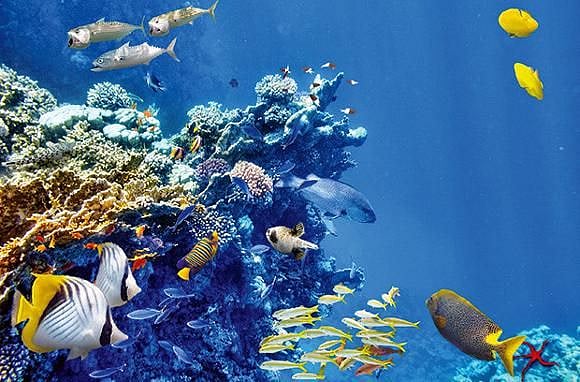
Breathing through a snorkel, I hover above a garden of furled, stony rose petals and clusters of tangled branches. Clownfish peer through the waving, rubbery fronds of anemones, and giant clams – some as big as a suitcase – gape open, revealing their colourful treasures.
I’m guided around the centre by Jamie McWilliam, a Scottish PhD student conducting research on sounds transmitted underwater.
‘In the past 30 years, there has been a 50 per cent decrease in coral,’ he tells me gravely.
Climate change, and the subsequent rise of water temperature, is one of the key causes of coral bleaching, while fertiliser run-off from the land is also highlighted as a killer. One of the main threats to the Great Barrier Reef is the crown-of-thorns starfish, a parasite ballooning in numbers due to the disruption of the delicate marine ecosystem.
Jamie is confident though that with care and attention, the beauty of the Reef can be saved. Sir Attenborough has an equally positive outlook. As he says: ‘It would be untruthful and unnecessarily sensationalist to say, “Oh yes, it’s all ruined since I was there last time”.
‘The beauty is so profound and deep, and the wonders to see are so sensational that even if they have diminished, it’s just one of the most wonderful places in the world.’
Sign up for the Daily Briefing
Get the latest news and updates straight to your inbox
Network Links
GN StoreDownload our app
© Al Nisr Publishing LLC 2026. All rights reserved.