South Korean technology races to the top
Samsung and LG may be forces to reckon with, but are the two firms going to stay at the top?
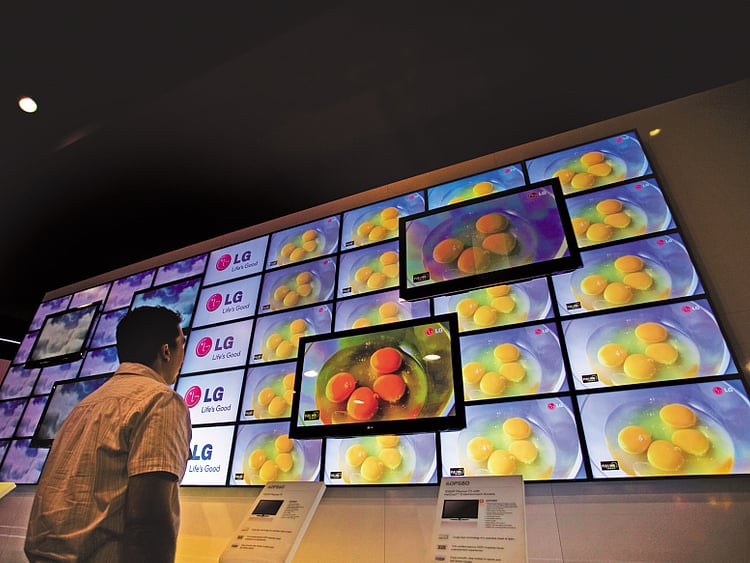
Within the space of a generation, South Korea’s electronics players have become world leaders. Samsung and LG are regularly the top three to five players in their sectors, and together hold more than 40 per cent of the market in global Smart TV shipments and account for more than 30 per cent of worldwide mobile phone sales.
In the 1990s, electronics became an important sector for the Korean economy. The industry rose to prominence late that decade and thrived in the years following the recent global recession. This was largely due to the focus on product innovation and investment in hardware research and development, at a time when companies elsewhere were cutting back. Last year, electronic equipment accounted for $119 billion (about Dh437 billion) or 21.7 per cent of GDP.
Samsung and LG have unveiled a host of new electronics devices in the past few years and Samsung will raise the bar yet again in October, when it shows off the first curved smartphone. “We plan to introduce a smartphone with a curved display in South Korea in October,” DJ Lee, Mobile Business Head of Strategic Marketing told Reuters. Officials believe it will launch the era of the flexible smartphone and help Samsung stay ahead of Apple, whose new 5c and 5s iPhones topped nine million units in the first three days of sales.
Samsung is the dominant player in the smartphone market. The company increased its lead over Apple in the second quarter of this year, rising to 31.7 per cent of the global market compared to 29.7 per cent in the same period of 2012, according to Gartner. Apple accounted for 14.2 per cent of the market in the second quarter of 2013 compared to 18.8 percent last year.
LG made it to third place, with a 5.1 per cent market share compared to 3.8 per cent. The new flagship G2 phone is expected to boost sales in the coming months, thanks to its real-life benefits such as ergonomic design, practical functions and an intuitive user experience. “Our definition of innovation today is technology that resonates with consumers,” D.Y. Kim, President of LG Electronics, Gulf FZE, said on the launch of the phone.
Curved displays are an early evolution in the race to produce wearable gadgets. The two companies, alongside Sony, are already dominant players in the curved television space, with OLED TV sets priced at about $9,000.
Overall, in the television sector, Korean brands accounted for 43 per cent of Q2’s global flat-panel TV revenue as per Gartner.
However, the companies remain wary of threats from market forces. For the first time since 2007, Dell moved ahead of Samsung in the worldwide PC monitor market, shipping more than five million units in the second quarter of 2013. Total PC monitor shipments for the quarter were 33.5 million units, which was 1.6 million units more than forecast but still represented a year-over-year decline of -0.7 per cent according to IDC’s Worldwide Quarterly PC Monitor Tracker.
Other threats are in smartphones and televisions, both areas where the Koreans dominate. Senior Vice-President, Samsung, Robert Yi told Bloomberg in August, “We may experience stiffer competition in the mobile business due to expansion of the mid- to low-end smartphone market.TV growth will continue to wane in developed markets.”
Just as Korean firms beat out their flat-screen Japanese counterparts, they may in turn be hit by low-cost Chinese flat screen makers. Formerly considered second-class players in the global LCD market, their ultra-high definition (UHD) displays are cheaper than OLEDs and sharper than standard LCDs. “The Chinese have done very well so far this year and their momentum is likely to continue for at least another year or so, as they have spotted the potential of this niche market well ahead of bigger rivals,” Nam Dae-jong, Analyst, Hana Daetoo Investment and Securities told Reuters.
Only 33,000 UHD sets were sold in the 200 million-unit LCD TV market, but shipments have soared around 20-fold, thanks to China, data from research firm IHS shows. Samsung and LG are now expanding their product lines to include more popular 50- to 60-inch UHD models.
“With the demand for OLED TV and Ultra HD TV expected to grow rapidly next year, the competition to gain supremacy in the next generation TV market will be fierce,” Havis Kwon, President and CEO, LG Electronics’ Home Entertainment Company told media at IFA Berlin in September. “LG will leverage its strong position and further consolidate its global TV business by speeding up the launch dates of its OLED TVs in a number of core markets. We will also introduce an expanded lineup of Ultra HD TVs and deliver a comprehensive, differentiated Smart TV user experience.”
Sign up for the Daily Briefing
Get the latest news and updates straight to your inbox
Network Links
GN StoreDownload our app
© Al Nisr Publishing LLC 2026. All rights reserved.