The National Pavilion of Syria at Biennale Arte 2026. Courtesy of Sara Shamma.
Venice Biennale 61st edition: Qatar and Syria deliver powerful message of humanity
From Palmyra to the Giardini, Arab artists weave resilience into immersive art
Last updated:
7 MIN READ
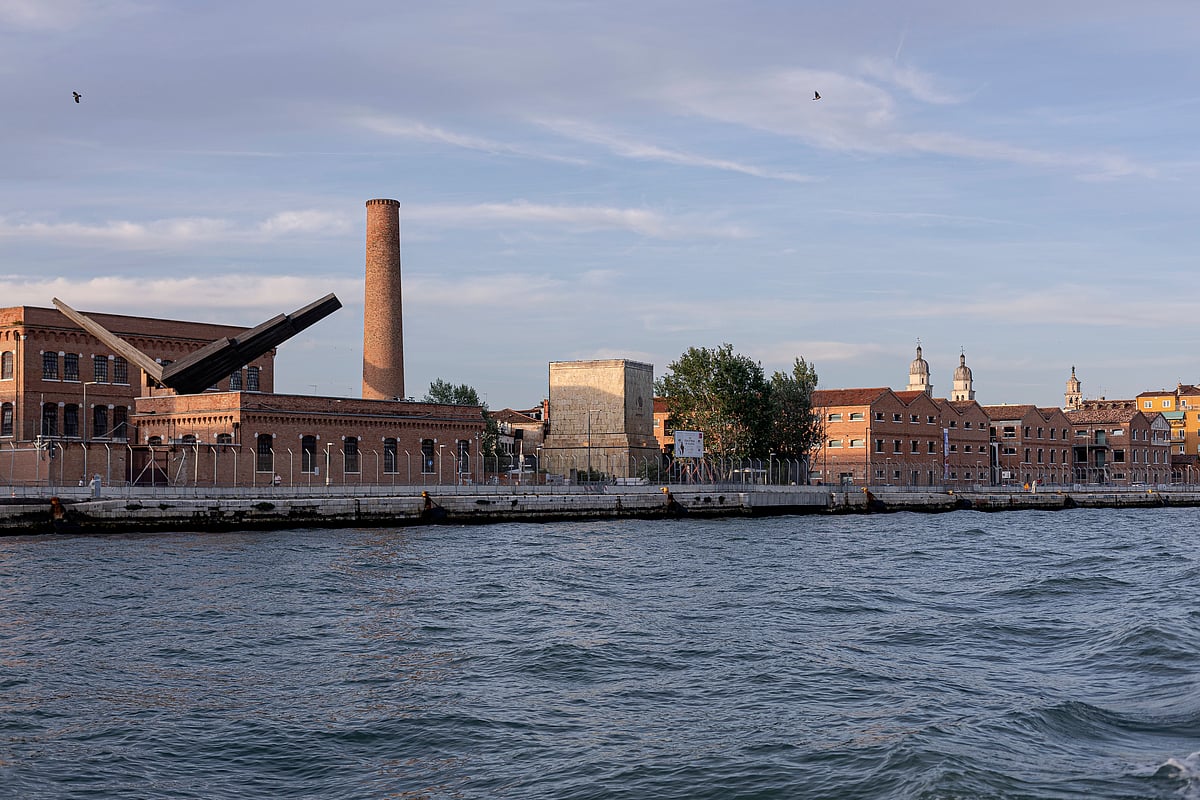
At the 61st International Art Exhibition of La Biennale di Venezia, the Qatar and Syria pavilions deliver powerful and nuanced message of shared humanity and hope.
The Venice Biennale has long served as a powerful platform for the Arab world to transform global perceptions and assert a leading cultural presence. In recent years, however, the region’s representation has grown significantly, both in scale and impact, moving from periphery to centre stage and becoming an integral part of the global art and architecture dialogue at this prestigious event.
Get updated faster and for FREE: Download the Gulf News app now - simply click here.
The 61st International Art Exhibition of La Biennale di Venezia, entitled “In Minor Keys” and curated by Koyo Kouoh, runs from 9th May to 22nd November 2026 and offers once again a stage where Arab nations can articulate their culture and identity, along with their creative ambition, to an international audience. Here, we spotlight two compelling presentations from the Qatari and Syrian pavilions, where the act of contextualising the past unfolds in a profound guise.
Presented in a tent-like structure in the Giardini della Biennale, on the site of the future permanent Qatar Pavilion designed by Lina Ghotmeh, untitled 2026 (a gathering of remarkable people) serves as a place for -cultural exchange and an affirmation of shared humanity.
Commissioned by Her Excellency Sheikha Al Mayassa bint Hamad bin Khalifa Al Thani, Chairperson of Qatar Museums, and co--curated by Tom Eccles and Ruba Katrib, the project is led by artist Rirkrit Tiravanija and builds on his legacy in relational art. It brings together artists, musicians, and chefs from across the Arab world in a unique, multidisciplinary collaboration featuring a film by Qatari-American artist Sophia Al-Maria, live performances organised by Lebanese artist Tarek Atoui, a large-scale sculpture by Kuwaiti-Puerto Rican artist Alia Farid, and a culinary programme of Middle Eastern cuisine designed by Palestinian chef Fadi Kattan.
A gathering of remarkable people highlights the importance of resilience in a complicated moment, now more than ever. The exhibition demonstrates the power of culture as a connective force and a vital means of bringing people together.
The National Pavilion of Syria at Biennale Arte 2026. Courtesy of Sara Shamma.
Co-curator Ruba Katrib, Chief Curator and Director of Curatorial Affairs, MoMA PS1, explains: “It is ultimately the people who animate this pavilion: the artists, chefs, musicians, and the networks of knowledge and exchange they bring together. The project is conceived as a multivalent and evolving experience shaped through encounter, listening, and collaboration.”
For Katrib, this collective format resonates strongly with the overarching theme of this year’s Biennale, “In Minor Keys”. It creates a space where there is time for reflection, connection, and shared humanity, through forms of exchange that are often ephemeral: “The pavilion creates a stage for an interdisciplinary and dynamic chorus to unfold through sound, conversation, food, performance, and collective experience,” she says.
The National Pavilion of Syria at Biennale Arte 2026. Courtesy of Sara Shamma.
Modelled on spaces in Qatar where people gather, the pavilion brings together voices from across the Arab world. Tom Eccles is co--curator of the exhibition. He is also Executive Director of the Centre for Curatorial Studies and the Hessel Museum of Art, Bard College. For him, while the works that comprise the pavilion are deeply rooted in Qatari culture, they also reflect broader histories and traditions from across the Arab world. This means they are able to engage with questions of migration, exchange, hospitality, memory, and collective experience in a way that speaks to the international audience in Venice: “Rather than presenting a fixed idea of identity, the project reflects the many ways Arab culture has circulated, evolved, and influenced broader cultural formations. The pavilion brings together art, film, music, food, and performance in a way that encourages audiences to make connections across disciplines and experiences. We hope this openness allows visitors from many different backgrounds to enter into the project meaningfully.”
Installation of Jerrican (2026) by Alia Farid within untitled 2026
The project spans so many disciplines: how did they manage to weave them into a cohesive and unified experience?
“All of the participants have been in close dialogue throughout,” says Katrib, “and thinking carefully about how the different elements can intersect and respond to one another. A key concept for us has been improvisation, which emerges most directly through the musical programme, but also operates more broadly across the pavilion as a method of collaboration and collective creation.”
There are many moments where the food, music, film, and sculpture overlap, both conceptually and materially. Certain symbols, sounds, gestures, and narratives recur across different works and media, creating an experience that is layered and evolving rather than linear. The pavilion is unified less through a single narrative than through an ongoing conversation.
“This is certainly a project with many moving parts,” Eccles admits, “but one of the most remarkable aspects was how immediately intuitive the collaboration felt once the framework began to take shape. All of the participants quickly embraced the project and were eager to contribute to its development collectively.”
Such an ambitious programme was bound to present some logistical challenges. Yet the co-curators were undeterred. The enthusiasm and openness of everyone involved made the process feel highly collaborative and organic, through a shared commitment to “thinking together across disciplines and forms.”
At the Syrian pavilion, artist Sara Shamma presents a deeply personal account of death and destruction, which she counters with her own philosophy of hope. Her multimedia, immersive installation, titled The Tower Tomb of Palmyra and curated by Yuko Hasegawa, aims to honour Syria’s cultural heritage and the resilience of its people.
At the heart of the installation are the ancient funerary towers of Palmyra, monumental structures which were destroyed during the conflict. Here they take centre stage, anchoring the narrative within global contemporary art discourse. They reflect on loss while conveying a message of hope and unity.
For Shamma, creation is inextricably tied to destruction. To build something new, something within us must inevitably end. Death, in a way, allows us to live more fully. When we accept mortality, we become more present, more creative, more alive.
“When I work with themes like the funerary towers, it’s not about negativity—it’s about renewal,” Shamma explains. “To create, I must let go of something within myself. I’ve experienced this personally—when I moved to Lebanon during the war, I had to detach myself from Damascus emotionally, in order to survive and rebuild.”
“Hope does not come from forgetting loss, but from transforming it into something meaningful. Destruction can erase buildings, but it does not erase memory, imagination, or the human desire to begin again.” Shamma speaks to how hope can be built from the ruins of loss, and this is where art becomes important. While she acknowledges that art cannot undo tragedy, she believes it is essential in helping people process grief, preserve their dignity, and reconnect with what violence tries to destroy.
“In The Tower Tomb of Palmyra, I wanted to create more than an object to look at. The pavilion becomes an experience: architecture, painting, sound, scents and emotion woven into a unified environment. Visitors enter a space of reflection rather than spectacle,” she says.
This installation is a realisation of an idea that has long preoccupied Shamma. What was originally conceived years ago has found its ideal “cradle” in Venice, signalling the renewed face of Syria’s international, cultural engagement and a significant change of format. “This presentation marks an important shift,” she explains, “because it places a single Syrian artist at the centre of the pavilion with a fully developed and ambitious concept. That creates a different kind of focus and allows visitors to enter one coherent artistic world, rather than encountering separate voices.”
“For me, this is significant because it reflects confidence… confidence in the strength of Syrian culture, in the depth of our history, and in the ability of contemporary artists from our region to contribute meaningfully to the global conversation at the highest level.”
This contribution to the global conversation has been significantly enhanced by the collaboration with Yuko Hasegawa, which Shamma describes as “deeply enriching because it has been built on trust, openness, and a genuine exchange of ideas.”
From the beginning, the renowned Japanese curator understood that The Tower Tomb of Palmyra was not simply about history, but about memory, presence, and the emotional afterlife of loss.
In Shamma’s view, Hasegawa brings a rare combination of international experience and philosophical sensitivity. Having worked across Asia, Europe and the wider world, she understands how to place a deeply Syrian story within a universal human conversation without losing its authenticity.
“For this important moment, when Syria returns to the Venice Biennale in a renewed and more focused form, it felt essential to work with a curator of real global stature. We wanted the pavilion to speak with confidence on the highest international level, while remaining true to its roots,” Shamma explains.
“For me, this collaboration has shown how a conversation between the Middle East, Asia, and Europe can create something richer than any one perspective alone.”
The inspiration behind the installation is ultimately drawn from the ancient tower tombs in Palmyra and Shamma’s fascination with these structures, both as architecture and something deeply symbolic. “Unlike traditional burial sites underground, these were vertical, which created a surreal and powerful experience,” she says.
It is from this powerful imagery that the installation takes its shape, inviting visitors into a world where painting, architecture, sounds and smells converge. While the multidisciplinary structure marks a new direction for Shamma, she has worked with sensory elements before. “Scent, in particular, is deeply connected to memory and emotion. And music has always been a central part of my process.”
“In this installation, the sounds are not from traditional music. They’re atmospheric: wind, distant voices, water droplets. These elements recreate the emotional environment of the space. The aim is to create an immersive experience that engages the viewer on multiple sensory levels.”
At the core of Shamma’s work is the human condition, a focus that is viscerally expressed within the pavilion. Large-scale portraits—figures that feel both present and distant, emerging from textured, almost sculptural surfaces—surround the space. “I am deeply fascinated by people—their expressions, gestures, details. Every individual is like an entire universe to me,” she reflects.
Another powerful aspect of the installation is its exploration of the themes of coexistence and resilience, and the way Shamma translates these into physical and emotional structures. Rooted in the historical and cultural legacy of Palmyra, the work positions the site as a symbol of coexistence.
“The ancient city was a place where different religions, ethnicities, and cultures lived together harmoniously,” she notes, “making it a powerful embodiment of pluralism.”
The installation ultimately acts as a reminder that, beyond conflict, there exists a deeper, enduring human fabric shaped by diversity, tolerance, and a shared history.
Sign up for the Daily Briefing
Get the latest news and updates straight to your inbox
Network Links
GN StoreAbout Gulf NewsTerms & ConditionsReach by GNSitemapContact usPrivacy PolicyGN FocusHave your sayWork with usAdvertise with usGulf News epaperPrinting Services
Download our app
© Al Nisr Publishing LLC 2026. All rights reserved.