The buzz on Google buzz
What is the buzz? Your questions on Google Buzz answered
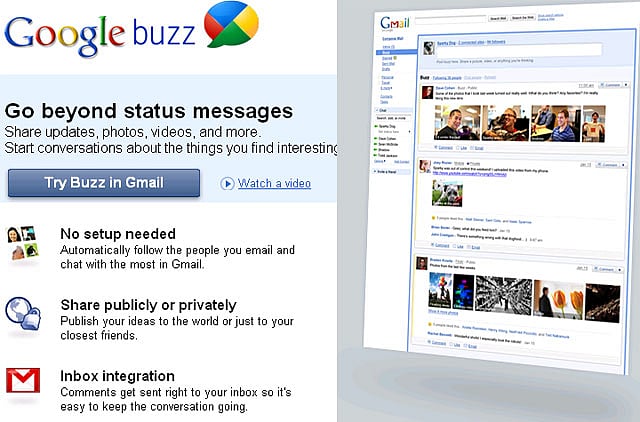
What is the buzz?
Buzz is the latest attempt at breaking into the global social networking market by tech giants Google. The service, which was unveiled on Tuesday, February 9, pitches the search specialist in direct competition with players like Facebook and Twitter.
Why is it important?
It’s important because of who is launching it. Like Apple, when Google speaks, people tend to sit up and take notice. They’ve already labeled it as “Google's approach to sharing.”
The buzz (pun intended) surrounding the announcement was huge. With twitter and search engines awash with people searching and sharing information from the launch press conference.
The immediacy of Buzz also comes from the way it will be rolled out. It also has a head-start on other social networking sites as it is being incorporated into it’s free Gmail service – which already boasts 170 million users. So basically, if you have Gmail, you have buzz.
So I need a Gmail account to get it?
No you don’t , but you will need to have some kind of Google account (be it maps, earth, news alerts etc) to be able to access it.
Advice on the official help page says: "You can read your Buzz from a number of Google products. You can access it through the left-hand links in your Gmail, from your Google Profile, or from a mobile device."
So while you don’t technically need Gmail to access it, the fact that Buzz is fully integrated with Gmail means they are hoping you will sign up if you don’t already have an account.
So what will it actually do that’s different?
Not that much, a lot of the Modus Operandi seems to be aimed at incorporating the best bits of other social networking sites like Facebook, Twitter, Picassa and even FourSquare.
There is the ability to follow people, have a profile, post status updates, rate content, share photos and send messages (both private and public).
What it says it will do best is ‘Google-ise’ the social media experience, using their love of algorithms to filter out the junk and leave the things you are interested in. To make sense of (and I guess aggregate) the mass of information that could be available to you.
The splash page on www.google.com/buzz spells this out, saying: “Just the good stuff. Buzz recommends interesting posts and weeds out ones you're likely to skip. Buzz recommends interesting posts and weeds out ones you're likely to skip."
Buzz also seems to be heavily skewed towards future mobile integration, especially with its GPS linkups and integration with already popular products like Google maps.
Other key innovations are the ability to let you know what the ‘buzz’ is in your local neighbourhood and updates that come in ‘real time’, that is without the need to refresh the page.
Is it going to change the world?
The fact that Buzz seems to have been rolled out first on mobiles gives an indication of the future direction Google sees social media going in.
You can be sure that Buzz will roll out genuinely innovative updates in the future.
Just around the corner is the ability to point your phone at a building, automatically locate you and update your status, have it tell you who is nearby, give reviews of restaurants in the building, and bring up a menu of what you could eat. Simple mobile payment gateways are probably somewhere in the pipeline too.
Only time will tell if it will it really takes off but the initial signs (apart from complaints about the seemingly slow roll-out) seem to be positive. However, the company will be wary of the lessons from Google Wave, which was much hyped but not particularly well used.
Do I really need another social media application?
That’s the key question. If I am already Linked in, Facebooking, Tweeting, reviewing and rating local establishments and locating myself, why do I need yet another social media strand? And do I really need to allow people to pinpoint my exact location at all times
The fact that it will, in theory, simplify things by bringing your existing applications onto one platform will clearly be a selling point.
But it also comes back to the mobile question, as very few of the social networking sites are taking full advantage of the technology and freedom offered by new smartphones. This is where Google is probably gambling on carving a niche. They probably won’t stop people using Facebook on desktops, but they might hope to do so on mobile.
What about privacy?
There are already privacy issues with social networking sites, so something which could potentially make your location available 24/7 might be a worry for some.
Imagine this. The boss you called to pull a sickie might spot you in the ‘neighbourhood’. An extreme case but it could potentially happen.
More likely is the chance for commercial partners to bombard you with unsolicited ‘offers’ as you walk by a store or restaurant. However, Google bosses have assured us that there is a new sophisticated spam filter in place.
With all social networks, you will have the ability to play with your privacy settings. But as a lot of users are not particularly web savvy (as has been demonstrated with very personal details being posted publicly on Facebook) then this could be a potential issue.
The answer, as always, is to know what you are doing. Learn about your privacy settings and never allow anything you don’t feel comfortable with.
Sign up for the Daily Briefing
Get the latest news and updates straight to your inbox
Network Links
GN StoreDownload our app
© Al Nisr Publishing LLC 2026. All rights reserved.